Lesson 01 — Hear the Main Argument
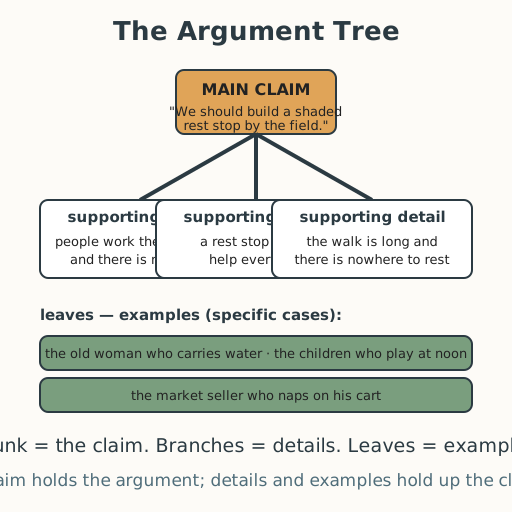
Learners learn to hear a speaker's main argument and separate it from the supporting details and examples. They meet a worked example of one spoken argument drawn as a tree (trunk = claim, branches = details, leaves = examples), practice a "listen for the trunk" routine, and sort sentences into the three buckets with a partner.
Objectives
Objectives
- D04.S1.06.01 Listen for and distinguish a speaker's main argument from supporting details and examples.
Essential question
How do I hear a speaker's main argument and tell it apart from the supporting details and examples?
Key vocabulary
Materials
Standard materials
- Argument-tree poster · 1 A poster that draws one spoken argument as a tree — the trunk is the main claim, the branches are supporting details, and the leaves are examples
- Argument sentence strips · 1 set per pair A set of spoken-style sentences from several short arguments, to sort into "main claim," "detail," and "example"
- Three-bucket sorting page · 1 per learner A page with three columns headed "main claim," "supporting detail," and "example"
Low-tech / no-cost
- Voice and a real argument One partner argues aloud for something small and real (where to sit, which game to play); the other names the claim, one detail, and one example; no cards needed
- A 'trunk, branch, or leaf?' game Say a sentence aloud and have partners signal trunk (claim), branch (detail), or leaf (example) with hand shapes
Enriched / lab & device
- A recording of a short talk or public message · 1 per group To replay a short spoken argument and sort its sentences more than once
- A class argument wall · 1 A shared wall where learners post the claim, details, and examples they hear across the unit, growing the pattern over time
Works in different contexts
- large-group Model one full argument on the board and sort its sentences together, then have pairs sort their own strips and justify each placement
- multi-age Younger learners name the one big claim while older learners sort all the sentences and explain why a detail is not an example
- self-directed A learner reads or listens to a short argument and writes its claim, its details, and its examples in the three columns, checking each
- level-grouped Learners ready to extend listen to a longer or two-sided argument and separate each side's claim from its own details and examples
- outdoor-only Listen to someone make a real case outside — where to plant, which path to take — and name the claim, one detail, and one example aloud
Lesson 1 — Hear the Main Argument
Summary
Learners learn to hear a speaker’s main argument and separate it from the supporting details and examples. They meet a worked example of one spoken argument drawn as a tree (trunk = claim, branches = details, leaves = examples), practice a “listen for the trunk” routine, and sort sentences into three buckets with a partner. This is the first of two listening skills; telling details from examples follows in the next lesson.
Objectives
- Listen for and distinguish a speaker’s main argument from supporting details and examples. (D04.S1.06.01)
Connection
A neighbor stands up at a gathering and says, “We should build a shaded rest stop by the field.” Then she talks for a long time: people work there all day, there is no shade, the old woman carries water, the children play at noon, the market seller naps on his cart. If you walk away only remembering “she talked a lot,” you missed the one thing she was really arguing for. Listening for the main argument is the skill of finding that one sentence — the claim — and seeing how everything else hangs off it as details and examples. Whether the gathering is a village meeting or a city council, a strong listener can say back: “Her main point is ___, and the rest was support.”
Materials
- Argument-tree poster
- Argument sentence strips
- Three-bucket sorting page
Preparation
- Print or draw the argument-tree poster (trunk = claim, branches = details, leaves = examples).
- Copy a set of argument sentence strips for each pair.
- Copy the three-bucket sorting page for each learner.
Facilitator note
This lesson is written to the learner (“you”). The idea to land is that an argument has a
spine: one main claim, supported by details (general reasons) and examples (specific
instances). The skill is separating them when a speaker mixes them together — not judging
whether the argument is good yet. Model the tree slowly and aloud; because this is a novice
skill, use a worked example and guided practice before independent sorting (Kirschner, Sweller
& Clark, 2006). Honor every home language: learners may listen to and sort arguments in their
strongest language. Use real, local arguments as examples wherever you can, and keep the
“whose claim is it?” question alive — a claim is a person’s position, not a fact that needs
no support (docs/philosophy.md §5).
Procedure
- Gather (5 min). Think of a time someone asked you for something and you had to find the one real point under all their words. Today you learn to hear the main argument.
- Meet the tree (10 min). Look at the poster. One argument is drawn as a tree. The trunk is the main claim: “We should build a shaded rest stop by the field.” The branches are supporting details — general reasons like “people work there all day” and “there is no shade.” The leaves are examples — specific cases like “the old woman who carries water” and “the children who play at noon.” A claim holds the argument; details and examples hold up the claim.
- Listen for the trunk (10 min). With a partner, one of you says a short argument aloud — for something small and real (where to sit, which game to play, where to put the new water tap). The other listens and names the trunk: “Your main claim is ___.” Then check: did they find the one sentence the whole argument rests on? Swap roles.
- Sort the strips (15 min). Take the sentence strips. Read each and place it in the right bucket: main claim, supporting detail, or example. For each one, say why — is it the one big sentence, a general reason, or a specific case?
- Close (5 min). A speaker gives you many sentences but one spine. Hearing the claim first, then the details and examples that support it, is the beginning of every good discussion — and the first step toward making arguments of your own.
Differentiation
- Support: Start with an argument that has one short claim and two very different sentences; provide a starter sentence (“The main claim is ___ because…”) and hand signals.
- Extension: Listen to a two-sided argument and separate each side’s claim from its own details and examples, then note where the two claims actually differ.
Assessment
- Formative (peer/observation): Can the learner state a speaker’s main claim and sort supporting sentences into details versus examples, giving a reason for each placement?
- Self-check: The learner asks, “If the speaker heard me name the trunk, would they nod and say ‘yes, that’s what I’m arguing’?”
Home connection
Listen to someone at home make a request or a case today; afterward, say back their one main claim, then one detail and one example they used.
Resources
- Separating a main claim from support is foundational to listening comprehension and critical thinking; for a classroom-friendly framing see the International Listening Association’s “Listening Skills” primer and Duke & Pearson’s synthesis of comprehension strategy research. On explicit instruction for novice skills, see Kirschner, Sweller & Clark (2006), “Why Minimal Guidance During Instruction Does Not Work.”