Lesson 02 — Details and Examples
Learners sharpen the listening skill from Lesson 1 by separating supporting details (general reasons) from examples (specific instances). They meet two test questions — "Does it apply broadly?" versus "Is it one specific case?" — sort sentences into the two columns, and write a detail and an example of their own for one claim.
Objectives
Objectives
- D04.S1.06.01 Listen for and distinguish a speaker's main argument from supporting details and examples.
Essential question
What is the difference between a supporting detail and an example, and how do I tell them apart?
Key vocabulary
Materials
Standard materials
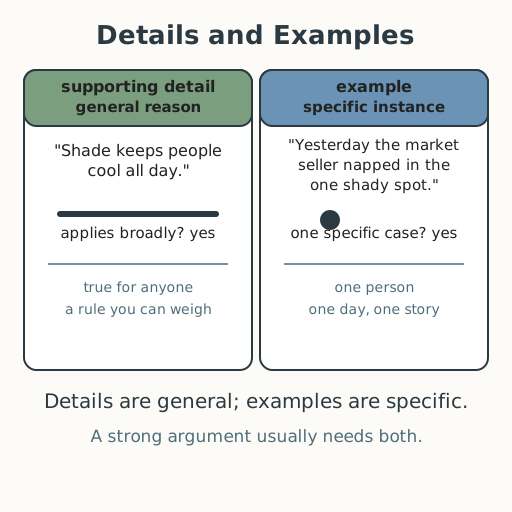
- Detail-versus-example poster · 1 A poster with two columns — "detail (general reason)" and "example (specific instance)" — each with sample sentences and the test questions "Does it apply broadly?" versus "Is it one specific case?"
- Detail-or-example sentence strips · 1 set per pair Sentences drawn from several short arguments, to sort into detail and example
- Two-column sorting page · 1 per learner A page with a "detail" column and an "example" column
Low-tech / no-cost
- Voice and a 'detail or example?' game Say a sentence aloud and have partners signal "general" (flat palm) or "specific" (one finger); no cards needed
- Found details and examples Take turns arguing for something you can see outside or in the room, giving one general detail and one specific example for each
Enriched / lab & device
- A detail-or-example passage · 1 per pair A short spoken-style passage mixing details and examples to underline in two ways and discuss
- A 'would this convince?' chart · 1 A shared chart where learners post a detail and an example, and note which one feels more convincing and why, building a bank of examples across the unit
Works in different contexts
- large-group Sort several sentences aloud as a whole group, then have pairs sort their own strips and justify each choice
- multi-age Younger learners sort simple, obvious sentences while older learners tackle close calls and explain how a detail could become an example
- self-directed A learner sorts the strips alone, then writes one detail and one example of their own and labels each
- level-grouped Learners ready to extend turn a general detail into a specific example and vice versa, and discuss which is more persuasive and when
- outdoor-only Argue for a real change outside — shade here, a path there — and give one general detail and one specific example for each, a partner checking which is which
Lesson 2 — Details and Examples
Summary
Learners sharpen the listening skill from Lesson 1 by separating supporting details (general reasons) from examples (specific instances). They meet two test questions — “Does it apply broadly?” versus “Is it one specific case?” — sort sentences into two columns, and write a detail and an example of their own for one claim.
Objectives
- Distinguish a speaker’s supporting details from their examples. (D04.S1.06.01)
Connection
Someone arguing for a shaded rest stop says two different kinds of things. “Shade keeps people cool all day” is a detail — a general reason that would be true for anyone, anywhere. “Yesterday the market seller napped in the one shady spot” is an example — a specific story about one person, one day. Both support the claim, but they work differently: a detail gives you the rule, an example gives you the picture. Telling them apart is how you know exactly what a speaker is offering you — a general reason to weigh, or a single case to check.
Materials
- Detail-versus-example poster
- Detail-or-example sentence strips
- Two-column sorting page
Preparation
- Print or draw the detail-versus-example poster (two columns with the two test questions).
- Copy a set of detail-or-example sentence strips for each pair.
- Copy the two-column sorting page.
Facilitator note
This lesson is written to the learner (“you”). The idea to land is that details are general and examples are specific — the difference is scope, not importance. Neither is “better”; each does a job in an argument, and a strong argument usually needs both. Retrieval practice: open by having learners recall Lesson 1’s trunk/branch/leaf image before refining it. Model the two test questions on a close call; do not rush past sentences that feel like both — those are the thinking. Honor every home language: learners sort and argue in their strongest language. Keep sorting cooperative and let learners justify choices rather than racing.
Procedure
- Gather (5 min). Recall last lesson’s tree: trunk (claim), branches (details), leaves (examples). Today you look closer at the difference between a branch and a leaf — a detail and an example.
- Meet the two questions (10 min). Look at the poster. A supporting detail is a general reason that applies broadly — “shade keeps people cool all day.” An example is a specific instance — “yesterday the market seller napped in the one shady spot.” Two questions sort them: Does it apply broadly? (detail) and Is it one specific case? (example).
- Sort the strips (15 min). With a partner, read each sentence and place it in the “detail” or “example” column. For each one, say why: is it a broad rule or a single case? Slow down on the close ones and talk them through.
- Write your own (10 min). Choose one claim — “our class should start a reading corner,” or one of your own. Write one detail (a general reason) and one example (a specific case) to support it, and label each.
- Close (5 min). A thoughtful listener hears not just that a speaker supports a claim, but how — with a general reason you can weigh, or a specific case you can check. Knowing the difference keeps you from being moved by a single vivid story when the general reason is weak — and from missing a strong reason hidden under one small example.
Differentiation
- Support: Provide sentences that differ sharply (one clearly general, one clearly a named person and day), and a word bank (“applies to everyone / one person / one day”).
- Extension: Take a general detail and expand it into a specific example, and take an example and generalize it into a detail; then say which is more convincing for one audience and why.
Assessment
- Formative (peer/self): Can the learner sort sentences into detail and example and state whether each applies broadly or names a specific case?
- Self-check: The learner asks, “For each sentence, could I say ‘this is true for anyone’ or ‘this is about one specific person or moment’?”
Home connection
Listen for one general reason and one specific example in a conversation today, and tell someone which is which and how you knew.
Resources
- Distinguishing general claims from specific instances is a core critical-thinking and listening skill; for classroom framing see Duke & Pearson’s synthesis of comprehension strategy research and the IES practice guides on comprehension. On retrieval and explicit instruction for novice skills, see Kirschner, Sweller & Clark (2006) and the retrieval practice literature (Agarwal & Bain, “Powerful Teaching”).