Lesson 05 — Cite Text Evidence
Learners learn to cite text evidence: to point to the exact words in a text that support an interpretation of what it means. They meet a worked example of an interpretation joined to its quote by "because the text says," practice underlining supporting words, and write their own interpretation with a cited quote.
Objectives
Objectives
- D04.S2.06.01 Cite text evidence to support an interpretation of what a text says and means.
Essential question
How do I point to words in a text to support what I think it means?
Key vocabulary
Materials
Standard materials
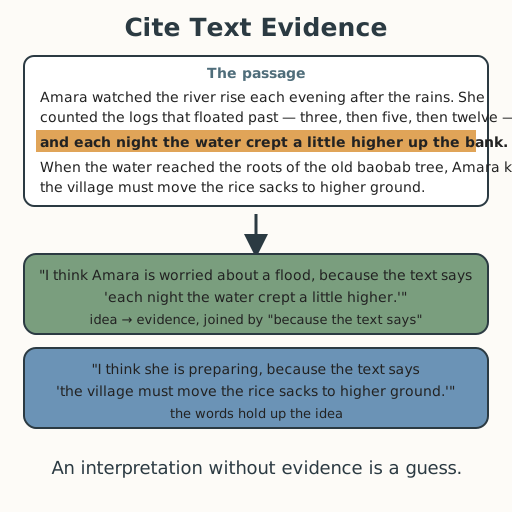
- Cite-the-evidence poster · 1 A poster showing one short passage with a highlighted sentence, an arrow, and an interpretation that names the evidence — "I think ___ because the text says ___"
- A short practice passage · 1 per pair A brief text (about a flood warning, a garden, or a journey) with room to underline and a sentence frame for citing evidence
- Evidence sentence frames · 1 per learner Frames such as "I think ___ because the text says '___'." and "The text says '___,' which shows ___."
Low-tech / no-cost
- A short spoken or written text and a finger Read a short text aloud; for each interpretation, point to (or say) the exact words that support it; no poster needed
- A 'quote or guess?' game Say an interpretation and have partners signal whether it is backed by exact words from the text (flat palm on the text) or is a guess (hand to head)
Enriched / lab & device
- A digital text with highlighting · 1 per group A short text on a device where learners highlight the exact words that support an interpretation, where devices are available
- A class evidence board · 1 A shared board where learners post an interpretation and its supporting quote side by side, growing a bank of cited evidence across the unit
Works in different contexts
- large-group Model one interpretation and its cited quote on the board, then have pairs practice on the passage with the frames and check each other's evidence
- multi-age Younger learners underline one supporting word while older learners write a full interpretation with a quoted sentence and explain why it supports
- self-directed A learner reads the passage, writes two interpretations, and under each copies the exact words that support it, checking each quote is really in the text
- level-grouped Learners ready to extend cite two pieces of evidence, and explain which is stronger support and why a single word can change an interpretation
- outdoor-only Read a short text aloud outside; for each interpretation, point to the text (held in hand or recalled) and say the exact words that support it
Lesson 5 — Cite Text Evidence
Summary
Learners learn to cite text evidence: to point to the exact words in a text that support an interpretation of what it means. They meet a worked example of an interpretation joined to its quote by “because the text says,” practice underlining supporting words, and write their own interpretation with a cited quote.
Objectives
- Cite text evidence to support an interpretation of what a text says and means. (D04.S2.06.01)
Connection
Two people read the same story and come away with different ideas. “Amara is just watching the river,” says one. “Amara is worried about a flood,” says the other. Which is right? You can’t settle it by feeling or by who says it louder — you settle it by going back to the words. “The water crept a little higher” and “the village must move the rice sacks” are evidence. An interpretation without evidence is a guess; an interpretation with cited evidence is an argument you can check. Reading well is this back-and-forth: what do I think, and where in the text does it say so?
Materials
- Cite-the-evidence poster
- A short practice passage
- Evidence sentence frames
Preparation
- Print or draw the cite-the-evidence poster (passage → highlighted quote → interpretation).
- Copy the practice passage for each pair and the sentence frames for each learner.
Facilitator note
This lesson is written to the learner (“you”). The idea to land is that an interpretation
must be anchored to the text — and the anchor is an exact quote, not a vague memory. Teach
the frame “I think ___ because the text says ‘___’” as a worked example (a novice skill;
model then guide — Kirschner, Sweller & Clark, 2006). This is the ethical heart of reading
too: we are honest about where our idea came from, and we can change our mind when the text
disagrees (docs/philosophy.md §5 — evidence distinguished from belief). Honor every home
language: learners may read and cite a passage in their strongest language; citing in a second
language is advanced, valuable work. Keep the practice text short and global — a flood, a
garden, a journey — so it lives anywhere.
Procedure
- Gather (5 min). Think of a time two people read the same thing and understood it differently. Today you learn to settle such differences with text evidence — the exact words.
- Meet the poster (10 min). Look at the poster. A passage tells of Amara watching the river rise. One sentence is highlighted: “each night the water crept a little higher up the bank.” The interpretation is joined to it: “I think Amara is worried about a flood, because the text says ‘each night the water crept a little higher.’” Another: “I think she is preparing, because the text says ‘the village must move the rice sacks to higher ground.’” The idea points to the words; the words hold up the idea.
- Learn the frame (5 min). Read the frames: “I think ___ because the text says ‘___’.” and “The text says ‘___,’ which shows ___.” These are bridges between your idea and the page. Say one aloud.
- Underline and cite (20 min). Read the practice passage with a partner. Underline three exact places that could support an interpretation. Then write one interpretation of your own, and under it, copy the exact words that support it, using a frame. Read it back and check: is that quote really in the text, word for word?
- Close (5 min). A good reader is like a careful witness: they can always point to what they saw. Your idea is only as strong as the words it stands on — so keep them close.
Differentiation
- Support: Provide a shorter passage and one interpretation with the quote already selected; ask the learner to match each interpretation to its quote.
- Extension: Cite two pieces of evidence for one interpretation, and write one sentence on which is stronger support and why.
Assessment
- Formative (peer/portfolio): Does the learner’s interpretation rest on an exact, copied quote from the text, and does the quote actually support the idea?
- Self-check: The learner asks, “Can I point to the exact words in the text that my idea stands on — and are they really there?”
Home connection
Read a short passage — a story, a message, a label — and tell someone one thing you think it means, ending with “because the text says…” and the exact words.
Resources
- Citing text evidence is a foundational comprehension skill; see Duke & Pearson’s synthesis of
comprehension strategy research and the IES practice guides (e.g., “Improving Adolescent
Literacy”). The distinction between evidence and belief is a core value (
docs/philosophy.md§5). On explicit instruction for novice skills, see Kirschner, Sweller & Clark (2006).