Lesson 04 — Disagreeing Respectfully
Learners practice disagreeing with an idea without harming the person who holds it. They meet the "idea vs. person" distinction, learn sentence starters that acknowledge before they disagree, and practice respectful disagreement on real topics — the second half of good discussion, after building on others' ideas.
Objectives
Objectives
- D04.S1.06.02 Participate in a group discussion, building on others' ideas and disagreeing respectfully.
Essential question
How do I disagree with someone's idea without hurting the person?
Key vocabulary
Materials
Standard materials
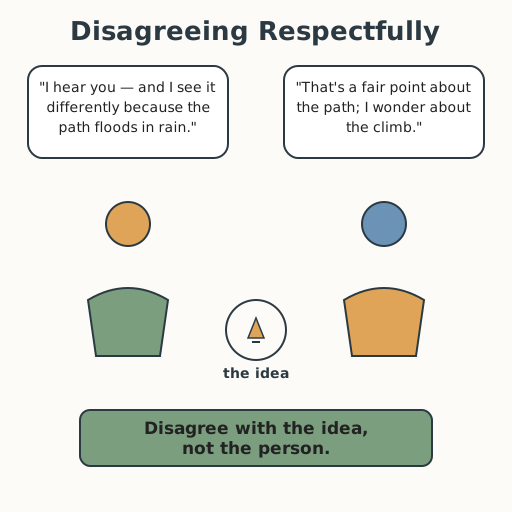
- Disagree-respectfully poster · 1 A poster showing the idea sitting *between* two people, with speech bubbles "I hear you, and I see it differently because…" and "that's a fair point, though I wonder…"
- Disagreement sentence starters · 1 per pair A card with starters such as "I hear you, and I see it differently because…", "That's a fair point, though…", and "I understand ___, but I think ___ because…"
- Disagreement practice cards · 1 set per pair Pairs of positions on a shared topic (a class rule, a plan, a story's ending) to practice disagreeing about the *idea*, not the *person*
Low-tech / no-cost
- Voice and a 'idea or person?' game Say a disagreement aloud and have partners signal whether it targets the idea (point at an imagined object between you) or the person (point at the speaker); no cards needed
- A 'both-sides circle' Take turns disagreeing about one real topic, each turn starting by acknowledging the other's point before giving your own; no paper needed
Enriched / lab & device
- A disagree-respectfully video or scene · 1 A short clip or acted scene of two people disagreeing well and badly, paused to compare which one builds the relationship and which one harms it
- A class 'respectful disagreement' wall · 1 A shared wall where learners post respectful disagreement starters and real examples from their discussions, growing across the unit
Works in different contexts
- large-group Model one respectful and one hurtful disagreement on the board and label the difference, then have pairs practice with the starters and cards
- multi-age Younger learners practice one acknowledgment ("I hear you") before disagreeing, while older learners add a reason and a fair counter-acknowledgment
- self-directed A learner writes two versions of the same disagreement — one aimed at the person, one at the idea — and notes exactly what changed and why it matters
- level-grouped Learners ready to extend disagree with a *respected authority's* idea (a rule, an author's claim) using the same respectful moves, and reflect on when disagreeing is hard
- outdoor-only Pair up outside on a real difference of opinion — which path, which spot — and practice one respectful disagreement using the starters, the idea placed between you
Lesson 4 — Disagreeing Respectfully
Summary
Learners practice disagreeing with an idea without harming the person who holds it. They meet the “idea vs. person” distinction, learn sentence starters that acknowledge before they disagree, and practice respectful disagreement on real topics — the second half of good discussion, after building on others’ ideas.
Objectives
- Participate in a group discussion by disagreeing respectfully. (D04.S1.06.02)
Connection
Two friends disagree about which path to take home. One says, “You’re always wrong — you have no sense of direction.” The other says, “I hear you want the quick way, and I see it differently because the short path floods in the rain.” Same disagreement, two very different conversations. The first attacks the person; the second disagrees with the idea — and still reaches the person. Disagreement is not the enemy of good discussion; it is how groups avoid going the wrong way together. The skill is to disagree in a way that keeps the person while challenging the idea — in a friendship, a family, or a whole community deciding something important.
Materials
- Disagree-respectfully poster
- Disagreement sentence starters
- Disagreement practice cards
Preparation
- Print or draw the disagree-respectfully poster (the idea between two people, with respectful speech bubbles).
- Copy the sentence-starter card for each pair.
- Copy the disagreement practice cards.
Facilitator note
This lesson is written to the learner (“you”). The idea to land is that disagreement is
healthy and necessary; disrespect is the problem, not the disagreement. The core move is
“acknowledge before you disagree” — name the other person’s point fairly first, then state
your own with a reason. Model a respectful and a hurtful version of the same disagreement and
label the difference (a novice skill; worked example first — Kirschner, Sweller & Clark, 2006).
This is a values-heavy lesson: we treat every person as worthy of respect even when their
idea is wrong, and we never rank people by who agrees with us (docs/philosophy.md §4).
Retrieval: connect back to Lesson 3’s “build on” moves — disagreeing well often starts by
acknowledging, which is itself a form of building. Honor every home language and every accent;
respectful disagreement sounds different across cultures, and that variety is itself
instructive. Hold the space gently — disagreement can feel scary, and the goal is safety with
honesty.
Procedure
- Gather (5 min). Think of a time you disagreed with someone and it went badly — or went well. Today you learn to disagree so that the idea is challenged, and the person is kept.
- Meet the two paths (10 min). Look at the poster. Two people face each other, and the idea sits between them — not inside either one. One says, “I hear you, and I see it differently because the path floods in rain.” The other says, “That’s a fair point about the path; I wonder about the climb.” Both disagree with the idea, never the person. The hurtful version — “you’re always wrong” — aims at the person and helps no one.
- Learn the starters (10 min). Read the card: “I hear you, and I see it differently because…”, “That’s a fair point, though…”, “I understand ___, but I think ___ because…”. Each one acknowledges first, then disagrees, then gives a reason. Practice one aloud.
- Practice the moves (20 min). With a partner, take a practice card — two positions on a real topic. One of you states your position; the other disagrees respectfully: name their point fairly, state your own, give a reason. Swap. After each round, check together: did we challenge the idea, and did we keep the person?
- Close (5 min). Good discussion needs both halves — building on ideas you share and disagreeing respectfully with ideas you don’t. A group that can do both thinks better than any one person alone, and stays a group while it thinks.
Differentiation
- Support: Provide the full starter to copy and a single clear topic; practice just the acknowledgment (“I hear you”) before adding a reason.
- Extension: Disagree with a respected idea — a class rule, an author’s claim, a tradition — using the same moves, and reflect in one sentence on why disagreeing with someone you respect is hardest and most important.
Assessment
- Formative (observation/self): Does the learner acknowledge the other’s point before disagreeing, aim at the idea (not the person), and give a reason?
- Self-check: The learner asks, “If I put my disagreement between us as an idea, could the other person still feel respected — even while we differ?”
Home connection
Next time you disagree with someone at home, try “I hear you, and I see it differently because…” and notice whether the conversation goes further than it usually does.
Resources
- Respectful disagreement and “acknowledge before you disagree” are core to civil discourse
and conflict resolution; see the CASEL relationship-skills competency and Michaels &
O’Connor’s accountable-talk moves. The claim that every person deserves respect even amid
disagreement is a values commitment (
docs/philosophy.md§4). On explicit instruction for novice skills, see Kirschner, Sweller & Clark (2006).