Lesson 07 — Reading Fiction and Poetry
Learners read and understand fiction and poetry, two genres that work on the imagination. They learn what to look for in each — characters, setting, and plot in a story; lines, stanzas, and images in a poem — read a short original example of each (in their strongest language where possible), and map what they find.
Objectives
Objectives
- D04.S2.06.02 Read and understand a variety of genres, including fiction, nonfiction, poetry, and drama, in at least one language.
Essential question
How do I read and understand fiction and poetry?
Key vocabulary
Materials
Standard materials
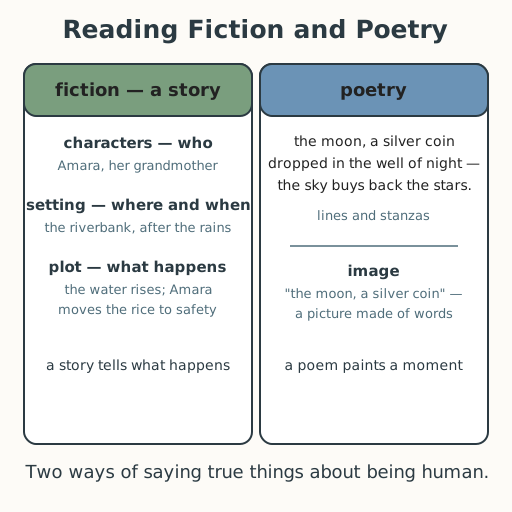
- Fiction-and-poetry poster · 1 A poster of two pages side by side — a story (labeled character, setting, plot) and a poem (labeled lines, stanzas, images) — each with its "what to look for" list
- A short fiction excerpt · 1 per pair A brief, original story scene (a journey, a festival, a family moment) to read and map
- A short poem · 1 per pair A brief, original poem with clear images, to read aloud and unpack
- Genre notes page · 1 per learner A page to record, for each genre, one thing you look for and one example you found
Low-tech / no-cost
- Voice and memory Tell a remembered or invented story aloud and notice its characters, setting, and plot; then say or sing a short poem from memory; no paper needed
- A 'story or poem?' game Read a line aloud and have partners signal "story" or "poem" and say what gave it away; no cards needed
Enriched / lab & device
- A small poetry or story collection · 1 per group Several short poems and stories from different cultures, in the learners' languages where possible, to read and compare
- A recording of a poem read aloud · 1 per group To hear how a poem sounds when read with rhythm and feeling, then try reading one aloud the same way
Works in different contexts
- large-group Read one story and one poem aloud together, mapping each on the board, then have pairs read and map a second pair of texts
- multi-age Younger learners name the characters or a favorite image while older learners map the full plot or explain how a poem's images build a feeling
- self-directed A learner reads a story and a poem, fills the genre notes page for each, and checks that each "what to look for" is actually found in the text
- level-grouped Learners ready to extend compare how a story and a poem can treat the *same* idea differently, and explain which form suits which effect
- outdoor-only Tell a story and speak a poem aloud outside, noticing how setting and rhythm feel different in the open air; map them in the air or the dirt
Lesson 7 — Reading Fiction and Poetry
Summary
Learners read and understand fiction and poetry, two genres that work on the imagination. They learn what to look for in each — characters, setting, and plot in a story; lines, stanzas, and images in a poem — read a short original example of each (in their strongest language where possible), and map what they find.
Objectives
- Read and understand fiction and poetry in at least one language. (D04.S2.06.02)
Connection
A story carries you into another life: a girl crossing a flooded field, a boy trading at a festival. A poem does something different: it hands you a picture made of words — “the moon, a silver coin / dropped in the well of night.” Both are fiction and poetry — writing that works on the imagination, in every language and every corner of the world. Each has its own shape, and knowing that shape is how you read them well: in a story you follow who, where, and what happens; in a poem you listen for the image and the rhythm. Neither is harder than the other; they are different tools for saying true things about being human.
Materials
- Fiction-and-poetry poster
- A short fiction excerpt
- A short poem
- Genre notes page
Preparation
- Print or draw the fiction-and-poetry poster (story page and poem page, each with its “what to look for” list).
- Copy the fiction excerpt and the poem for each pair, and a genre notes page per learner.
Facilitator note
This lesson is written to the learner (“you”). The idea to land is that genres have shapes, and reading well means looking for what each genre is built from: fiction — characters (who), setting (where and when), plot (what happens); poetry — lines, stanzas, and images (pictures in words). Use original, short examples so no copyright is in question, and read them aloud — poetry especially is meant for the ear. Honor home languages above all: learners should read and map texts in their strongest language, and a poem or story in a home language is a gift to the whole class, never a “translation problem.” No genre is above another; fiction and poetry are ways humans everywhere have always made meaning. This is the first of two genre lessons; nonfiction and drama follow.
Procedure
- Gather (5 min). Think of a story you love and a song or rhyme you remember. Today you read two kinds of imaginative writing: fiction and poetry.
- Meet the two pages (10 min). Look at the poster. On the left, a story: look for characters (who), setting (where and when), and plot (what happens, in order). On the right, a poem: look for lines and stanzas (the poem’s shape) and images (pictures made of words). A story tells what happens; a poem paints a moment.
- Read the fiction (15 min). With a partner, read the short story. Map it: who are the characters? where and when is it set? what happens — the plot — in order? Tell the story’s shape back in a few sentences.
- Read the poem (15 min). Read the short poem aloud — twice, slowly. Then map it: what images do you see? what do the lines and stanzas do with rhythm and breath? Say which image stays with you and why.
- Close (5 min). Fiction gives you another life to live for a little while; poetry gives you a moment to hold. When you know what each genre is made of, you can enter both — in any language — and come back with something worth keeping.
Differentiation
- Support: Read the story and poem aloud together; provide a simple three-part frame (who / where / what happens) and a single “favorite image” prompt.
- Extension: Compare how a story and a poem could treat the same idea — say, a storm — differently, and write one sentence on which form fits which effect and why.
Assessment
- Formative (observation/self): Can the learner map a story’s characters, setting, and plot, and name an image and the shape of a poem, in at least one language?
- Self-check: The learner asks, “Can I point to each thing I claim — the character, the setting, the plot, the image — in the actual text?”
Home connection
Ask someone at home for a story or a poem they love — in any language — and name one thing about its shape: who it is about, or one image it paints.
Resources
- Genre knowledge (how story and poetry are structured) supports comprehension; see Duke &
Pearson’s synthesis of comprehension strategy research and the IES “Improving Adolescent
Literacy” guide. The claim that no genre or language is above another is a values commitment
(
docs/philosophy.md§4). Read-aloud supports fluency and enjoyment; see the work on read-alouds in the National Reading Panel report (2000).