Lesson 08 — Reading Nonfiction and Drama
Learners read and understand nonfiction and drama, two more genres in a well-read life. They learn what to look for in each — headings and checkable facts in nonfiction; characters, dialogue, and stage directions in drama — read a short original example of each (in their strongest language where possible), and map what they find.
Objectives
Objectives
- D04.S2.06.02 Read and understand a variety of genres, including fiction, nonfiction, poetry, and drama, in at least one language.
Essential question
How do I read and understand nonfiction and drama?
Key vocabulary
Materials
Standard materials
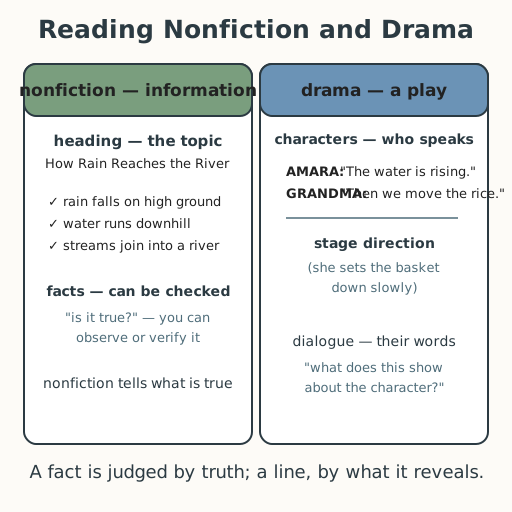
- Nonfiction-and-drama poster · 1 A poster of two pages side by side — a nonfiction page (heading, facts, an example) and a play page (characters, dialogue, stage directions) — each with its "what to look for" list
- A short nonfiction passage · 1 per pair A brief, original informational text (about water, bees, or a plant) with a clear heading and facts
- A short play scene · 1 per pair A brief, original drama scene with two or three characters, dialogue, and stage directions
- Genre notes page · 1 per learner A page to record, for each genre, one thing you look for and one example you found
Low-tech / no-cost
- Voice and a real fact Say three true things about something you can see, as a mini nonfiction text with a heading; then act a tiny scene aloud with one partner; no paper needed
- A 'fact or line?' game Read a sentence aloud and have partners signal whether it belongs to nonfiction (a fact) or to a play (a spoken line); no cards needed
Enriched / lab & device
- A small nonfiction and plays collection · 1 per group Short informational texts and short plays from different cultures, in learners' languages where possible, to read and compare
- A performed scene · 1 per group Learners read a scene aloud with parts, moving as the stage directions say, to feel how drama is meant to be performed
Works in different contexts
- large-group Read one nonfiction passage and one play scene aloud together, mapping each on the board, then have pairs read and map a second pair of texts
- multi-age Younger learners name the facts or the characters while older learners explain how stage directions shape a scene or how facts are organized
- self-directed A learner reads a nonfiction passage and a play scene, fills the genre notes page for each, and checks each "what to look for" is really in the text
- level-grouped Learners ready to extend explain why a fact and a line of dialogue must be judged by different standards — one by truth, one by what it reveals
- outdoor-only Build a tiny nonfiction text from three real observations outside, then act a short scene in the open air, noticing how space changes a performance
Lesson 8 — Reading Nonfiction and Drama
Summary
Learners read and understand nonfiction and drama, two more genres in a well-read life. They learn what to look for in each — headings and checkable facts in nonfiction; characters, dialogue, and stage directions in drama — read a short original example of each (in their strongest language where possible), and map what they find.
Objectives
- Read and understand nonfiction and drama in at least one language. (D04.S2.06.02)
Connection
Some writing is there to tell you what is true: a page headed “How Rain Reaches the River,” with facts you could check. Other writing is there to be performed: a page where two people speak and the words in brackets say “she sets the basket down slowly.” The first is nonfiction — information you can verify; the second is drama — a play meant to be acted. A well-read person can move between them without confusion: they know that a fact and a spoken line are judged by different standards — a fact by whether it is true, a line by what it shows about the character. Both are everywhere, in every language, from a newspaper to a festival stage.
Materials
- Nonfiction-and-drama poster
- A short nonfiction passage
- A short play scene
- Genre notes page
Preparation
- Print or draw the nonfiction-and-drama poster (information page and play page, each with its “what to look for” list).
- Copy the nonfiction passage and the play scene for each pair, and a genre notes page per learner.
Facilitator note
This lesson is written to the learner (“you”). The idea to land is that nonfiction and drama have different shapes and different standards: nonfiction is organized with headings and built from facts you can check; drama is built from characters, dialogue, and stage directions and is meant to be performed. Retrieval: recall Lesson 7’s genre shapes, and recall the fact/opinion distinction from Grade 5. Keep the examples original and short; read the scene aloud with parts — drama is for the voice and body. Honor home languages above all: read and map in the strongest language, and never rank genres or languages. Nonfiction and drama exist in every human culture; they are not any one region’s invention.
Procedure
- Gather (5 min). Think of something true you learned today, and a moment of acting you have seen or done. Today you read nonfiction and drama.
- Meet the two pages (10 min). Look at the poster. On the left, nonfiction: look for a heading that names the topic, and facts — statements you could check. On the right, drama: look for characters (who speaks), dialogue (their words), and stage directions (bracketed instructions for how they move and speak). Nonfiction asks “is it true?”; drama asks “what does this show?”
- Read the nonfiction (15 min). With a partner, read the short passage. Map it: what is the heading? what facts does it give? for one fact, say how you could check it. Summarize the passage in two sentences.
- Read the drama (15 min). Read the short scene aloud, taking the parts. Map it: who are the characters? what does the dialogue reveal about them? what do the stage directions tell the actors to do? Act it once, following the stage directions.
- Close (5 min). You have now read four of the great genres — fiction, poetry, nonfiction, and drama. Each has its own shape and its own way of being true. Knowing the shape is how you read anything, anywhere, with confidence.
Differentiation
- Support: Read the passage and scene aloud together; provide a simple frame (heading + facts; characters + one stage direction) and a single “how could we check it?” prompt.
- Extension: Explain in one paragraph why a fact and a line of dialogue must be judged by different standards — truth versus what it reveals — and give an example of each.
Assessment
- Formative (observation/self): Can the learner identify a nonfiction text’s heading and checkable facts, and a drama’s characters, dialogue, and stage directions, in at least one language?
- Self-check: The learner asks, “Could I point to each thing I claim — the heading, the fact, the line, the stage direction — in the actual text?”
Home connection
Find one piece of nonfiction (a label, a message, a notice) and one moment of drama (a story acted out, a conversation) around you, and name what each is made of.
Resources
- Genre knowledge (how informational and dramatic texts are structured) supports
comprehension; see Duke & Pearson’s synthesis and the IES “Improving Adolescent Literacy”
guide. Distinguishing a checkable fact from a spoken line is part of the evidence-vs-belief
skill (
docs/philosophy.md§5). Reading plays aloud supports fluency and comprehension; see the National Reading Panel report (2000).