Lesson 14 — Across a Language Difference
Learners cap the unit by communicating across a language difference. They meet four bridges — gestures, drawings, translation tools, and patience — act out real cross-language scenarios, and reflect on what works, what needs care, and why every language and speaker deserves patience and respect. The lesson revisits the unit's argument, evidence, discussion, and language-comparison skills.
Objectives
Objectives
- D04.S4.06.02 Communicate across a language difference using strategies such as gestures, drawings, translation tools, and patience.
- D04.S4.06.01 Compare how the same idea is expressed in two or more languages, noting what is gained or lost.
- D04.S1.06.02 Participate in a group discussion, building on others' ideas and disagreeing respectfully.
Essential question
How do I communicate with someone when we don't share a language?
Key vocabulary
Materials
Standard materials
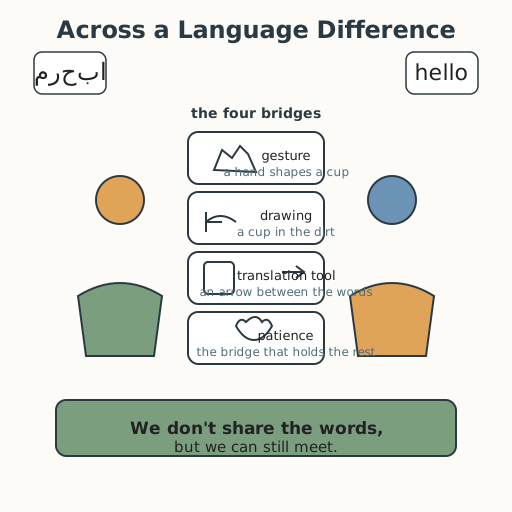
- Bridge-the-difference poster · 1 A poster of two people who don't share a language, joined by four labeled bridges — gestures, drawings, a translation tool, and patience — each with a small example
- Communication scenario cards · 1 set per group Cards describing a real cross-language moment — asking for water, giving directions, welcoming a newcomer, helping someone find a place — to act out
- Bridge toolkit page · 1 per learner A page to record, for one scenario, which bridges the learner would use and one thing to be careful about
Low-tech / no-cost
- Voices, hands, and patience Without sharing a language, act out one real need (thirst, direction, a welcome) using only gestures and drawings; notice what works and what needs care; no tools needed
- A 'which bridge?' game Say a scenario aloud and have partners signal which bridge fits best — gesture, drawing, tool, or patience — and why; no cards needed
Enriched / lab & device
- A translation tool · 1 per group A device with a translation app to try in one scenario, then discuss what it got right and what it flattened, treating it as a helper with limits
- A class bridge wall · 1 A shared wall where learners post the bridges that worked and the moments that needed patience, growing a toolkit the whole group owns
Works in different contexts
- large-group Model one scenario with all four bridges on the board, then have groups act out scenarios and report which bridge carried the most meaning
- multi-age Older learners act as the "person who speaks the other language" while younger learners practice one bridge (a gesture or a drawing) to make a need known
- self-directed A learner works through one scenario alone, writing which bridges they would use, what could go wrong, and one way to be patient and respectful
- level-grouped Learners ready to extend reflect on when a translation tool helps and when it fails (nuance, tone, a proverb), and why a human being is still needed
- outdoor-only Pair up outside across a real or imagined language difference and use gestures, drawings in the dirt, and patience to accomplish one task together
Lesson 14 — Across a Language Difference
Summary
Learners cap the unit by communicating across a language difference. They meet four bridges — gestures, drawings, translation tools, and patience — act out real cross-language scenarios, and reflect on what works, what needs care, and why every language and speaker deserves patience and respect. The lesson revisits the unit’s argument, evidence, discussion, and language-comparison skills.
Objectives
- Communicate across a language difference using gestures, drawings, translation tools, and patience. (D04.S4.06.02)
- Compare how the same idea is expressed in two or more languages, noting what is gained or lost. (D04.S4.06.01)
- Participate in a group discussion, building on others’ ideas and disagreeing respectfully. (D04.S1.06.02)
Connection
A traveler reaches a village where no one speaks her language. She is thirsty. She doesn’t need perfect words to be understood — she can gesture a cup to her mouth, draw a cup in the dirt, try a translation tool on a phone if she has one, and above all bring patience while the two of them find the way. Communication across a language difference is not about speaking the “right” language; it is about meeting the other person halfway, using every tool you have and treating their language — and yours — as equal. This is the skill you have been building all unit: listening, arguing with reasons, and honoring many languages, now put to use with a real human being across from you.
Materials
- Bridge-the-difference poster
- Communication scenario cards
- Bridge toolkit page
Preparation
- Print or draw the bridge-the-difference poster (two people, four labeled bridges).
- Copy scenario cards for each group and a bridge toolkit page per learner.
- If devices are available, prepare one translation tool for a trial.
Facilitator note
This lesson is written to the learner (“you”). The idea to land is that communication across
a language difference is possible and human, and that the four bridges — gestures, drawings,
translation tools, and patience — are tools, not magic. Hold the anti-deficit heart firmly:
not sharing a language is ordinary, never a failure, and multilingualism is wealth
(docs/philosophy.md §4). Be honest about translation tools — they help and they flatten
(nuance, tone, a proverb), which connects back to Lesson 13’s “gained and lost.” This is the
capstone, so build in retrieval: learners draw on the discussion moves (Lessons 3–4), the
argument and evidence skills (Lessons 9–11), and language comparison (Lesson 13) as they
reflect. Keep scenarios safe and everyday; celebrate every successful bridge, however small.
Honor every home language and accent in the room.
Procedure
- Gather (5 min). Think of a time you and someone else did not share a language — and you still understood each other. Today you practice the bridges that make that possible.
- Meet the four bridges (10 min). Look at the poster. Two people speak different languages, but four bridges join them: gestures (a hand shapes a cup), drawings (a cup in the dirt), a translation tool (a phone arrow between the words), and patience (a heart — the bridge that holds the others up). No single bridge is enough alone; together, and with patience, they carry meaning across.
- Act it out (20 min). With your group, take a scenario card — asking for water, giving directions, welcoming a newcomer, helping someone find a place. One of you plays a person who does not share the others’ language. Use gestures, drawings, and patience to accomplish the task; if you have a translation tool, try it once and notice what it helps and what it misses. Swap roles so each of you tries a bridge.
- Reflect on the bridges (10 min). On your page, record for your scenario: which bridges carried the most meaning, what could have gone wrong, and one way patience mattered. Then, in your group, discuss: build on each other’s ideas and, if you differ, disagree respectfully — using the moves from earlier in the unit.
- Close (5 min). You began this unit learning to hear an argument; you end it learning to reach a person. Listening, reasoning, honoring many languages, and meeting another human with patience — that is what it means to communicate in a many-voiced world.
Differentiation
- Support: Use one scenario with a single clear need (thirst) and practice one bridge (a gesture or a drawing) before combining them.
- Extension: Reflect in writing on when a translation tool helps and when it fails — nuance, tone, a proverb — and why a patient human being is still the most important bridge.
Assessment
- Summative (performance/observation/self): Can the learner use at least two bridges to accomplish a cross-language task, and reflect on what worked, what needed care, and where patience mattered — treating both languages as equal?
- Self-check: The learner asks, “Did I meet the other person halfway — using my tools, honoring their language, and staying patient — rather than expecting them to do all the work?”
Home connection
Try one bridge with someone at home or nearby who knows a different language — a gesture, a drawing, or one new word — and notice what carries meaning and what needs patience.
Resources
- Strategies for cross-language communication (gesture, drawing, translation tools, patience)
are grounded in multilingual and intercultural communication research; see UNESCO guidance on
multilingual education and the literature on lingua franca and plurilingual competence
(Council of Europe’s CEFR companion). Translation tools have real limits — see the critical
literature on machine translation. The principle that no language is above another and that
multilingualism is wealth is a values commitment (
docs/philosophy.md§4).