Lesson 13 — The Same Idea in Many Languages
Learners compare how the same idea is expressed in two or more languages and notice what is gained or lost in each. They meet a worked example — a greeting of peace across Arabic, Hebrew, and English — compare idea cards, and record one idea in two languages with a note on what each carries that the other does not.
Objectives
Objectives
- D04.S4.06.01 Compare how the same idea is expressed in two or more languages, noting what is gained or lost.
Essential question
How is the same idea expressed in different languages, and what is gained or lost?
Key vocabulary
Materials
Standard materials
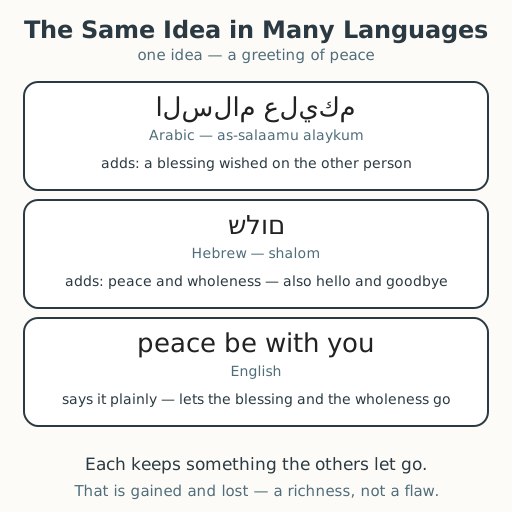
- One-idea-three-languages poster · 1 A poster showing one idea — a greeting of peace — in three languages, each with a note on what it adds or loses against the others
- Idea comparison cards · 1 set per group Cards pairing one idea (a greeting, a thanks, a proverb, a word for home) in two or more languages, to compare for what is gained or lost
- Gained-and-lost page · 1 per learner A page to record one idea in two languages and note what each expresses that the other does not
Low-tech / no-cost
- Voices in the room Learners share one idea — a greeting, a thanks, a word for home — in the languages they know, and the group notices what each carries; no cards needed
- A 'say it in two languages' circle Take turns saying one idea two ways, then name one thing the first has that the second lacks, and one thing the second has that the first lacks
Enriched / lab & device
- A multilingual idea wall · 1 A growing wall of one idea expressed in many languages, each with a "gained" and "lost" note, built by learners and their families
- A translation-tool comparison · 1 per group Where devices are available, put one idea through a translation tool and compare what the tool keeps and what it flattens, noticing its limits
Works in different contexts
- large-group Explore one idea in three languages on the poster together, then have groups compare idea cards and share one gained/lost pair each
- multi-age Younger learners say one idea in two languages they know while older learners write what each expresses that the other does not
- self-directed A learner records one idea in two languages on the page and notes one thing each expresses that the other does not, checking with someone who knows both
- level-grouped Learners ready to extend compare a proverb or a nuanced word across three languages and explain why no single translation is "the same"
- outdoor-only Walk and talk — find one idea (a greeting, a name for a place or plant) and share it in two languages, naming what each carries that the other lacks
Lesson 13 — The Same Idea in Many Languages
Summary
Learners compare how the same idea is expressed in two or more languages and notice what is gained or lost in each. They meet a worked example — a greeting of peace across Arabic, Hebrew, and English — compare idea cards, and record one idea in two languages with a note on what each carries that the other does not.
Objectives
- Compare how the same idea is expressed in two or more languages, noting what is gained or lost. (D04.S4.06.01)
Connection
One person says “السلام عليكم” (as-salaamu alaykum), another says “שלום” (shalom), a third says “peace be with you.” All three greet with peace, yet none says exactly what the others say. The Arabic wishes a blessing on the other person; the Hebrew shalom also means wholeness and works as hello and goodbye; the English says the idea plainly and lets the blessing and the wholeness go. No language is “better” — but each keeps something the others let go, and lets go of something the others keep. Comparing languages this way is how you discover that meaning is never quite carried whole from one tongue to another — and that this is a richness, not a flaw.
Materials
- One-idea-three-languages poster
- Idea comparison cards
- Gained-and-lost page
Preparation
- Print or draw the one-idea-three-languages poster (peace greeting in three languages with gained/lost notes).
- Copy idea comparison cards for each group and a gained-and-lost page per learner.
Facilitator note
This lesson is written to the learner (“you”). The idea to land is that translation always
gains and loses, and this is a wealth, not a defect — no language is “better,” and no
language says everything (docs/philosophy.md §4). Use accurate examples and check them: the
Arabic as-salaamu alaykum (“peace be upon you”) is a blessing; Hebrew shalom means peace,
wholeness, hello, and goodbye, sharing a Semitic root (s-l-m) with the Arabic salaam. Be
careful and humble with languages you do not speak — prefer examples learners or their
families actually know, and let those who speak a language be its experts. Invite learners to
share their own languages as gifts. The linguistic facts are evidence; the claim that all
languages are equally worthy is a value we hold (docs/philosophy.md §4–5). Retrieval: connect
back to Grade 5’s writing-systems and language-and-culture lessons.
Procedure
- Gather (5 min). Think of a greeting, a thanks, or a word for home you know in more than one language. Today you ask: what does each version keep that the others let go?
- Meet the three greetings (10 min). Look at the poster. Three bubbles, one idea — peace. “السلام عليكم” wishes a blessing on the other person. “שלום” carries peace and wholeness, and is also hello and goodbye. “Peace be with you” says it plainly and drops the blessing and the wholeness. Each is complete; none is complete in the same way. That is gained and lost.
- Compare the cards (15 min). With your group, take the idea cards. For each pair of versions, ask two questions: “What does this one keep that the other lets go?” and “What does it let go?” If someone in the group speaks the language, let them be the expert.
- Record your own (15 min). On your page, write one idea in two languages you know or can learn — a greeting, a thanks, a word for home, a proverb. Under each, note one thing it expresses that the other does not. Check with someone who knows both if you can.
- Close (5 min). The world’s languages are not copies of each other; they are many different ways of holding the world. Noticing what is gained and lost between them is how you meet each language — and each speaker — with respect and wonder.
Differentiation
- Support: Use one pair of greetings the learner already knows, and ask only “what does your language’s greeting carry that the other doesn’t?”
- Extension: Compare a proverb or a nuanced word across three languages, and write one sentence on why no single translation can be “the same” as the original.
Assessment
- Formative (observation/self): Can the learner give one idea in two languages and name at least one thing each expresses that the other does not?
- Self-check: The learner asks, “For my two versions, could I say what each one keeps and what it lets go — without calling either one better?”
Home connection
Ask someone at home for one idea — a greeting, a thanks, a proverb — in a language they know, and find one thing it carries that your own language’s version does not.
Resources
- Translation as always gaining and losing is a core insight of translation studies and
linguistic anthropology; see Daniel L. Everett, Language: The Cultural Tool, and the work
on untranslatability and linguistic relativity (Sapir, Whorf, and later linguists). The
shared Semitic root of salaam/shalom is standard in historical linguistics. The claim that
all languages are equally valid is a values commitment (
docs/philosophy.md§4).