Lesson 05 — Cells: The Basic Unit of Life
Learners learn that cells are the basic unit of life: every living thing is made of cells, and some living things are just one cell. They match cell parts to their jobs, compare plant and animal cells, and meet single-celled organisms — amoebae, yeast, and pond algae — that do all of life's work inside one small cell.
Objectives
Objectives
- D06.S2.06.01 Explain how cells are the basic unit of life and that some living things are made of a single cell.
Essential question
What are living things made of, and how can one single cell be a whole living thing?
Key vocabulary
Materials
Standard materials
- Cell diagram · 1 per pair The graphic showing an animal cell, a plant cell, and a single-celled organism, with parts labeled
- Cell parts cards · 1 set per pair Cards for membrane, nucleus, cytoplasm, and (plant) cell wall and chloroplasts, to match to jobs
- One cell, whole life page · 1 per learner A page to draw one single-celled organism and write what it does in its one cell
Low-tech / no-cost
- A cloth bag, a small ball, and water Model a cell — the bag is the membrane, the ball is the nucleus, the water is the cytoplasm — with a wall (box) for a plant cell
- Voice and body Learners stand together as one cell — some as the membrane (the walls), one as the nucleus, the rest as cytoplasm, acting out "one cell does every job"
Enriched / lab & device
- A simple microscope or magnifier and pond water or a leaf · 1 per group To look for real cells and single-celled life where available
- A short video of a single-celled organism (an amoeba, paramecium, or yeast) under a microscope · 1 per group To see one cell doing all of life's jobs
Works in different contexts
- large-group Project the cell diagram and label it together; the group matches each part card to its job aloud
- multi-age Younger learners point to "the bag" (membrane) and "the ball" (nucleus); older learners explain why a single cell can be a whole living thing
- self-directed A learner studies the diagram, matches part cards to jobs, and writes what one single-celled organism does in its one cell
- level-grouped Learners ready to extend compare plant and animal cells and name two parts a plant cell has that an animal cell lacks
- outdoor-only Find a pond, puddle, or damp soil and imagine the single-celled life in it; use the diagram to name what its one cell must do
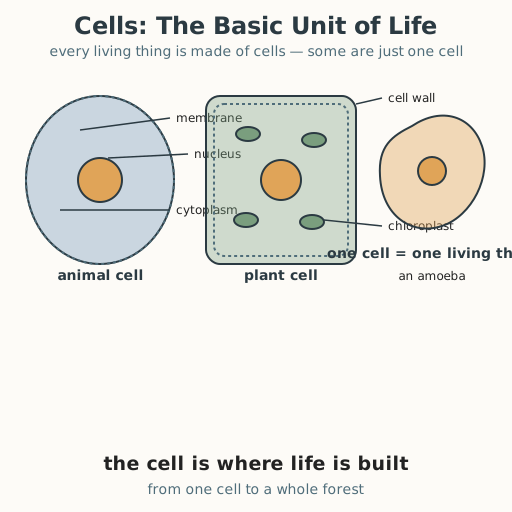
Lesson 5 — Cells: The Basic Unit of Life
Summary
Learners learn that cells are the basic unit of life: every living thing — plant, animal, fungus — is built of cells, and some living things are made of a single cell. They match cell parts to their jobs, compare plant and animal cells, and meet single-celled organisms such as amoebae, yeast, and pond algae, which perform all of life’s tasks inside one tiny cell.
Objectives
- Explain how cells are the basic unit of life and that some living things are made of a single cell. (D06.S2.06.01)
Connection
Your own body is a city of cells — trillions of them, each too small to see without a microscope. Yet some living things need no city at all: the yeast that makes bread rise is a single cell, and the green algae floating in a pond is a single cell too. From a giant tree to the yeast in dough, the rule is the same: the cell is the small living unit everything bigger is made from. Today you meet that unit up close.
Materials
- Cell diagram
- Cell parts cards
- “One cell, whole life” page
Preparation
- Print or draw the cell diagram and part cards per pair.
- Recall Grade 3–4: living things grow, move, and reproduce; now we ask what they are made of.
- Have the cloth-bag/ball/water model ready if using it.
Facilitator note
Written to the learner (“you”). Three ideas to land: (1) cells are the basic unit
of life — all living things are made of cells; (2) some living things are one
cell — a single cell can be a whole organism; (3) a few parts and their jobs
(membrane = boundary, nucleus = control center, cytoplasm = the gel that fills it;
plants add a cell wall for support and chloroplasts for making food). Model
the worked example with the bag model: the bag is the membrane (it holds the inside
in and lets some things pass), the ball is the nucleus, the water is the cytoplasm.
Note the “how do we know” through-line: we know cells exist because microscopes let
us see them — that is evidence, not guess. The claim that all life is made of cells
is a well-tested scientific theory (cell theory); hold it as evidence-based, not as
dogma. Yeast (single-celled fungi) is a welcoming, global example — bread and
fermented foods across cultures. See
docs/facilitation.md.
Procedure
- Gather (5 min). What are you made of? Skin, blood, bone, muscle — and if we could look closer and closer, what is the smallest living piece? Write your guess.
- Meet the cell (10 min). Look at the diagram. A cell is the basic unit of life — the smallest part that is itself alive. The membrane is its boundary, the nucleus is its control center, and the cytoplasm is the gel that fills it. A plant cell adds a stiff cell wall for support and chloroplasts for making food from sunlight. Point to each part and say its job.
- One cell, whole life (10 min). Not everything is built of many cells. A single-celled organism is a living thing made of exactly one cell — an amoeba in a puddle, yeast in bread dough, algae on a pond. That one cell must eat, grow, and reproduce all by itself. On your page, draw one and write the jobs it does in its one cell.
- Match parts to jobs (15 min). With a partner, match each part card to its job: membrane → boundary; nucleus → control center; cytoplasm → filling; cell wall → support; chloroplasts → food-making. Then build your own cell with the bag model (or stand together as one cell) and point to each part.
- Close (5 min). From one cell to a whole forest, the cell is where life is built. And some living things never get bigger than a single cell — yet they are complete and alive.
Differentiation
- Support: Use the bag model and a two-part label (membrane = bag, nucleus = ball); focus on “one cell can be a whole living thing.”
- Extension: Explain two ways a plant cell differs from an animal cell and why a plant’s cell wall helps it stand tall without a skeleton.
Assessment
- Formative (observation): Can the learner name the cell as the basic unit of life, name one single-celled organism, and match two parts to their jobs?
- Self-check: The learner asks, “Can I explain what one cell must be able to do for a single-celled organism to stay alive?”
Home connection
With permission, look at bread yeast or a drop of pond water if a magnifier is available. Tell someone what you think you are seeing: one cell doing all of life’s jobs.
Resources
- BBC Bitesize (KS3), “What are plant and animal cells?” — cell parts and plant/animal cells: https://www.bbc.co.uk/bitesize/topics/znyycdm/articles/zkm7wnb
- BBC Bitesize (KS3), “Unicellular organisms” — single-celled living things: https://www.bbc.co.uk/bitesize/topics/znyycdm/articles/z4f26yc
- National Geographic Education, “Cell Theory” — cells as the basic unit of life: https://education.nationalgeographic.org/resource/cell-theory/