Lesson 04 — Bias: How It Creeps In and How to Reduce It
Learners meet bias as a steady lean in one direction — different from random error — and see how selection bias and observer bias creep into results. They play a sampling game, label the bias in real scenarios, and practice the fixes: random sampling, blind measurement, and recording before judging.
Objectives
Objectives
- D06.S1.06.02 Identify sources of error or bias in a simple investigation and suggest how to reduce them.
Essential question
How does bias differ from error, and what can we do to keep it out of our results?
Key vocabulary
Materials
Standard materials
- Bias scenario cards · 1 set per group Three short scenarios — the garden sampled only at the sunny edge, the survey asked only of friends, the reader who expected a result
- Bias-hunt page · 1 per learner Columns for "what leaned the result," "kind of bias," and "how to reduce it"
- A bag of mixed counters or beans of two kinds · 1 per group For a sampling game that shows how a small or chosen sample can lean
Low-tech / no-cost
- Two kinds of seeds or stones and a bag Draw samples by hand and see how a chosen sample differs from a random one
- Voice and body Act out a biased sampler (only checking the easy corner) and a fair sampler (drawing blind), and discuss the difference
Enriched / lab & device
- A short news or research example to discuss · 1 per group A real example of a survey or study and who was (and was not) included
- A device to run a random sampler or number generator · 1 per group To see that a random draw, over many tries, evens out
Works in different contexts
- large-group Read one scenario aloud and have the group point to the lean; decide together whether it is selection bias or observer bias
- multi-age Younger learners sort scenarios into "fair" and "not fair"; older learners name the bias and design the fix
- self-directed A learner reads the three cards, labels each bias, and writes one way to reduce each
- level-grouped Learners ready to extend design a small fair survey of the class and explain what makes the sample fair
- outdoor-only Compare two ways to count plants or insects — checking only the path edge versus stepping to random spots; discuss which is fairer
Lesson 4 — Bias: How It Creeps In and How to Reduce It
Summary
Learners distinguish bias — a steady lean in one direction — from the random error they met yesterday. Through a sampling game and three real scenarios, they see how selection bias (choosing the easy or familiar sample) and observer bias (leaning toward the answer we expect) creep into results, and they practice the fixes: random sampling, blind measurement, and recording before judging.
Objectives
- Identify sources of bias in a simple investigation and suggest how to reduce them. (D06.S1.06.02)
Connection
When someone asks “which foods do people here like best?” and asks only their own friends, or measures only the plants closest to the path, the answer comes out leaning one way — not by accident, but because of who or what was chosen. That steady lean is bias. It matters beyond the classroom: whose health gets studied, whose needs get counted, whose voices shape a decision. If the sample is not fair, the answer is not fair. Today you learn to spot the lean and straighten it.
Materials
- Bias scenario cards
- Bias-hunt page
- A bag of mixed counters or beans of two kinds
Preparation
- Print the scenario cards and bias-hunt page.
- Fill each bag with mostly one kind of counter/bean and fewer of the other, mixed well.
- Recall Lesson 3: error is a random spread; today’s topic is a steady lean.
Facilitator note
Written to the learner (“you”). The core distinction: error is random (yesterday),
bias is a steady lean in one direction. Two kinds to land: selection bias
(you sample only the easy, near, or familiar cases) and observer bias (you
unconsciously read toward what you expect). Three fixes: random sampling (choose
without a pattern), blind measurement (the reader does not know which sample is
which), and record before judging (write all data down first, decide later). The
sampling game makes it concrete: a handful that is mostly one color “leans” the same
way a chosen sample does. This lesson carries the egalitarian lens directly —
whose data counts and whose is left out is a fairness question, not just a technique —
so name it as a value, while the mechanics of bias are the evidence-based part.
Keep scenarios age-appropriate and connect every bias to a fix (agency, not despair).
See docs/facilitation.md.
Procedure
- Gather (5 min). Recall yesterday: error made your five measurements a little different, all around the truth. Bias is different — it pushes every result the same way. Think: when has a choice of where or whom to check made an answer come out one-sided?
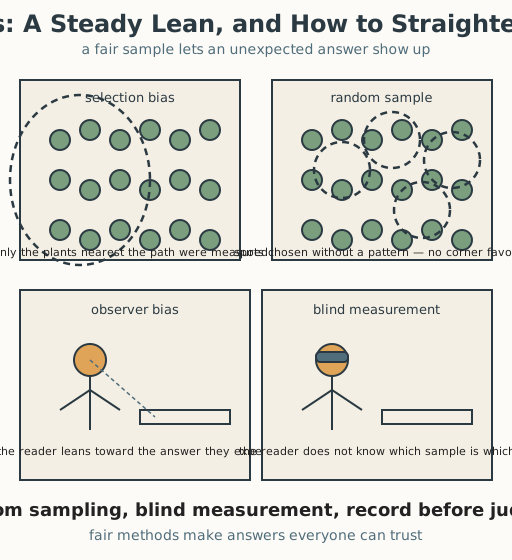
- Play the sampling game (10 min). Your bag has two colors of counters, mixed. First, grab a big handful from the top only — note how much of each color you got. Now shake the bag, close your eyes, and draw randomly, one by one. Compare: which draw better matches what is actually in the bag? The chosen handful leaned; the random draw did not.
- Meet two biases (10 min). Look at the diagram. Selection bias is choosing a sample that favors some cases over others — measuring only the sunny edge of the garden. Observer bias is leaning toward the answer you expect — reading the ruler a little toward “taller” because you hope your plants are tallest.
- Hunt the bias (15 min). Read the three scenario cards. For each, write on your page: what made the result lean, which bias it is, and one way to reduce it. Use the three fixes — random sampling, blind measurement, and record before judging.
- Close (5 min). Bias is a lean we can straighten. When the sample is fair and the reader is blind, the answer can be trusted by everyone — and fairness in science is a fairness to people.
Differentiation
- Support: Sort scenario cards into “fair” and “not fair” first; use a two-word record (selection | observer) with a fix bank.
- Extension: Design a small fair survey of the class on a harmless question, describing exactly how you will choose a random sample and record before judging.
Assessment
- Formative (observation): Can the learner label a scenario’s bias (selection or observer) and suggest a matching fix (random, blind, or record-first)?
- Self-check: The learner asks, “Would my method let an unexpected answer show up, or does it quietly push toward the answer I expect?”
Home connection
Notice one “count” around you — who is included and who is missed. Ask: is the sample fair, or does it lean? Tell someone what you would change to make it fair.
Resources
- Understanding Science (UC Berkeley), “What is science?” — how science guards against bias (see “The social side of science → Human endeavor, human biases”): https://undsci.berkeley.edu/understanding-science-101/what-is-science/
- BBC Bitesize (KS3), “Bias in science” — how bias creeps in and how to reduce it: https://www.bbc.co.uk/bitesize/topics/zsg6m39/articles/zybm7yc