Lesson 07 — Forms of Energy and How Energy Changes
Learners meet the five forms of energy — kinetic, potential, thermal, chemical, and electrical — through everyday examples from around the world, and learn that energy can change from one form to another. They sort examples, act out the forms, and hunt for them in the world around them.
Objectives
Objectives
- D06.S3.06.01 Describe the forms of energy (kinetic, potential, thermal, chemical, and electrical) and how energy changes between them.
Essential question
What are the forms energy takes, and how does energy change from one form to another?
Key vocabulary
Materials
Standard materials
- Forms-of-energy diagram · 1 per pair The graphic showing five forms, each with a clear example and label
- Energy form cards · 1 set per pair Cards naming everyday examples to sort into kinetic, potential, thermal, chemical, and electrical
- Energy detective page · 1 per learner A page to hunt for and label energy forms around the room or home
Low-tech / no-cost
- A stretched rubber band, a rolling stone, and warm hands Feel potential (stretch), kinetic (roll), and thermal (rub hands) directly
- Voice and body Learners act out each form — moving (kinetic), poised (potential), shivering (thermal), eating (chemical), a spark (electrical)
Enriched / lab & device
- A simple battery-and-bulb circuit · 1 per group To see chemical energy in the battery become electrical, then light and heat in the bulb
- A short video of energy forms in the real world · 1 per group To see kinetic, potential, thermal, chemical, and electrical energy at work
Works in different contexts
- large-group Hold up each example and have the group call out the form; act out all five together
- multi-age Younger learners sort examples into the five forms; older learners explain the change from one form into another
- self-directed A learner studies the diagram, sorts the cards, and lists three energy forms they can find around them
- level-grouped Learners ready to extend name a two-step change (e.g., chemical → kinetic → thermal) in one real object
- outdoor-only Hunt outdoors for moving things (kinetic), high things (potential), warm earth (thermal), food (chemical), and any spark or lightning (electrical)
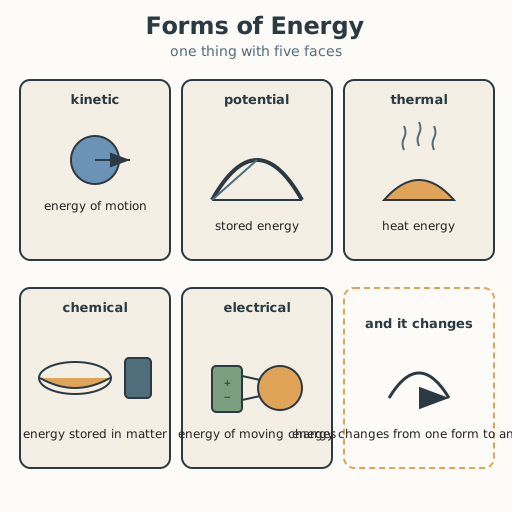
Lesson 7 — Forms of Energy and How Energy Changes
Summary
Learners meet the five forms of energy — kinetic (motion), potential (stored), thermal (heat), chemical (stored in matter), and electrical (moving charges) — through everyday examples, and learn the key idea that energy can change from one form to another. They sort examples, act out the forms, and hunt for energy in the world around them.
Objectives
- Describe the forms of energy (kinetic, potential, thermal, chemical, electrical) and how energy changes between them. (D06.S3.06.01)
Connection
Energy is everywhere, wearing different clothes. The rolling ball is kinetic; the stretched bow, ready to spring, is potential; the steaming bowl of soup is thermal; the rice and fuel that power your day are chemical; the current that lights a lamp is electrical. From a campfire to a charging phone to a river turning a wheel, the same energy keeps changing its form. Today you learn to name all five and watch them change.
Materials
- Forms-of-energy diagram
- Energy form cards
- Energy detective page
Preparation
- Print or draw the diagram, cards, and detective page.
- Recall Grade 4: energy moves from place to place (heat, sound, light) and is never destroyed; today we name its forms.
- Have a rubber band and a rolling object ready for the feel-it activity.
Facilitator note
Written to the learner (“you”). Two ideas to land: (1) the five forms and a clear
example of each, and (2) energy changes form (transforms). Keep the forms concrete
and bodily: kinetic = moving, potential = stored by position or stretch, thermal =
heat, chemical = stored in food/fuel/batteries, electrical = moving charges in wires.
Model the worked example with the rubber band: stretched it is potential, released it
becomes kinetic, and (rub your hands) motion becomes thermal. The claim that energy
changes form without being destroyed (conservation) is introduced lightly here and
formalized in Grade 9 — keep the everyday meaning now. Global examples keep it
faithful to many lives: a river turning a water wheel, a charcoal stove, a solar
panel, a bicycle. Note technology’s role honestly: the same energy that cooks a meal
also powers engines — a chance to name both benefit and care. See
docs/facilitation.md.
Procedure
- Gather (5 min). Where is energy in this room right now? Point to something moving, something warm, something plugged in. Write three guesses.
- Meet the five forms (10 min). Look at the diagram. Kinetic energy is energy of motion. Potential energy is stored — a ball held high, a bow pulled back. Thermal energy is heat. Chemical energy is stored in food and fuel. Electrical energy moves through wires as moving charges. Point to each and say its example aloud.
- Feel it (10 min). Stretch a rubber band (potential) and let it fly (kinetic). Rub your hands together fast — the motion becomes thermal. You just watched energy change form: potential → kinetic → thermal.
- Sort the cards (15 min). With a partner, sort every card into one of the five forms: a rolling cart (kinetic), a raised bucket (potential), a hot stone (thermal), a candle or a bowl of rice (chemical), a lit bulb (electrical). Then for two cards, name a change — what form did it come from, and what did it become?
- Close (5 min). Energy is one thing with five faces, always changing between them. Name a form, and you can start to see the changes happening everywhere.
Differentiation
- Support: Use the five example objects in hand and a two-word label for each; focus on naming the forms before changes.
- Extension: Choose one object (a lamp, a bicycle, a cooking fire) and write a two-step chain of changes, naming each form in order.
Assessment
- Formative (observation): Can the learner name all five forms, match each to an example, and describe one energy change from one form to another?
- Self-check: The learner asks, “For any object, can I name its energy form now and one form it came from or will become?”
Home connection
Be an energy detective at home: find one example of each of the five forms. Tell someone what you found and one change you saw energy make.
Resources
- BBC Bitesize (KS3), “Energy stores” — the forms of energy and how energy changes: https://www.bbc.co.uk/bitesize/topics/zc3g87h/articles/zg2sn9q
- U.S. Energy Information Administration (EIA), “Forms of energy” — a clear, age-accessible reference: https://www.eia.gov/kids/what-is-energy/forms-of-energy.php