Lesson 08 — Energy Transformations in Action
Learners follow energy through whole chains of change — food to motion to heat, and sunlight to food to electricity to light — and see that at every step energy changes form and some always escapes as heat. They build their own chains with cards and trace the input and output of everyday devices.
Objectives
Objectives
- D06.S3.06.01 Describe the forms of energy (kinetic, potential, thermal, chemical, and electrical) and how energy changes between them.
- D06.S1.06.01 Collect and organize data in tables and graphs, and use them to support or revise a claim.
Essential question
How does energy change through a chain of forms in the real things we use every day?
Key vocabulary
Materials
Standard materials
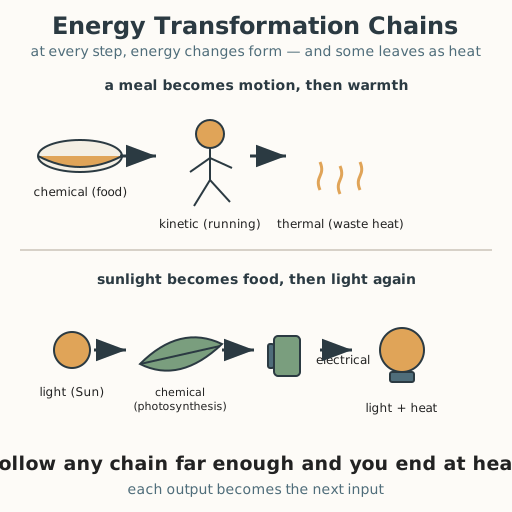
- Transformation chain diagram · 1 per pair The graphic showing two chains — food → motion → heat, and sunlight → chemical → electrical → light
- Chain cards · 1 set per pair Cards with the forms of energy, to build chains in order
- Transformation tracker page · 1 per learner A page to trace the input and output energy of three everyday devices or actions
Low-tech / no-cost
- A candle or oil lamp, a wheel, and warm hands Trace chemical → light + heat (candle), potential → kinetic (wheel), kinetic → thermal (rub hands)
- Voice and body Learners act out a chain — crouched (potential) → leap (kinetic) → puff and fan themselves (thermal) — passing a token down the line
Enriched / lab & device
- A small solar cell, a hand-crank flashlight, or a battery circuit · 1 per group To watch a real chain — light → electrical, motion → electrical → light, or chemical → electrical → light
- A short video of a real energy chain (a power plant, a bicycle, a solar panel) · 1 per group To see a multi-step transformation end to end
Works in different contexts
- large-group Build one long chain on the board, with the group naming each form in turn and where the waste heat leaves
- multi-age Younger learners order two-card chains (food → motion); older learners build four-step chains and name the waste heat at the end
- self-directed A learner builds three chains with the cards and traces input and output for each on the tracker page
- level-grouped Learners ready to extend compare two devices and explain which wastes more energy as heat and why
- outdoor-only Trace sunlight → plant growth (chemical) → food → motion → heat in a real garden or field, naming each step aloud
Lesson 8 — Energy Transformations in Action
Summary
Learners follow energy through whole chains of change — food to motion to heat, and sunlight to food to electricity to light — and discover that at every step energy changes form, and some always escapes as heat. They build their own chains with cards and trace the input and output energy of the devices and actions they use every day.
Objectives
- Describe how energy changes between forms through a chain of transformations. (D06.S3.06.01)
- Use the chain to record and read energy data, revisiting how organized data supports a claim. (D06.S1.06.01)
Connection
Nothing uses energy only once. The food you ate became the motion of your day and then the warmth of your body. Sunlight became the food a plant made, and that food — or the fuel pressed from old plants — became the electricity that lights a lamp. Every useful thing is a chain of changes, and at the end of every chain some energy slips away as heat. Today you follow the chain from start to finish.
Materials
- Transformation chain diagram
- Chain cards
- Transformation tracker page
Preparation
- Print or draw the diagram, chain cards, and tracker page.
- Recall Lesson 7: the five forms of energy. Today we link them into chains.
- Have a candle, a wheel, or a hand-crank light ready if using the feel-it activity.
Facilitator note
Written to the learner (“you”). The key idea to land: a transformation is a chain —
each output becomes the next input — and some energy always leaves as heat. Model
the worked example by building the food chain aloud, form by form, and pointing to the
“waste heat” at the end. Two distinctions worth naming: energy changes form (this
lesson’s standard) versus energy is conserved (Grade 9 — do not require the
quantitative law now; just note “none of it disappears, though some becomes heat we
cannot easily reuse”). The honest technology/environment lens: every machine wastes
some energy as heat, which is why using less and using energy well matters — a value
we hold, stated alongside the evidence. Global examples (a solar cooker, a water
wheel, a bicycle, a cooking fire) keep it faithful to many lives. See
docs/facilitation.md.
Procedure
- Gather (5 min). Recall the five forms from Lesson 7. Now the question: what happens when energy changes more than once, step after step?
- Meet the chains (10 min). Look at the diagram. Follow the top chain: chemical (food) → kinetic (running) → thermal (warm body). Follow the bottom chain: light (Sun) → chemical (the leaf’s food, made by photosynthesis) → electrical (battery) → light + heat (bulb). At every arrow, energy changes form — and a little leaves as heat.
- Build chains (15 min). With your cards, build three chains in order. Start each with a beginning form and end with heat: food → motion → heat; Sun → plant → food; battery → electrical → light → heat. Check each arrow with a partner: “does this form become that one?”
- Trace input and output (10 min). On your tracker page, pick three things — a bicycle, a cooking fire, a lamp — and write its input energy and its output energy (including the heat that escapes). What pattern do you see?
- Close (5 min). Energy is a traveler that changes clothes at every stop, and always leaves a little warmth behind. Follow any chain far enough and you end at heat.
Differentiation
- Support: Provide pre-ordered two-card chains with the end blank; focus on naming each form aloud and finding the heat.
- Extension: Compare two devices (a lamp and a hand-crank light) and explain, using the chain, which wastes more energy as heat and why that matters for using energy well.
Assessment
- Formative (observation): Can the learner order a three-step chain and name the form at each step and the heat that escapes?
- Self-check: The learner asks, “For any device, can I trace the energy back step by step and forward to the heat?”
Home connection
Pick one thing you use (a phone, a stove, a bicycle) and trace its energy chain out loud to someone — every form it passes through, ending in heat.
Resources
- BBC Bitesize (KS3), “Energy stores” — chains of energy change: https://www.bbc.co.uk/bitesize/topics/zc3g87h/articles/zg2sn9q
- U.S. Energy Information Administration (EIA), “Laws of energy” — energy changes form and is conserved: https://www.eia.gov/kids/what-is-energy/laws-of-energy.php