Lesson 12 — Soil Supports Life
Learners bring the unit together around one place where every system meets: soil. Soil is made of minerals from broken-down rock (the rock cycle) and humus from decayed life (cells and decomposers), it cycles water and nutrients (matter), and it feeds the plants that capture the Sun's energy (energy). They revisit the unit's through-line — collect data, check a claim, and separate evidence from inference.
Objectives
Objectives
- D06.S4.06.02 Explain how the rock cycle recycles Earth's materials and how soil supports life.
- D06.S2.06.02 Describe how energy flows and matter (such as carbon and water) cycles through an ecosystem.
- D06.S1.06.01 Collect and organize data in tables and graphs, and use them to support or revise a claim.
- D06.S3.06.01 Describe the forms of energy (kinetic, potential, thermal, chemical, and electrical) and how energy changes between them.
Essential question
How does soil — made by rock and life together — support the living systems of Earth?
Key vocabulary
Materials
Standard materials
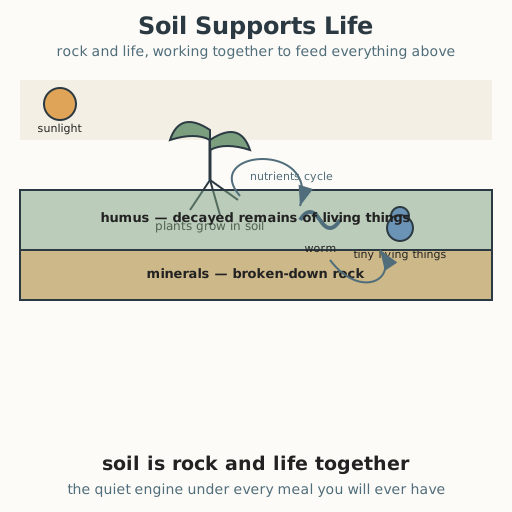
- Soil diagram · 1 per pair The graphic showing soil's layers and its living community, with minerals from rock and humus from decay
- Soil sample and a magnifier · 1 per group A handful of soil to look at closely (if available), or a drawn soil picture
- Unit reflection page · 1 per learner A page to record what soil is made of, what it supports, and one "how do we know" sentence
Low-tech / no-cost
- A handful of real soil and a stick Sift and sort soil outdoors, naming what comes from rock and what comes from life; no printed page needed
- Voice and body Learners act as soil — some as rock grains, some as decaying life, some as roots and worms — and tell the story of how soil feeds the world
Enriched / lab & device
- A simple soil test or a pH/water-holding comparison · 1 per group To investigate how soil holds water and nutrients, with data recorded in a table
- A short video of soil life (earthworms, fungi, roots) and of farming soil care · 1 per group To see the living community of soil and how people care for it
Works in different contexts
- large-group Build one big soil picture together, with the group naming each part's origin — rock, life, or both — and what it feeds
- multi-age Younger learners sort "from rock" and "from life"; older learners trace the full loop from rock cycle to food and back, and separate evidence from inference
- self-directed A learner studies the diagram, examines soil, and writes what it is made of, what it supports, and how we know
- level-grouped Learners ready to extend run a small soil investigation (water-holding or settling) with a data table and a claim
- outdoor-only Examine real soil outdoors, find its mineral grains and living matter, and name the life it supports right there
Lesson 12 — Soil Supports Life
Summary
Learners close the unit at the place where every system meets: soil. They learn that soil is made of minerals from broken-down rock (the rock cycle) and humus from decayed life (cells and decomposers), that it cycles water and nutrients, and that it feeds the plants that capture the Sun’s energy. They revisit the unit’s through-line — collect data, check a claim, and separate evidence from inference — to show the whole unit at work in one handful of earth.
Objectives
- Explain how the rock cycle recycles Earth’s materials and how soil supports life. (D06.S4.06.02)
- Revisit how matter cycles through an ecosystem (D06.S2.06.02), how energy changes form (D06.S3.06.01), and how data support or revise a claim (D06.S1.06.01) to connect soil to the living, physical, and inquiry threads of this unit.
Connection
Everything you have ever eaten began, in some way, in soil. The grain, the fruit, the grass that fed the animal — all of it grew from a thin, living layer of earth that is part broken rock and part the remains of old life. A farmer’s field, a mountain meadow, a river delta, a rooftop garden: all depend on the same handful of dark, living ground. And people have been reading that ground for thousands of years — soil- keepers who know a field by its color, its feel, and its smell, from the terraced slopes of the Andes to Sahelian fields to the dark forest-garden earth of the Amazon. That long observation is a science in its own right, held beside — never beneath — the soil science you learn today. Today you learn what soil is made of, and why it is the quiet engine under every meal you will ever have.
Materials
- Soil diagram
- Soil sample and a magnifier
- Unit reflection page
Preparation
- Print or draw the soil diagram and a reflection page per learner.
- Gather a small soil sample per group (or a drawn soil picture) and a magnifier.
- Have the unit’s earlier diagrams handy for the recall.
Facilitator note
Written to the learner (“you”). This capstone has two jobs: teach the last standard
(rock cycle recycles materials; soil supports life) and close the unit’s
through-line (data → claim → support/revise → evidence vs. inference). Two ideas to
land: soil = minerals (broken rock) + humus (decayed life), and soil is the
place rock, life, water, and energy meet. Name the cross-links explicitly: the rock
cycle makes the mineral part (Lesson 11); cells and decomposers make the humus and
cycle nutrients (Lessons 5–6); energy flows from Sun to plant (Lessons 7–8); and a
soil investigation uses tables, graphs, and claims (Lessons 1–4). The ethics and
egalitarian lenses: healthy soil feeds everyone, and caring for soil is caring for
people — a value we hold, stated alongside the evidence. Keep “how do we know” alive:
we can see soil’s parts and test water-holding, but we infer the deep rock
origins and the slow work of decomposers. Connect to agency — learners can protect
soil. See docs/facilitation.md.
Procedure
- Gather and recall (5 min). Quick unit review: how do we organize data and check a claim? (tables, graphs, support or revise — Lessons 1–2). What is the unit of life? (the cell — Lesson 5). What flows and what cycles in an ecosystem? (energy flows; matter cycles — Lesson 6). What recycles rock? (the rock cycle — Lesson 11). Today’s last question: what does all of that make possible?
- Meet soil (10 min). Look at the diagram. Soil is a mix of minerals — broken-down rock from the rock cycle — and humus — the decayed remains of living things, broken down by decomposers. Together they hold water, air, and nutrients, and they are home to countless living things. Soil is where the rock cycle meets the living world.
- Look closely (10 min). With a magnifier, examine your soil sample. Sort what you see into “from rock” (gritty grains, sand) and “from life” (dark bits, roots, tiny creatures). Write each in the right column.
- Soil supports life (15 min). Trace the connections: rock weathers into mineral grains (rock cycle); dead plants and animals decay into humus (decomposers); soil holds water and nutrients that cycle (matter); plants grow in it and capture the Sun’s energy (energy); and everything that eats depends on those plants. Draw the loop on your page.
- Separate evidence from inference (10 min). Sort these: “I saw mineral grains in the soil” (evidence — you looked); “this soil took thousands of years to form from rock” (inference — you reason it); “we should care for soil so it can feed everyone” (a value — a choice). Which is which?
- Close (5 min). One handful of soil is the whole unit in miniature: rock recycled, life decomposed, water and nutrients cycling, the Sun’s energy caught by plants — and you, the scientist, holding it with open eyes, evidence, and care.
Differentiation
- Support: Sort soil parts into two labeled piles (“from rock” | “from life”); use a two-word record and the diagram as reference.
- Extension: Run a small soil investigation (which soil holds water best?) with a data table, a bar graph, and a claim you support or revise.
Assessment
- Summative (portfolio): The unit reflection page, showing what soil is made of, what it supports, the rock-and-life loop, and a “how do we know” sentence that separates evidence from inference.
- Observation: Can the learner connect rock cycle + decomposers + water/nutrient cycling + plant energy to explain how soil supports life?
Home connection
Find a patch of soil near home and look closely. Tell someone what part came from rock, what part came from life, and one thing you could do to protect it.
Resources
- Food and Agriculture Organization (FAO), “Soils Portal — Key definitions” — soil as weathered minerals plus organic matter: https://www.fao.org/soils-portal/about/all-definitions/en/
- BBC Bitesize (KS2), “What is soil made from?”: https://www.bbc.co.uk/bitesize/topics/z9bbkqt/articles/zgqkcmn