Lesson 11 — The Rock Cycle Recycles Earth's Materials
Learners meet the rock cycle: rock is made, broken down, and made again in a loop that never uses Earth's materials up. They learn the three rock types — igneous, sedimentary, and metamorphic — and the processes that turn one into another, and they trace one rock's long journey around the cycle.
Objectives
Objectives
- D06.S4.06.02 Explain how the rock cycle recycles Earth's materials and how soil supports life.
Essential question
How are rocks made, broken down, and made again in a cycle that never uses Earth's materials up?
Key vocabulary
Materials
Standard materials
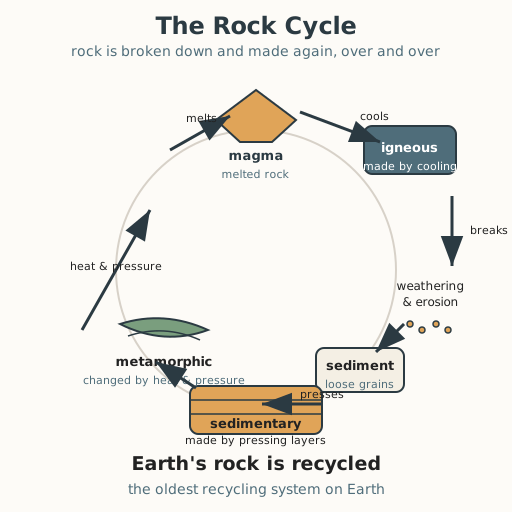
- Rock-cycle diagram · 1 per pair The graphic showing the loop — magma → igneous → weathering/erosion → sediment → sedimentary → heat/pressure → metamorphic → melting → magma
- Rock-type cards · 1 set per pair Cards for igneous, sedimentary, metamorphic, and the processes between them, to arrange into the cycle
- Cycle page · 1 per learner A page to draw the cycle and trace one rock's journey through it
Low-tech / no-cost
- Clay, sand, and stones Model the cycle by hand — press layers (sedimentary), squeeze and warm (metamorphic), and imagine melting (igneous)
- Voice and body Learners act out the cycle — breaking down (weathering), pressing (sedimentary), squeezing (metamorphic), melting and cooling (igneous) — around a circle
Enriched / lab & device
- Real rock samples (granite, sandstone, slate) · 1 set per group To feel igneous, sedimentary, and metamorphic rock
- A short video of volcanoes, rivers, and mountain-building · 1 per group To see each part of the rock cycle happening in real places
Works in different contexts
- large-group Build one large cycle on the board and have the group move a "rock" token around it, naming each change
- multi-age Younger learners sort rocks into "made by cooling," "made by pressing," and "changed by heat and pressure"; older learners trace the full loop
- self-directed A learner studies the diagram, arranges the cards into the cycle, and writes one rock's journey around it
- level-grouped Learners ready to extend explain how one rock could become all three types over deep time, and what drives each change
- outdoor-only Find real rocks, sand, and soil outdoors and decide where each sits in the cycle and what process likely made it
Lesson 11 — The Rock Cycle Recycles Earth’s Materials
Summary
Learners meet the rock cycle: rock is made, broken down, and made again in a loop that never uses Earth’s materials up. They learn the three rock types — igneous (made by cooling), sedimentary (made by pressing layers), and metamorphic (changed by heat and pressure) — and the processes that turn one into another, then trace one rock’s long journey around the cycle.
Objectives
- Explain how the rock cycle recycles Earth’s materials. (D06.S4.06.02)
Connection
The sand on a beach was once part of a mountain. The mountain, long before that, was once molten rock, and the grains of sand may one day be pressed into new stone and lifted again. Rock is not a thing that is used once and gone; it is recycled, broken down and rebuilt over times so long we cannot watch them. Today you learn the cycle that makes every mountain, beach, and pebble part of one slow, endless story.
Materials
- Rock-cycle diagram
- Rock-type cards
- Cycle page
Preparation
- Print or draw the rock-cycle diagram, cards, and cycle page.
- Recall Grade 5: weathering, erosion, and the slow changes to Earth’s surface.
- Have clay, sand, and stones ready if using the hand model.
Facilitator note
Written to the learner (“you”). The one idea to land: rock is recycled — made,
broken down, and made again, in a loop that has run for billions of years. Three rock
types, each tied to a process: igneous (cooled from magma or lava), sedimentary
(pressed from layers of sediment), metamorphic (changed by heat and pressure). The
cycle is driven by Earth’s internal heat (melting) and surface processes (weathering,
erosion, deposition). Model the worked example with the clay/sand model and trace one
rock around the diagram aloud. The deep-time scale is evidence-based (radiometric
dating of rocks); the sense of wonder — that the ground under us is ancient and
recycled — can seed an environmental reflection about caring for what is never truly
“used up,” but name it as a value. Keep the “how do we know” line: we cannot watch a
cycle that takes millions of years, so we infer it from the rocks we can see and
measure. See docs/facilitation.md.
Procedure
- Gather (5 min). Hold a pebble or a grain of sand. How old is it, and where has it been? Write a guess: could it have once been part of a mountain?
- Meet the cycle (10 min). Look at the diagram. The rock cycle is a loop. Magma (melted rock) cools into igneous rock. Weathering and erosion break rock into sediment, which presses into sedimentary rock. Heat and pressure change rock into metamorphic rock, which can melt back into magma — and the loop begins again. Point to each step and say what happens.
- Arrange the cycle (10 min). With your cards, lay out the three rock types and the processes between them in a circle: cooling, weathering/erosion, pressing, heat/pressure, melting. Check each arrow with a partner: does this process turn that rock into the next one?
- Trace one rock (15 min). On your cycle page, draw the loop and trace one rock’s journey: born from cooling magma, weathered into sand, pressed into sandstone, folded by pressure, and melted to begin again. Label each rock type as you go.
- Close (5 min). Nothing about rock is used up and thrown away. It is broken down and rebuilt, over and over — the oldest recycling system on Earth.
Differentiation
- Support: Sort rock samples or cards into the three types first; trace the cycle with a moving token and say each change aloud.
- Extension: Explain how one rock could become all three types over deep time, naming the process that drives each change (cooling, pressing, heat/pressure).
Assessment
- Formative (observation): Can the learner name the three rock types, the process that makes each, and state that the cycle recycles Earth’s materials?
- Self-check: The learner asks, “Can I start anywhere in the cycle and trace a rock all the way around, naming each rock type and change?”
Home connection
Find a rock near home and decide which type it might be and how it likely formed. Tell someone the cycle that rock has been part of — and will rejoin.
Resources
- National Geographic Education, “The Rock Cycle”: https://education.nationalgeographic.org/resource/rock-cycle/
- BBC Bitesize (KS3), “The rock cycle” — igneous, sedimentary, and metamorphic rock: https://www.bbc.co.uk/bitesize/topics/z3fv4wx/articles/z2xx6g8