Lesson 05 — Tell a Story with Movement, Voice, and One More Element
Learners create a short performance that combines movement, voice, and one other element — music, a prop, or shadow — to tell a story. A worked example performs a three-part story ("a seed becomes a tree that gives shade") showing each part's movement, voice, and chosen element, then small groups devise and perform their own short story, using a storyboard to keep the beginning, middle, and end clear.
Objectives
Objectives
- D07.S3.06.01 Create a short performance that combines movement, voice, and one other element such as music or a prop to tell a story.
Essential question
How do I combine movement, voice, and one other element to tell a short story?
Key vocabulary
Materials
Standard materials
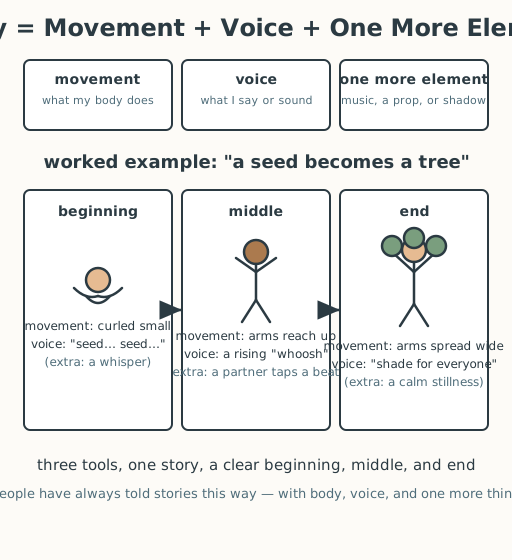
- Performance recipe card · 1 per group A card reading 'Story = Movement + Voice + One more element,' with the worked example storyboard (a seed grows into a tree that gives shade) showing each part's movement, voice, and chosen element
- Prop and sound basket · 1 per group A few simple props (a cloth, a stick, a cup, a scarf) and sound makers (a shaker, a drum, a bell) for learners to choose their one extra element
- Storyboard page · 1 per group Three boxes (beginning, middle, end) to sketch or write the movement, voice, and extra element for each part
Low-tech / no-cost
- Body and voice only Tell the story with movement and voice alone; the "one more element" can be shadow, stillness, or a found object from the room
- Found-object props and natural sounds A leaf, stone, or cloth becomes the prop; clapping, tapping, or wind sounds become the extra element
Enriched / lab & device
- A simple lighting or shadow setup · 1 per class A lamp or torch to make shadows as the extra element, adding a whole new storytelling layer
- A recording device · 1 per group To record the performance so the group can watch it back and revise the story's clarity
Works in different contexts
- large-group Model the seed-to-tree worked example once for the whole room, then have small groups devise their own story and perform for one another in a rotating "audience"
- multi-age Younger learners supply the movement while older learners supply voice and the extra element, and everyone helps choose the story
- self-directed A learner devises a solo story, performs it for a mirror or records it, and checks that all three parts (movement, voice, one more) are present and clear
- level-grouped Learners ready to extend add a fourth element (music and a prop together) or a twist in the middle, and explain how it sharpens the story
- outdoor-only Use the outdoor space itself — a slope, a tree, wind, and natural props — as the stage and the extra element
Lesson 5 — Tell a Story with Movement, Voice, and One More Element
Summary
Learners create a short performance that combines movement, voice, and one other element — music, a prop, or shadow — to tell a story. A worked example performs a three-part story (“a seed becomes a tree that gives shade”) showing each part’s movement, voice, and chosen element, then small groups devise and perform their own short story, using a storyboard to keep the beginning, middle, and end clear.
Objectives
- Create a short performance that combines movement, voice, and one other element such as music or a prop to tell a story. (D07.S3.06.01)
Connection
You already tell stories with more than words. You lean in and lower your voice to tell a secret; you throw your arms wide to show how big the fish was; you tap a rhythm on the table to set the mood. A performance just gathers these together on purpose: your movement shows what happens, your voice says or sounds the feeling, and one more element — a prop, a beat, a shadow — carries the story somewhere words and bodies alone cannot. Today you put all three together to tell one small story from beginning to end.
Materials
- Performance recipe card
- Prop and sound basket
- Storyboard page
Preparation
- Copy the performance recipe card and storyboard page for each group.
- Gather the prop and sound basket.
- Recall Grade 5: learners choreographed a group dance or scene with a clear idea, working cooperatively; Grade 4: they created a character with voice, body, and a simple prop or costume.
- Arrange the room into small groups with space to move safely.
Facilitator note
This lesson is written to the learner (“you”). The idea to land is integration with
clarity: a performance works when movement, voice, and one more element all serve the
same story and the story has a clear beginning, middle, and end. Model the seed-to-tree
worked example fully first (explicit instruction for a novice skill — Kirschner, Sweller &
Clark, 2006). Keep the stories small and safe — a seed, a journey, a message, a rescue —
and invite only stories learners feel good sharing; performance can feel vulnerable at
this age (identity and self-consciousness spike in grades 6–8, see docs/development.md),
so make the audience kind, applause warm, and participation a choice. Celebrate every
completed story; clarity, not virtuosity, is the goal. See docs/facilitation.md and
docs/contexts.md on cooperative group work and emotional safety.
Procedure
- Gather (5 min). Last lesson you heard how two traditions celebrate differently. Today you become the performers: you tell a short story using movement, voice, and one more element.
- Meet the recipe (10 min). Look at the recipe card: Story = Movement + Voice + One more element. Here is a worked example, “a seed becomes a tree that gives shade.” Beginning: you curl small on the ground and whisper “seed… seed…” — movement (small and curled) + voice (a quiet whisper). Middle: you rise slowly, arms reaching up, and make a rising “whoosh” while a partner taps a soft beat — movement + voice + music (the extra element). End: you stand tall, arms spread like branches, and say calmly, “shade for everyone.” Three parts, one story, three tools working together.
- Choose your story (5 min). With your group, pick a small story with a clear beginning, middle, and end — a journey, a message carried through a storm, a rescue, a gift, a change. Sketch or write it in your storyboard’s three boxes.
- Devise it (15 min). Decide, for each part: what does my movement show? what does my voice say or sound? what one more element — a prop, music, or shadow — carries it further? Rehearse once through, softly.
- Perform for an audience (15 min). Take turns performing for another group, then switch. Watch for the story: can we follow the beginning, middle, and end? Applaud warmly after every performance.
- Close (5 min). You just told a story the way humans always have — with your body, your voice, and one more thing that lifts it into the air. Keep your storyboard; next lesson you will meet how two whole traditions tell their stories through movement and drama.
Differentiation
- Support: Provide a pre-made story (the seed, or “carry a message across a stream”) and let each learner hold one job — mover, voice, or extra element.
- Support (movement, voice, and motor alternatives): Movement does not have to be full-body — it can be a hand, an eyebrow, a turn of the head, or moving a prop, puppet, or object in place of your own body. Voice does not have to be spoken words — it can be a clap, a tap, a hum, a sign, a written or typed line, or a partner speaking your words. A learner may instead direct or keep the storyboard, shaping the story while others perform it. The story — not the able-bodiedness of its teller — is the learning.
- Extension: Add a second extra element (music and a prop) or a twist in the middle, and write one sentence on how the added element sharpens the story.
Assessment
- Formative (performance/peer): Does the performance combine movement, voice, and one other element, and does its story have a followable beginning, middle, and end?
- Self-check: The group asks, “Did all three tools serve the same story, and could the audience follow our beginning, middle, and end?”
Home connection
Tell a tiny story at home with just your body, your voice, and one object nearby — and ask a listener what they understood the story to be.
Resources
- Storytelling through movement, voice, and an extra element is a standard of elementary drama education; for a classroom-friendly framing of devised performance, see the resources of the International Drama/Theatre and Education Association (IDEA): https://www.idea-org.net/
- Kirschner, Sweller & Clark (2006), “Why Minimal Guidance Does Not Work,” on modeling worked examples for novice skills.