Lesson 04 — Two Musical Traditions, One Theme: Celebration
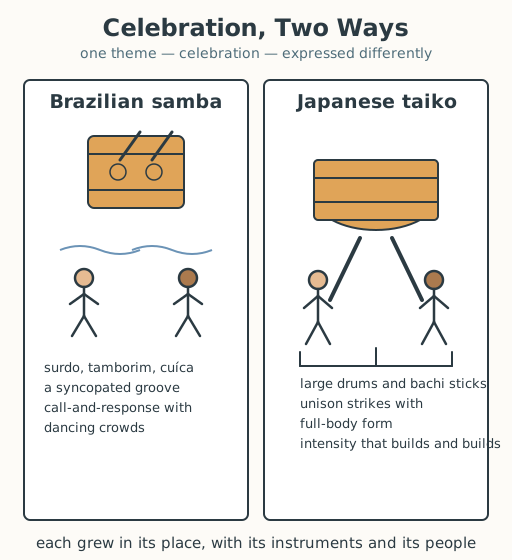
Learners compare how two living musical traditions express one shared theme — celebration — differently. A worked example reads Brazilian samba (syncopated groove, call-and-response, dancing crowds) against Japanese taiko (unison strikes, full-body form, building intensity), then learners compare a further pairing from a respectful menu, always meeting these musics as living traditions to honor, never as specimens to rank.
Objectives
Objectives
- D07.S2.06.02 Compare how two musical traditions express a shared theme such as celebration or grief differently.
Essential question
How do two musical traditions express a shared theme such as celebration differently?
Key vocabulary
Materials
Standard materials
- Tradition listening cards · 1 set Cards naming two living traditions and their observable features — Brazilian samba (surdo bass drum, tamborim, cuíca; syncopated groove, call-and-response, dancing crowds) and Japanese taiko (large drums, bachi sticks; unison strikes, full-body form, building intensity) — plus a short menu of further pairings for learners to compare
- Compare chart · 1 per learner A four-column page — "Tradition and place" → "Instruments I hear" → "How the music moves" → "How it expresses celebration"
- Recordings (if available) · 1 set Respectful short audio or video clips of samba and taiko in their living settings, played if and where available
Low-tech / no-cost
- Spoken and clapped descriptions Describe each tradition in words and clap or tap its rhythm — syncopated for samba, steady and strong for taiko — so learners compare without recordings
- Comparison by voice Complete the chart aloud in pairs, naming one observable feature and how it expresses celebration
Enriched / lab & device
- A world map and listening stations · 1 Place each tradition on the map and play short respectful clips at listening stations, building a global picture of how celebration sounds
- A guest or a community recording · 1 per class Invite a local musician who plays in a living tradition, or use a community recording, so learners meet the music from a living practitioner
Works in different contexts
- large-group Model the samba-versus-taiko worked example whole-class (clap the syncopation, then strike the unison together), then have small groups each compare one further pairing and share out
- multi-age Younger learners move or clap along to each rhythm; older learners name the observable difference (groove vs unison) and how it expresses celebration
- self-directed A learner completes the chart for two traditions from the menu and writes one sentence comparing how each expresses celebration
- level-grouped Learners ready to extend research a third tradition that celebrates (with a source) and add it to the chart with a note on its instruments and rhythm
- outdoor-only Compare two ways celebration sounds locally — a festival rhythm, a work song, a call — and connect each to its place and instruments
Lesson 4 — Two Musical Traditions, One Theme: Celebration
Summary
Learners compare how two living musical traditions express one shared theme — celebration — differently. A worked example reads Brazilian samba (syncopated groove, call-and-response, dancing crowds) against Japanese taiko (unison strikes, full-body form, building intensity), then learners compare a further pairing from a respectful menu, always meeting these musics as living traditions to honor, never as specimens to rank.
Objectives
- Compare how two musical traditions express a shared theme such as celebration differently. (D07.S2.06.02)
Connection
People celebrate everywhere — a wedding, a harvest, a festival, a game won — and music carries the joy. But celebration does not sound the same in every place. At one festival the drums sway and swing so bodies can dance; at another the drums crack together in one great voice so the whole street feels it. Neither is “better”; each grew in a place, with its instruments and its people. Listening for the difference — the groove, the unison, the call-and-answer — is how we hear another community’s joy with respect.
Materials
- Tradition listening cards
- Compare chart
- Recordings (if available)
Preparation
- Prepare the listening cards, each labeled with its place and features.
- Copy a compare chart for each learner.
- Cue short, respectful recordings of samba and taiko if available; otherwise prepare clapped/spoken descriptions.
- Recall Grade 5: learners explained how music reflects the place, history, or community that made it, citing what they hear.
Facilitator note
This lesson is written to the learner (“you”). The idea to land is comparison, not
ranking: we name observable features (instruments, rhythm, unison vs groove, form) and
connect them to how each tradition expresses celebration — never calling one “more
advanced.” Both samba and taiko are living traditions made by living people; samba
de roda (Bahia) is inscribed on UNESCO’s Intangible Cultural Heritage list. If a learner
belongs to one of these traditions, invite them to be the authority and never correct them
about their own music. Keep the focus on celebration (joyful and age-appropriate); if a
learner asks about grief, offer the extension pairing (Irish keening vs New Orleans jazz
funeral) gently and with reverence, and always attach agency and hope. See
docs/facilitation.md on honoring living traditions and docs/contexts.md on cultural
power dynamics.
Procedure
- Gather (5 min). Last lesson you notated a melody so others could follow it. Today you listen across the world: how do two traditions express the same theme — celebration — in different ways?
- Meet the comparison (15 min). Look at the first card, Brazilian samba. What I hear: a syncopated groove — the beat sways and off-beats dance — played on the surdo (big bass drum), tamborim (small hand drum), and cuíca (a drum that “laughs”), with voices calling and answering while crowds dance. How it celebrates: the groove invites everyone to move together. Now Japanese taiko. What I hear: unison strikes — many drums hit together as one — on large drums with bachi sticks, players’ whole bodies moving with each strike, the intensity building and building. How it celebrates: one powerful shared voice that fills the festival street. Same theme — celebration — expressed two ways: a flowing groove versus united precision. The reason lies in the instruments, the occasion (a dancing carnival street vs a shrine festival), and the musical idea each tradition holds dear.
- Compare a second pairing (15 min). Choose one pairing from the menu and fill your chart: its instruments, how the music moves, and how it expresses celebration. Menu options (meet them respectfully): Andean siku panpipes (interlocking pairs, bright pentatonic air) vs West African djembe drumming (layered rhythms, call-and-response); or, if you prefer a different theme, grief — Irish keening (a slow, ornamented solo voice) vs a New Orleans jazz funeral (a slow dirge that lifts into a swing).
- Share a reason (10 min). In a small group, share one comparison. Name what you heard (the observation) and how it expresses the theme. Notice that every tradition makes sense in its own place.
- Close (5 min). Celebration is one human joy with a hundred voices. Comparing them is not about better or worse — it is about hearing each one truly. You will use this same respectful ear all through this unit.
Differentiation
- Support: Use a sentence frame — “In ___ I hear ___ (instrument/rhythm), and it celebrates by ___; in ___ I hear ___, and it celebrates by ___.” Clap or move to one feature each.
- Extension: Research a third celebration tradition (with a source), complete a chart row, and write one sentence on how its instruments and rhythm express joy.
Assessment
- Formative (observation/self): Can the learner name at least one observable feature of each tradition and connect it, with a reason, to how that tradition expresses celebration — without ranking one against the other?
- Self-check: The learner asks, “Did I name something I actually heard, and did I connect it to how the music celebrates — speaking about living people and their music with respect?”
Home connection
Listen to two different celebration songs or pieces you know — from a festival, a wedding, a game, or a holiday — and name one way each expresses joy differently.
Resources
- Smithsonian Folkways Recordings offers respectful recordings and teaching notes for world music, including Brazilian samba and West African drumming: https://folkways.si.edu/tools-for-teaching
- UNESCO’s Intangible Cultural Heritage list includes samba de roda (Brazil) and frames these musics as living heritage: https://ich.unesco.org/