Lesson 08 — Evaluate a Product or Building: Works, Who's Left Out, Environment
The capstone brings the unit together: learners evaluate a product or building on three lenses — how well it works, who it leaves out, and its effect on the environment — and propose one improvement. A worked example evaluates a school entrance (shelter but steps that leave some people out, concrete and glass with an energy cost), then learners evaluate an object or building of their choice and, in a closing reflection, revisit the unit's through-lines: deliberate art, comparison, notation, performance, and the design cycle.
Objectives
Objectives
- D07.S4.06.02 Evaluate a product or building on how well it works, who it leaves out, and its effect on the environment.
- D07.S1.06.01 Use the elements and principles of art such as line, shape, color, balance, and contrast deliberately to express an idea or feeling.
- D07.S2.06.01 Create a melody or rhythmic composition and notate it so others can follow it.
- D07.S3.06.01 Create a short performance that combines movement, voice, and one other element such as music or a prop to tell a story.
- D07.S4.06.01 Use a full design cycle, including research, prototypes, and testing, to make something and document the process.
Essential question
How do I evaluate a product or building on how well it works, who it leaves out, and its effect on the environment?
Key vocabulary
Materials
Standard materials
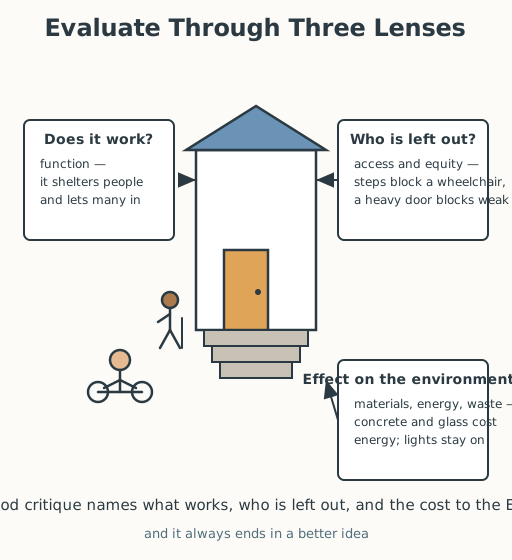
- Three-lenses poster · 1 A poster showing the three evaluation lenses — 'Does it work?' (function), 'Who is left out?' (access and equity), 'Effect on the environment?' (materials, energy, waste) — with the worked example of a school entrance evaluated through each lens
- Evaluate chart · 1 per learner A three-section page — "Does it work?" → "Who is left out?" → "Effect on the environment?" — plus a line for one improvement and its reason
- Object or building images · 1 set Cards of common products and buildings to evaluate — a public water tap, a bus stop shelter, a school entrance with steps, a plastic bottle, a bicycle, a market stall, a phone
Low-tech / no-cost
- Spoken evaluations Describe a local object or building in words and evaluate it through the three lenses aloud, in pairs; no printed cards needed
- The real environment as the example Evaluate an actual object or building nearby — a door, a tap, a path, a stall — by looking at it directly
Enriched / lab & device
- A neighborhood walk or photo set · 1 Walk the local area or review photos to choose a real building or product to evaluate with the three lenses
- A simple audit sheet · 1 per pair A printed audit sheet to tally access barriers (steps, height, grip, distance) and environmental features (materials, energy, waste) on a real site
Works in different contexts
- large-group Model the school-entrance worked example on the board, then have small groups each evaluate one card or real object and share one lens-finding plus one improvement
- multi-age Younger learners point to who might be left out or where materials come from; older learners connect a finding to function, access, or environment and propose one improvement
- self-directed A learner chooses one real product or building, evaluates it through all three lenses, and writes one improvement with a reason
- level-grouped Learners ready to extend propose a redesign of their chosen object or building and explain how it improves all three lenses at once
- outdoor-only Choose a real outdoor structure or object — a path, a gate, a shade, a bench — and evaluate it through the three lenses on the spot
Lesson 8 — Evaluate a Product or Building: Works, Who’s Left Out, Environment
Summary
The capstone brings the unit together: learners evaluate a product or building on three lenses — how well it works, who it leaves out, and its effect on the environment — and propose one improvement. A worked example evaluates a school entrance (shelter but steps that leave some people out, concrete and glass with an energy cost), then learners evaluate an object or building of their choice and, in a closing reflection, revisit the unit’s through-lines: deliberate art, comparison, notation, performance, and the design cycle.
Objectives
- Evaluate a product or building on how well it works, who it leaves out, and its effect on the environment. (D07.S4.06.02)
- Revisit using art elements deliberately (D07.S1.06.01), composing and notating a melody (D07.S2.06.01), performing with movement, voice, and one more element (D07.S3.06.01), and running the full design cycle (D07.S4.06.01).
Connection
Everything around you was designed by someone — the tap you turn, the bus stop you wait at, the bottle you drink from, the door you walk through. And every design answers three questions, whether its maker asked them or not: Does it work? Who does it leave out? What does it cost the Earth? A tap may give clean water but be too high for a child or too hard to turn for an older hand; a bottle may be cheap but pile up for centuries; a building may shelter thousands but turn its back on anyone who cannot climb its steps. Learning to ask all three questions is how you stop being only a user of the designed world and become its thoughtful judge — and, someday, its better maker.
Materials
- Three-lenses poster
- Evaluate chart
- Object or building images
Preparation
- Print or draw the three-lenses poster, including the worked example.
- Copy an evaluate chart for each learner.
- Gather the object and building images (or choose a real nearby object or building).
- Recall Grade 5: learners compared designs for different climates and explained how the environment shapes design; Grade 4: they explained how an object reflects its materials and needs.
Facilitator note
This lesson is written to the learner (“you”). The idea to land is the three-lens
critique: a good evaluation names (1) how well it works, (2) who it leaves out, and
(3) its effect on the environment — and then proposes an improvement. This carries the
egalitarian and environmental lenses explicitly (see docs/philosophy.md §4), and it
plants the seed for Grade 7’s accessibility standard (D07.S4.07.01). Keep the examples
concrete and non-ranking; the point is not to shame any design but to see it fully. Be
ready for learners to notice real inequities (a building with no ramp, a tap no one in a
wheelchair can reach); meet these with calm honesty and always connect them to agency —
“what could a better design do?” — never despair. The closing reflection is retrieval
practice across the whole unit. See docs/facilitation.md and docs/contexts.md.
Procedure
- Gather (5 min). This unit you used art elements on purpose, compared the same subject and the same theme across cultures, composed and notated a melody, performed a story, and ran the full design cycle. Today, the capstone: you turn that careful eye on the designed world and evaluate a product or building.
- Meet the three lenses (15 min). Look at the poster. Here is a worked example — a school entrance. Does it work? Yes — it shelters people, has a door, and lets many in. Who is left out? Its steps leave out people who use wheelchairs or canes and parents carrying small children, and its heavy door leaves out anyone with a weak grip. Effect on the environment? Its concrete and glass cost energy to make, and a dark corridor needs electric light all day. Notice: a design can work and still leave people out and cost the Earth. All three lenses matter at once.
- Choose and evaluate (20 min). Pick one product or building — a public water tap, a bus stop shelter, a plastic bottle, a bicycle, a market stall, a phone, or something near you. Fill your chart: Does it work? Who is left out? Effect on the environment? Be specific and honest, never mocking.
- Propose one improvement (10 min). Write one change that would help, and the reason. For example: add a ramp beside the steps, so people who use wheels can enter too. A good critique always ends in a better idea, not just a complaint.
- Revisit the unit (5 min). Look back: you made art with deliberate elements; you compared the sun, celebration, and good-against-evil across cultures with reasons; you notated a melody others could follow; you performed a story; you ran a full design cycle and wrote it down. Say which of these you are most proud of, and why.
- Close (5 min). Making and judging are one act: seeing clearly, honoring others, and shaping something honest and useful. That act belongs to everyone, everywhere — and now it belongs to you.
Differentiation
- Support: Use a sentence frame for each lens — “It works because ___; it leaves out ___ because ___; it affects the environment by ___” — and evaluate one object together first.
- Extension: Propose a full redesign of your chosen object or building and explain how it improves all three lenses at once.
Assessment
- Summative (observation/portfolio/self): Does the learner evaluate a product or building on all three lenses — function, who it leaves out, and environmental effect — and propose one improvement with a reason? Does the closing reflection recall the unit’s through-lines?
- Self-check: The learner asks, “Did I name how it works, who it leaves out, and its effect on the Earth — and did I end with a better idea, not just a complaint?”
Home connection
Choose one object or building you use daily and evaluate it with the three lenses, then tell someone one improvement you would make and why.
Resources
- The three lenses of design critique (function, access/equity, environmental impact) map to the engineering-design and sustainability framing of the Smithsonian Science Education Center: https://ssec.si.edu/
- UNESCO’s Education for Sustainable Development frames caring for people and the Earth as one practice, which underlies the access-and-environment lenses: https://www.unesco.org/en/sustainable-development/education