Lesson 01 — Primary and Secondary Sources: Two Ways to See the Past
Learners meet the historian's first tool: the difference between a primary source (made at the time, by someone who was there) and a secondary source (made later, by someone who studied the primary sources). A worked example uses the 1883 Krakatoa eruption, and learners sort sources and record two sources of their own.
Objectives
Objectives
- D08.S1.06.01 Explain the difference between a primary source and a secondary source and use each to describe one past event.
Essential question
What is the difference between a primary source and a secondary source, and why do historians use both?
Key vocabulary
Materials
Standard materials
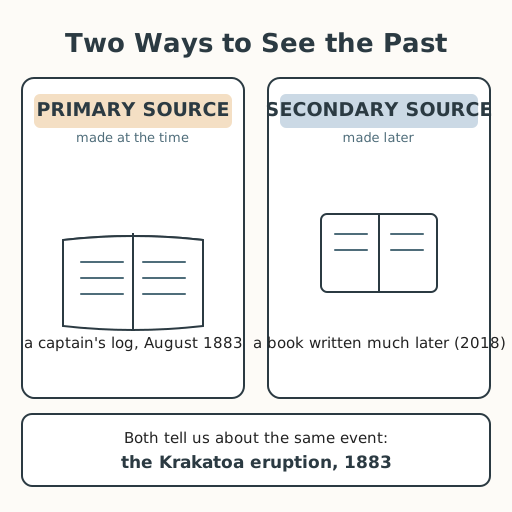
- Source-kind poster · 1 A two-panel poster showing a primary source (a captain's log from August 1883) and a secondary source (a book written in 2018), both about the 1883 Krakatoa eruption
- Source sort cards · 1 set of 8 Eight cards describing sources — four primary, four secondary — for learners to sort into two columns
- My two sources page · 1 per learner A page with two boxes where learners record one primary and one secondary source about one event in their own life
Low-tech / no-cost
- Read-aloud and voice The facilitator describes the worked example aloud; learners call out "primary" or "secondary" for each card, using voice only
- Hand-drawn two-column chart Learners draw two columns in a notebook or in the dirt, labeled "made at the time" and "made later," and sort the items by speaking them in
Enriched / lab & device
- A digital source set · 1 per pair A small set of images (a letter, a photograph, a museum panel, a textbook page) viewed on a device, sorted with the same two-column frame
- A world map · 1 A map to place Krakatoa in Southeast Asia so learners see where the worked-example event happened
Works in different contexts
- large-group Sort the eight cards together on a big board with the whole group calling out each choice, then have pairs record their own two sources
- multi-age Younger learners sort the cards by a simple "made then / made now" question while older learners explain why and add their own examples
- self-directed A learner reads the worked example, sorts the eight cards, and writes their own primary and secondary source about one event in their life
- level-grouped Learners ready to extend write a sentence about why a historian would want both kinds of source, not just one
- outdoor-only Hold up real objects from around you — a leaf, a stone, a drawing made yesterday — and decide together which are "made at the time" and which are "made later" about the same event
Lesson 1 — Primary and Secondary Sources: Two Ways to See the Past
Summary
Learners meet the historian’s first tool: the difference between a primary source (made at the time, by someone who was there) and a secondary source (made later, by someone who studied the primary sources). A worked example uses the 1883 Krakatoa eruption, and learners sort sources and record two sources of their own.
Objectives
- Explain the difference between a primary source and a secondary source. (D08.S1.06.01)
Connection
Think of a photo you took yesterday of something that really happened — a meal, a storm, a game. That is like a primary source: it comes from the moment. Now think of a book or video someone made about your town or country, years later. That is like a secondary source: it was made later, by someone who studied the first-hand evidence. Historians use both, the way you might use your own photo and a book about your home — one shows the moment, the other steps back to explain it.
Materials
- Source-kind poster
- Source sort cards (eight items)
- My two sources page
Preparation
- Print or draw the source-kind poster.
- Copy the eight source sort cards and a “my two sources” page for each learner.
- Arrange a circle for the worked example and a flat space for sorting.
Facilitator note
This lesson is written to the learner (“you”). The skill to build is recognizing primary
and secondary sources — not memorizing the 1883 eruption. Model the worked example fully
(explicit instruction, guided practice) before learners sort on their own; source-kind
thinking is a new skill for most Grade 6 learners. Use the simple test: was it made at
the time of the event, by someone who was there (or very close)? That is primary.
Made later, by someone who studied the evidence? That is secondary. Note honestly that
the line can blur — a source can be “more primary” or “more secondary” — but the two poles
are what learners need first. This lesson sets up the next, where learners use both kinds
to describe one past event. See docs/facilitation.md.
Procedure
- Gather (5 min). Last year you put events on timelines. This year you begin working like a historian — asking where does the story come from? That question has two answers: a primary source and a secondary source.
- Meet the two kinds (10 min). Look at the poster. On the left is a primary source: a ship captain’s log written in August 1883, when the volcano Krakatoa (in Southeast Asia, between Java and Sumatra) erupted. The captain wrote it at the time, because he was there. On the right is a secondary source: a book called Volcanoes: A History, written in 2018. Its author was not there in 1883; she studied the captain’s log and other evidence, then wrote about it later.
- Worked example: sort a few together (10 min). A primary source is made at the time, by someone who was there. A secondary source is made later, by someone who studied the primary sources. Sort these two together: a telegraph message sent the day of the eruption (primary — at the time) and a museum panel about Krakatoa written last year (secondary — later). You decide which is which and why.
- Sort your own (15 min). Take the eight cards and sort them into two columns: made at the time and made later. Check with a partner: did you agree on all eight? If not, explain your reasons.
- Record two of your own (5 min). On your page, write one event from your own life — a birthday, a trip, a storm. Then list one primary source about it (a photo, a memory, a note you wrote that day) and one secondary source about it (a story someone told later, an article, a documentary).
- Close (5 min). A historian’s first question is where does this come from? You now know the two answers — and why a good history uses both.
Differentiation
- Support: Use the two-pole test on real objects (a leaf from the ground vs. a drawing of it); sort fewer cards, and scribe the learner’s own two sources.
- Extension: Write one sentence about why a historian would want both kinds of source — what each one adds that the other cannot.
Assessment
- Formative (observation): Can the learner correctly sort sources as primary or secondary and give the reason (“made at the time” vs. “made later”)?
- Self-check: The learner asks, “Could I tell a primary source from a secondary one, and explain why each one counts the way it does?”
Home connection
Ask someone at home to show you one thing from your family’s past that was made “at the time” (a photo, a letter, an object) and one thing made “later” (a story, a book, a show) — and sort them together.
Resources
- The 1883 eruption of Krakatoa, one of the largest volcanic eruptions in recorded history, is documented by the Smithsonian Institution’s Global Volcanism Program (https://volcano.si.edu/). The distinction between primary and secondary sources is a standard tool of historical method; see, for example, the guidance of the U.S. National Archives (https://www.archives.gov/) and the British Library (https://www.bl.uk/). Dates are approximations that scholars revise as new evidence appears; the source-kind idea, not the exact day, is what matters here.