Lesson 02 — Using Each Kind: Describe One Past Event
Learners use a primary source and a secondary source together to describe one past event: the Indian Ocean voyages of Zheng He (1405–1433). A worked example pairs an eyewitness account (Ma Huan) with a modern history book, then learners choose an event and write a two-source note — this unit's first portfolio artifact.
Objectives
Objectives
- D08.S1.06.01 Explain the difference between a primary source and a secondary source and use each to describe one past event.
Essential question
How can I use a primary source and a secondary source together to describe one past event?
Key vocabulary
Materials
Standard materials
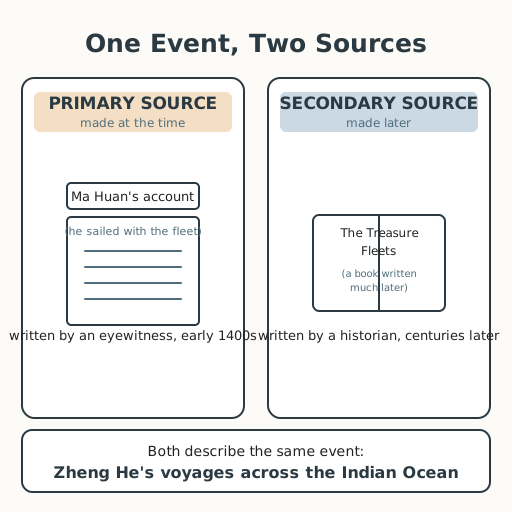
- Zheng He two-source poster · 1 A poster pairing a primary source (Ma Huan's eyewitness account, early 1400s) and a secondary source (a modern book about the treasure fleets), both describing the voyages of Zheng He
- Two-source event cards · 1 set of 3 Three event cards, each with one primary and one secondary source, so pairs can choose an event to describe — the Great Zimbabwe (oral tradition and archaeology), the 1324 pilgrimage of Mansa Musa, and the 1857 rebellion in India
- Describe-with-two-sources note · 1 per learner A note page with three prompts (what was the event, what the primary source says, what the secondary source adds)
Low-tech / no-cost
- A read-aloud and retell The facilitator reads the two Zheng He sources aloud; learners retell the event using each source in their own words, voice only
- Hand-drawn two-source note Learners draw three boxes in a notebook and answer the three prompts for one event; no printed page needed
Enriched / lab & device
- A device for source images · 1 per pair Images of the actual sources (a Ming map, a manuscript page, a modern museum panel) viewed and discussed with the same prompts
- A world map of the Indian Ocean · 1 A map to trace Zheng He's routes from China across Southeast Asia, South Asia, Arabia, and East Africa
Works in different contexts
- large-group Describe the Zheng He event together on the board, then have pairs choose one of the three cards and write their own two-source note
- multi-age Younger learners say one thing each source tells them while older learners write the full two-source note and lead the comparison
- self-directed A learner reads the worked example, chooses one event card, and completes the two-source note for that event alone
- level-grouped Learners ready to extend compare the primary and secondary source and write what each one adds that the other cannot show
- outdoor-only Describe one shared recent event (a storm, a harvest, a trip) twice — once as someone who was there, once as someone who heard about it later — and notice the difference
Lesson 2 — Using Each Kind: Describe One Past Event
Summary
Learners use a primary source and a secondary source together to describe one past event: the Indian Ocean voyages of Zheng He (1405–1433). A worked example pairs an eyewitness account (Ma Huan) with a modern history book, then learners choose an event and write a two-source note — this unit’s first portfolio artifact.
Objectives
- Use a primary source and a secondary source, each, to describe one past event. (D08.S1.06.01)
Connection
When you tell about something that happened — a storm, a festival, an accident — you can tell it two ways: as someone who saw it, or as someone who heard about it and looked into it. Both are useful, and they sound different. A historian does the same thing: a primary source is the voice of someone who was there; a secondary source is the voice of someone who studied it later. Today you use both, together, to describe one real event from the past.
Materials
- Zheng He two-source poster
- Two-source event cards (three events)
- Describe-with-two-sources note
Preparation
- Print or draw the Zheng He two-source poster.
- Copy the three event cards and a two-source note for each learner.
- Arrange a circle for the worked example and a flat space for writing.
Facilitator note
This lesson is written to the learner (“you”). The skill to build is describing one past
event using both kinds of source, and noticing what each adds. Model the Zheng He example
fully, then let learners choose an event and write. Guard against “the primary source is
true, the secondary is not”: both can be accurate or mistaken; the point is that they come
from different places and do different work. The three event cards are deliberately global —
Great Zimbabwe (Southern Africa), the 1324 pilgrimage of Mansa Musa (West Africa), and the
1857 rebellion in India (South Asia) — so no single people’s story is the default. This
lesson produces the unit’s primary-versus-secondary source note portfolio artifact. See
docs/facilitation.md.
Procedure
- Gather (5 min). Recall from last lesson: a primary source is made at the time by someone who was there; a secondary source is made later by someone who studied the evidence. Today you put both to work on one event.
- Worked example: Zheng He (15 min). Read the poster. The event is the voyages of Zheng He, a Chinese admiral who led huge fleets across the Indian Ocean between 1405 and 1433 — to Southeast Asia, South Asia, Arabia, and the coast of East Africa. The primary source is the account of Ma Huan, an interpreter who sailed with the fleet and wrote down what he saw — the people, the ports, the animals. The secondary source is a modern book, The Treasure Fleets, written by a historian centuries later who studied Ma Huan’s writing and other evidence to explain the voyages. Notice what each adds: Ma Huan gives the feel of being there; the modern book gives the big picture.
- Choose an event (5 min). Pick one of the three event cards. Each card gives one primary source and one secondary source about a real past event.
- Write your two-source note (15 min). On your note, answer three prompts: What was the event? What does the primary source tell you? What does the secondary source add? Use the words of the sources, and note how the two voices differ.
- Share and check (5 min). With a partner, read one of your prompts aloud. Does your partner agree that you have used one primary and one secondary source?
- Close (5 min). A single past event can be described many ways. When you use both kinds of source, you get closer to a full picture. Keep this note — it is the first page of your portfolio.
Differentiation
- Support: Provide sentence starters (“The event was…; the primary source says…; the secondary source adds…”) and scribe where needed; use only the Zheng He example.
- Extension: Add a third line to your note: “What could the primary source show that the secondary source could not — and the other way around?”
Assessment
- Formative (portfolio/observation): Can the learner describe one past event using a primary source and a secondary source, and name what each contributes?
- Self-check: The learner asks, “Did I use one primary and one secondary source, and can I say what each one added?”
Home connection
Tell someone at home about Zheng He’s voyages — first as Ma Huan saw them, then as a modern historian explains them — and ask which version felt different and why.
Resources
- The voyages of Zheng He (1405–1433), in which Chinese fleets sailed the Indian Ocean as far as East Africa, are documented in primary and secondary sources; Ma Huan’s eyewitness account, Yingya Shenglan, is translated and studied by historians (see, e.g., the work of J.V.G. Mills and later scholarship). Overviews appear in the UNESCO “Maritime Silk Road” project (https://www.unesco.org/en/silk-road) and the British Library (https://www.bl.uk/). The 1324 pilgrimage of Mansa Musa is described in the writings of the contemporary Egyptian scholar al-Umari and later histories (see the British Museum, https://www.britishmuseum.org/). Great Zimbabwe is documented through archaeology and UNESCO World Heritage listing (https://whc.unesco.org/en/list/364/). The 1857 rebellion in India is documented in British and Indian records and in later scholarship. Dates are approximations that scholars revise as new evidence appears.