Lesson 05 — Knowledge Across Generations: Oral, Written, Apprenticeship
Learners meet three ways knowledge passes between generations — oral tradition, written records, and apprenticeship — through the songlines of Australian Aboriginal peoples, the Timbuktu manuscripts of Mali, and master-and-apprentice craft in Japan. The three traditions are held side by side as equals, none better than another.
Objectives
Objectives
- D08.S2.06.01 Explain how knowledge is passed from one generation to the next through oral tradition, written records, or apprenticeship, using examples from different peoples.
Essential question
How is knowledge passed from one generation to the next — through oral tradition, written records, and apprenticeship?
Key vocabulary
Materials
Standard materials
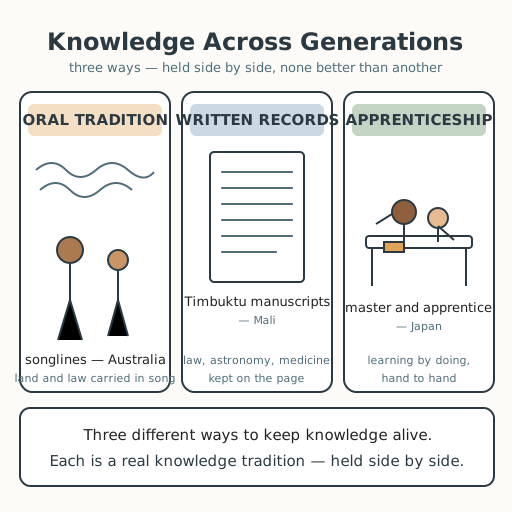
- Knowledge traditions poster · 1 A three-panel poster showing oral tradition (songlines, Australia), written records (Timbuktu manuscripts, Mali), and apprenticeship (master and apprentice, Japan), held side by side
- Knowledge traditions cards · 1 set of 3 Three one-page cards describing each tradition and how it is passed on, for small-group reading
- Knowledge-transmission note · 1 per learner A note page to record one tradition, how knowledge passes in it, and one thing it keeps alive
Low-tech / no-cost
- A read-aloud and retell The facilitator tells the three traditions aloud; learners retell one and say how knowledge passes in it, voice only
- A 'passing knowledge' circle Learners sit in a circle and pass a small object while each names one thing they learned from an older person and how (by word, by page, or by doing)
Enriched / lab & device
- A device with images · 1 per pair Photographs of a manuscript page, a songline painting, and a craft studio, discussed with the same frame
- A world map · 1 A map to place Australia, Mali, and Japan so learners see the three traditions across the globe
Works in different contexts
- large-group Read one tradition together and chart it, then have three groups each study one tradition and teach it to the others
- multi-age Younger learners match each tradition to its place while older learners write the note and lead the comparison
- self-directed A learner reads the three cards, fills the knowledge-transmission note for one tradition, and writes how it passes knowledge
- level-grouped Learners ready to extend compare two traditions — how each keeps knowledge, and what each is especially good at holding
- outdoor-only Sit in a circle and share, by word, something you learned from an older person; then name which of the three ways (word, page, or doing) it used
Lesson 5 — Knowledge Across Generations: Oral, Written, Apprenticeship
Summary
Learners meet three ways knowledge passes between generations — oral tradition, written records, and apprenticeship — through the songlines of Australian Aboriginal peoples, the Timbuktu manuscripts of Mali, and master-and-apprentice craft in Japan. The three traditions are held side by side as equals, none better than another.
Objectives
- Explain how knowledge is passed from one generation to the next through oral tradition, written records, or apprenticeship, using examples from different peoples. (D08.S2.06.01)
Connection
Think of something you know that no one wrote down — a family recipe, a song, a way of fixing things, a story your grandparent tells. That is knowledge passing from one generation to the next. Humans have done this in many ways: some knowledge is carried by word, some on the page, and some by doing — a craft learned hand to hand. Each is a real way of knowing, and no single way is “better.” Today you meet all three, held side by side.
Materials
- Knowledge traditions poster
- Knowledge traditions cards (three traditions)
- Knowledge-transmission note
Preparation
- Print or draw the three-panel poster.
- Copy the three tradition cards and a note for each learner.
- Arrange a circle for the story and small groups for the cards.
Facilitator note
This lesson is written to the learner (“you”). The skill to build is explaining how
knowledge passes in each tradition, and holding all three as equal. This is a values and
perspective lesson as much as a knowledge lesson: guard firmly against ranking (“written is
more advanced than oral”). Oral tradition is not a lesser version of history; it is a
complete knowledge system, and it has kept land, law, science, and story alive for many
generations. The three examples span three continents and honor Indigenous and non-European
knowledge traditions. Learners may share their own traditions — welcome that; a learner’s
own way of knowing is part of the human story. This lesson produces the unit’s
knowledge-transmission example portfolio artifact. See docs/facilitation.md.
Procedure
- Gather (5 min). So far you have read the past through sources and through change and continuity. Now ask: how does knowledge survive from one generation to the next?
- Meet the three traditions (20 min). Read the cards. Oral tradition — songlines (Australia): Australian Aboriginal peoples carry knowledge of the land, its water, its law, and its ancestors in songlines — songs that map the country and are sung and passed down across many generations, so the way is never lost. Written records — Timbuktu manuscripts (Mali): families in and around Timbuktu kept thousands of manuscripts — in Arabic and local languages — on law, astronomy, medicine, and math, copied and preserved from parent to child for centuries. Apprenticeship — Japan: a craft, such as sword-making, pottery, or tea, is learned by doing, alongside a master, over years — the knowledge lives in skilled hands and careful practice, passed from teacher to learner.
- Notice what they share (5 min). All three pass knowledge from one generation to the next — the difference is how: by word, by page, or by doing. And many peoples use more than one way at once.
- Record one tradition (15 min). Choose one tradition. On your note, write: which tradition it is, how knowledge passes in it (by word, by page, or by doing), and one thing it keeps alive (the land, the laws, the stars, a craft).
- Share and check (5 min). With a partner, read your note and listen to theirs. Can you each name how your partner’s tradition passes knowledge?
- Close (5 min). Knowledge is the gift one generation gives the next. Humans give it in many ways — and every way is real.
Differentiation
- Support: Use one tradition at a time with a fill-in note and picture prompts; scribe the learner’s words and keep the three traditions clearly labeled.
- Extension: Compare two traditions — what each one is especially good at holding, and where they agree or differ in how knowledge is kept.
Assessment
- Formative (portfolio/observation): Can the learner explain how knowledge passes in one tradition and name one thing it keeps alive — holding the three traditions as equals?
- Self-check: The learner asks, “Did I treat each way of knowing with respect, and can I explain how knowledge passes in the one I chose?”
Home connection
Ask someone at home how they learned one thing they know well — by word, by page, or by doing — and tell them the three traditions you met today.
Resources
- Australian Aboriginal songlines, which encode knowledge of land, water, and law, are documented in Indigenous knowledge and scholarship (see the Australian Institute of Aboriginal and Torres Strait Islander Studies, https://aiatsis.gov.au/). The Timbuktu manuscripts, thousands of documents preserved by families, are documented in the Timbuktu Manuscripts Project and UNESCO (https://whc.unesco.org/en/list/119/). Japanese master-apprentice craft traditions are documented in Japanese cultural heritage practice (see UNESCO Intangible Cultural Heritage listings, https://ich.unesco.org/). These three traditions are presented side by side as equals, in line with the curriculum’s commitment to honor many knowledge traditions, not to rank them.