Lesson 04 — Finding Change and Continuity in Another Society
Learners apply change and continuity to a second society, choosing among three cards — Māori settlement in Aotearoa, the first century of Japan's Edo period, and Ming China — and record one change and one continuity in a note. This becomes the unit's hundred-year change-and-continuity portfolio artifact.
Objectives
Objectives
- D08.S1.06.02 Describe change and continuity over a period of about a hundred years in one society, giving an example of each.
Essential question
Can I find one example of change and one of continuity in a second society across about a hundred years?
Key vocabulary
Materials
Standard materials
- Society cards · 1 set of 3 Three one-page society cards, each covering about a hundred years — Māori settlement in Aotearoa (about 1300–1500), the first century of Japan's Edo period (1600–1700), and Ming China (about 1368–1500) — with a few change and continuity facts each
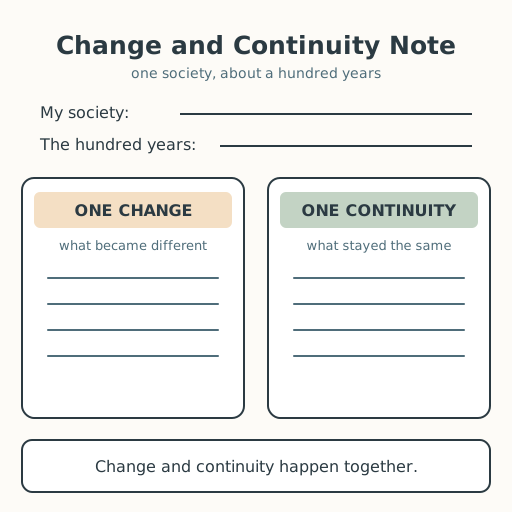
- Change-and-continuity note · 1 per learner A note page with two boxes — one change, one continuity — for the learner's chosen society
- Pencils · per learner
Low-tech / no-cost
- A read-aloud and retell The facilitator tells the three societies' hundred-year stories aloud; learners retell one and name one change and one continuity, voice only
- Hand-drawn two-box note Learners draw two boxes in a notebook or in the dirt and write (or speak) one change and one continuity for one society
Enriched / lab & device
- A device with images · 1 per pair Photographs (Edo prints, Ming maps, Māori carvings) viewed and discussed with the change/continuity frame
- A world map · 1 A map to place Aotearoa, Japan, and China so learners see where each hundred-year story happened
Works in different contexts
- large-group Read one society card together and chart it, then have pairs choose another and write their own note, sharing one finding each
- multi-age Younger learners pick a society and name one change while older learners write the full change-and-continuity note and lead the comparison
- self-directed A learner reads the three cards, chooses one society, and completes the change-and-continuity note alone
- level-grouped Learners ready to extend compare two societies — one change and one continuity in each — and note any similarity between them
- outdoor-only Walk your own place and record (by memory or in the dirt) one change and one continuity from living memory; no cards needed
Materials
Lesson 4 — Finding Change and Continuity in Another Society
Summary
Learners apply change and continuity to a second society, choosing among three cards — Māori settlement in Aotearoa, the first century of Japan’s Edo period, and Ming China — and record one change and one continuity in a note. This becomes the unit’s hundred-year change-and-continuity portfolio artifact.
Objectives
- Describe change and continuity over a period of about a hundred years in one society, giving an example of each. (D08.S1.06.02)
Connection
You practiced change and continuity on one society — the Songhai and Timbuktu. Now you do it on a society you choose, the way a historian picks a place and asks: over this hundred years, what became different, and what stayed the same? It is the same skill you use when you notice that your own street has a new shop (change) but the same corner tree (continuity) — turned toward the past.
Materials
- Society cards (Māori settlement, Edo Japan, Ming China)
- Change-and-continuity note
- Pencils
Preparation
- Copy the three society cards and a note for each learner.
- Review the card facts so you can retell them aloud.
- Arrange a circle for retrieval and a flat space for writing.
Facilitator note
This lesson is written to the learner (“you”). This is the application and retrieval
step of the change-and-continuity skill: learners recall the Songhai example, then apply
the frame to a society of their own choosing. The three cards are deliberately from three
regions — Oceania (Aotearoa), East Asia (Japan and China) — and each centers the society’s
own life, not outside conquest. For each society, change and continuity are both present; a
learner’s job is to find one of each with reasons. This lesson produces the unit’s
change-and-continuity note portfolio artifact. See docs/facilitation.md.
Procedure
- Gather and recall (5 min). Without looking at your notes, tell a partner one example of change and one of continuity from the Songhai hundred years. This is retrieval — pulling it from memory.
- Meet the three societies (10 min). Read the three cards. Māori settlement in Aotearoa (about 1300–1500): ancestors of the Māori voyaged across the Pacific and settled Aotearoa (New Zealand); they adapted crops and life to a colder land, while whakapapa (genealogy) and oral tradition carried their history forward. Edo Japan (1600–1700): after long wars, peace arrived; cities like Edo grew and new roads connected the land, while rice farming and family and community life stayed steady. Ming China (about 1368–1500): a new dynasty rebuilt the land, printed books, and sent fleets across the Indian Ocean, while farming, family, and classical learning continued.
- Choose and record (20 min). Pick one society. On your note, write the society and the hundred years, then fill two boxes: one change (what became different) and one continuity (what stayed the same) — each with a reason.
- Share and check (10 min). With a partner, read your note. Does your partner agree that your change is a real change and your continuity a real continuity for that society?
- Close (5 min). You can now hold two truths at once about any place: it changes, and it carries on. Keep this note — it joins your portfolio.
Differentiation
- Support: Use one society card with sentence starters (“One thing that changed was…; one thing that stayed the same was…”) and scribe where needed.
- Extension: Choose a second society and write one change and one continuity for it too, then name one similarity between the two societies’ stories.
Assessment
- Formative (portfolio/observation): Can the learner name one change and one continuity for a chosen society, with a reason for each?
- Self-check: The learner asks, “Is my change really a change, and my continuity really a continuity — and can I explain why?”
Home connection
Tell someone at home the hundred-year story of the society you chose — one change and one continuity — and ask what changed and what stayed the same in your own family over a similar span.
Resources
- Māori settlement of Aotearoa and the centrality of whakapapa are documented in Māori oral tradition and in New Zealand’s national collections (see Te Ara — the Encyclopedia of New Zealand, https://teara.govt.nz/). The Edo period of Japan (1603–1868), including the growth of Edo and early Tokugawa peace, is standard in Japanese history (see the Tokyo National Museum, https://www.tnm.jp/). The Ming dynasty (1368–1644), including the Zheng He voyages and printing, is standard in Chinese history (see the Palace Museum collections, https://en.dpm.org.cn/). Dates are approximations that scholars revise as new evidence appears; the change-and-continuity idea, not the exact year, is what matters here.