Lesson 11 — A Movement for Freedom: The People of India
Learners study a movement for freedom — the Indian independence movement — as a mass movement of ordinary people: women, workers, students, and peasants who marched, boycotted, spun their own cloth, and refused unjust rule with dignity until India became free in 1947. A second card (Ghana's independence movement) offers comparison. The people are centered as authors of their own freedom, never as victims.
Objectives
Objectives
- D08.S4.06.02 Describe a movement for rights or freedom, such as a struggle against colonial rule or for equal treatment, and what its people did.
Essential question
What did a movement for freedom do — and how did ordinary people, acting together, win rights and dignity?
Key vocabulary
Materials
Standard materials
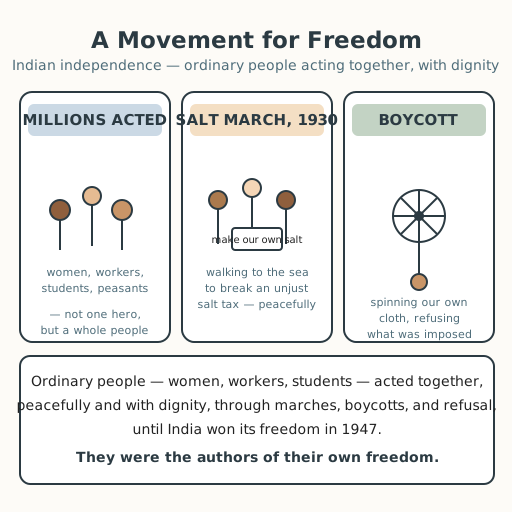
- Freedom-movement poster · 1 A three-panel poster of the Indian independence movement — millions acted, the 1930 Salt March, and the boycott (spinning one's own cloth) — told through the people's own courage and agency
- Movement story cards · 1 set of 2 Two one-page cards — the Indian independence movement (1920s–1947) and Ghana's independence movement (1947–1957) — each naming the injustice, what the people did, and the outcome
- Rights-movement note · 1 per learner A note page with three prompts (what was the injustice, what the people did, what they won)
Low-tech / no-cost
- A read-aloud and retell The facilitator tells the movement stories aloud; learners retell one and say what the people did and what they won, voice only
- A 'standing together' circle In a circle, each learner names one thing people can do together to win rights and dignity, passing a stone or shell
Enriched / lab & device
- A device with respectful images · 1 per pair Photographs of the Salt March and of Ghana's independence celebrations, discussed with the injustice–action–outcome prompts
- A world map · 1 A map to place India and Ghana and see the wider wave of independence movements across the world
Works in different contexts
- large-group Read one movement together and chart it, then have pairs work through the other and share one action each
- multi-age Younger learners retell one movement while older learners write the injustice, action, and outcome and lead the discussion
- self-directed A learner reads the two cards, fills the rights-movement note for one, and writes one sentence about the people's courage and agency
- level-grouped Learners ready to extend compare the two movements — the injustice, the actions, and how ordinary people acted in each
- outdoor-only Act out a peaceful march together, then name a real movement for rights and one thing its people did; no paper needed
Lesson 11 — A Movement for Freedom: The People of India
Summary
Learners study a movement for freedom — the Indian independence movement — as a mass movement of ordinary people: women, workers, students, and peasants who marched, boycotted, spun their own cloth, and refused unjust rule with dignity until India became free in 1947. A second card (Ghana’s independence movement) offers comparison. The people are centered as authors of their own freedom, never as victims.
Objectives
- Describe a movement for rights or freedom, such as a struggle against colonial rule or for equal treatment, and what its people did. (D08.S4.06.02)
Connection
Think of a time people around you changed something unfair — not by force, but by acting together, refusing to go along, and holding to their dignity. That is what a movement for freedom is: ordinary people, many of them, deciding that an unjust rule will no longer stand. Today you meet one of the great such movements, told through the courage of the people who made it.
Materials
- Freedom-movement poster
- Movement story cards (India, Ghana)
- Rights-movement note
Preparation
- Print or draw the freedom-movement poster.
- Copy the two story cards and a note for each learner.
- Review the note below on holding difficult topics with dignity and hope.
Facilitator note
This lesson is written to the learner (“you”). This is a difficult topic, held with
dignity and hope — never victimhood. Center the people as the heroes of their own story:
name the injustice (colonial rule, which denied self-rule and dignity) briefly and
factually, and spend most of the time on what the people did and what they won.
Emphasize that the Indian independence movement was a mass movement of millions — women,
workers, students, peasants, and leaders from many regions and faiths — not the act of one
person; a single famous name (Mohandas Gandhi) is honored but never treated as the whole
story. Offer Ghana’s independence as a comparison that shows the same courage on another
continent. Connect difficulty to hope and to something the learner can do. This lesson
produces the unit’s rights-movement note portfolio artifact. See docs/facilitation.md.
Procedure
- Gather (5 min). You have seen what power is and when it is used unfairly. Today you meet the answer people have always found to unfair power: a movement — ordinary people acting together for rights and dignity.
- Meet the Indian independence movement (20 min). Read the card. Under colonial rule, India’s people did not govern themselves; they were ruled by Britain, and many were treated unjustly. Over decades, millions of ordinary people — women, workers, students, and peasants, led by many, including Mohandas Gandhi — acted peacefully: in the Salt March of 1930, people walked to the sea to make their own salt, refusing an unjust tax; they boycotted foreign cloth and spun their own; they refused to cooperate with unjust laws, and they helped one another throughout. In 1947, after decades of this courage, India won its independence.
- Meet Ghana’s movement (10 min). Read the second card. In Ghana (West Africa), people organized through the Convention People’s Party, with boycotts and peaceful strikes — “positive action” — until, in 1957, Ghana became the first sub-Saharan African colony to win independence, and many African nations soon followed.
- Record one movement (10 min). Choose one. On your note, write: What was the injustice? What did the people do? What did they win? Center the people’s actions and courage.
- Share and check (5 min). With a partner, read your note. Did you both center what the people did, not only what was done to them?
- Close (5 min). Freedom is not given; it is won, by ordinary people acting together with dignity. That is one of the deepest truths of the human story.
Differentiation
- Support: Use one movement at a time with a fill-in note and picture prompts; scribe the learner’s words and keep the tone calm and hopeful.
- Extension: Compare the two movements — the injustice, the actions, and how ordinary people acted in each — and name one thing they share.
Assessment
- Formative (portfolio/observation): Can the learner name the injustice, what the people did, and what they won, in one movement — framing the people with dignity and agency?
- Self-check: The learner asks, “Did I center the people’s actions and courage, not only the injustice — and did I hold the story with respect?”
Home connection
Ask someone at home about a movement for rights or freedom they know of — near or far — and what its people did to win it.
Resources
- The Indian independence movement, including the 1930 Salt March and the boycotts and noncooperation that led to independence in 1947, is documented in Indian history and scholarship and in the Nobel Prize site (https://www.nobelprize.org/). It is told here as a mass movement of millions, not the act of one person. Ghana’s independence movement, led by the Convention People’s Party under Kwame Nkrumah, winning independence in 1957, is documented in Ghanaian and African history. These are told as stories of dignity, agency, and collective action, in line with the curriculum’s commitment to center liberation, not victimhood.