Lesson 10 — Power Used Fairly or Unfairly
Learners apply the idea of power to the question of fairness: how power can be used fairly (all voices heard, serving all) or unfairly (one decides, some silenced, serving the few). A three-question fairness test — does it serve everyone? who speaks? can it be challenged? — helps them judge scenarios, while they learn that "fair" is a value judgment as well as a description.
Objectives
Objectives
- D08.S4.06.01 Explain what power is, who holds it in a community or society, and how it can be used fairly or unfairly.
Essential question
How can power be used fairly or unfairly — and how can we tell the difference?
Key vocabulary
Materials
Standard materials
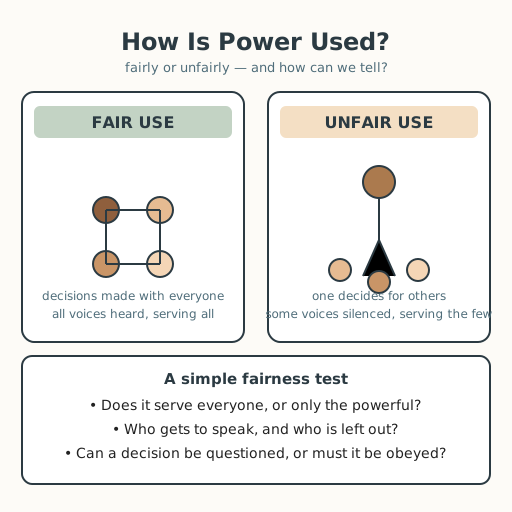
- Fair-and-unfair poster · 1 A two-panel poster contrasting fair use (all voices heard, serving all) with unfair use (one decides, some silenced, serving the few), plus a three-question fairness test
- Fair-or-unfair cards · 1 set of 6 Six short scenarios about the use of power — three fair, three unfair — for learners to judge with the fairness test
- Fairness-test note · 1 per learner A note page with the three questions to apply to one scenario and record a judgment with reasons
Low-tech / no-cost
- A read-aloud and circle The facilitator reads the scenarios aloud; learners judge each with the fairness test and say why, voice only
- A 'fair or unfair' circle In a circle, each learner names one real decision they saw and whether it passed the fairness test; no cards needed
Enriched / lab & device
- A device with short case images · 1 per pair Images of consensus councils and of one-sided rule, discussed with the fairness-test questions
- A world map · 1 A map to place fair and unfair examples of power across societies
Works in different contexts
- large-group Judge the six scenarios together with the fairness test on the board, then have pairs apply the test to one scenario and write a reason
- multi-age Younger learners sort cards into fair and unfair piles while older learners explain their reasons and write the note
- self-directed A learner reads the worked example, judges the six scenarios, and fills the fairness-test note for one
- level-grouped Learners ready to extend debate a close case — a decision that serves many but silences a few — and weigh what fairness requires
- outdoor-only Stand in a circle (fair) and then have one person direct everyone else (unfair), then name the difference with the fairness test
Lesson 10 — Power Used Fairly or Unfairly
Summary
Learners apply the idea of power to the question of fairness: how power can be used fairly (all voices heard, serving all) or unfairly (one decides, some silenced, serving the few). A three-question fairness test — does it serve everyone? who speaks? can it be challenged? — helps them judge scenarios, while they learn that “fair” is a value judgment as well as a description.
Objectives
- Explain what power is, who holds it in a community or society, and how it can be used fairly or unfairly. (D08.S4.06.01)
Connection
Think of a rule you once thought was unfair — and one you thought was fair. What made the difference? Maybe: everyone had a say (fair) or one person decided for everyone (unfair); it helped everyone (fair) or helped only a few (unfair). People have asked this question in every society. Today you learn a simple fairness test to tell the difference, and you practice it — while remembering that what is fair is also something people must decide together, not just measure.
Materials
- Fair-and-unfair poster
- Fair-or-unfair cards (six scenarios)
- Fairness-test note
Preparation
- Print or draw the fair-and-unfair poster.
- Copy the six scenario cards and a note for each learner.
- Arrange a circle for discussion and a flat space for writing.
Facilitator note
This lesson is written to the learner (“you”). The skill to build is reasoning about
fairness with a simple, shared test — while distinguishing evidence from values. The test
(does it serve everyone? who speaks? can it be challenged?) is a tool for judgment, not a
rule that decides everything; help learners see that “fair” and “unfair” are partly values
people hold, not only facts to measure. Use examples from many societies and from the
learner’s own life. Guard against reducing fairness to “majority rule”: a majority can still
treat a minority unfairly. This lesson prepares the next, on a movement for rights. See
docs/facilitation.md.
Procedure
- Gather (5 min). Last lesson you learned what power is. Today you ask the harder question: is this power being used fairly or unfairly?
- Meet the fairness test (10 min). Read the poster. Fair use of power: decisions are made with everyone, all voices are heard, and the power serves all. Unfair use: one person or group decides for others, some voices are silenced, and the power serves the few. The test has three questions: Does it serve everyone, or only the powerful? Who gets to speak, and who is left out? Can a decision be questioned, or must it be obeyed?
- Worked example: judge one scenario (10 min). A village assembly where everyone may speak, and a decision is reached only when all agree — that is fair use. A ruler who taxes the poor heavily while the rich pay little, and who allows no one to object — that is unfair use. Apply the three questions to each and say why.
- Judge the scenarios (15 min). Take the six cards. For each, run the fairness test and sort it as fair or unfair — and be ready to say which question tipped your judgment.
- Record your reasoning (5 min). On your note, write one scenario, your judgment (fair or unfair), and the reason, using the test.
- Close (5 min). Power itself is neither good nor bad — but how it is used can be fair or unfair. And when it is unfair, people have always found the courage to say so. That is the next chapter.
Differentiation
- Support: Use two clear scenarios with picture prompts; scribe the learner’s note and read the test aloud slowly.
- Extension: Debate a close case — a decision that serves many but silences a few — and weigh what fairness would require.
Assessment
- Formative (observation): Can the learner apply the fairness test to a scenario and give a reason for judging it fair or unfair?
- Self-check: The learner asks, “Did I use the test — serving whom, who speaks, can it be questioned — and can I explain my judgment?”
Home connection
With someone at home, take one household or community rule and run the fairness test on it together, then talk about whether it passes.
Resources
- The Haudenosaunee (Iroquois) Confederacy’s consensus decision-making is documented in
Haudenosaunee oral tradition and in scholarship (see the Smithsonian’s National Museum of
the American Indian, https://americanindian.si.edu/). West African village assemblies
with open discussion are documented in scholarship (see, for example, the work of
historians on Igbo and other societies). The fairness test is offered as a reasoning tool,
not a universal rule; the curriculum teaches learners to distinguish evidence from values
and to decide “fair” together, in line with
docs/philosophy.md§5.