Lesson 05 — When Systems Leave People Out — Without Anyone Meaning To
Learners explain **how rules, laws, and systems can treat some groups unfairly even when no one person intends harm**. They trace a rule step by step to see *who is left out*, then trace system example cards and suggest one small change.
Objectives
Objectives
- D09.S2.06.02 Explain how rules, laws, or systems can treat some groups unfairly even when no one person intends harm.
Essential question
How can a rule, law, or system treat some groups unfairly even when no one intends harm?
Key vocabulary
Materials
Standard materials
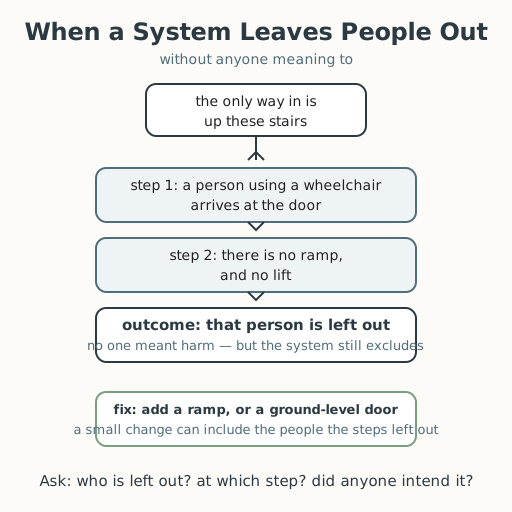
- System-flow poster · 1 A diagram of one rule flowing through several steps to an outcome, with a 'who is left out?' box at the end and 'no one intended this' underneath
- System example cards · 1 set per group Everyday and real rules/systems to trace — a staircase-only entrance, a sign in only one language, a rule that schedules meetings when some people work or pray, a test in only one format — each with 'who is left out?' question
- Trace-a-system page · 1 per learner A page to trace one rule from step to outcome, name who is left out, and suggest one small change
Low-tech / no-cost
- A spoken walk-through Walk a rule aloud step by step while learners stand as each step, and one learner steps aside when the rule leaves them out
- Three-question tracing For each spoken rule ask three questions aloud — who is affected? who is left out? did anyone intend that? — with no paper needed
Enriched / lab & device
- A short reading or picture set on a real system · 1 A brief age-appropriate account of a real rule or system (a school gate, a form, a schedule) that left some people out without intent, traced as a group
- A class systems wall · 1 A shared display where learners post the systems they traced and the small change they suggested
Works in different contexts
- large-group Trace one system together on the poster, then have groups trace a card and share 'who is left out' in one sentence
- multi-age Younger learners point to who is left out; older learners trace the step where the rule excludes them and suggest a change
- self-directed A learner traces a system card alone, names who is left out and which step does it, and suggests one small change
- level-grouped Learners ready to extend compare two systems and say which leaves more people out and how they can tell
- outdoor-only Use a real or drawn path with a 'step' marked on it; learners walk the rule's steps and one steps aside where the rule excludes them
Lesson 5 — When Systems Leave People Out — Without Anyone Meaning To
Summary
Learners explain how rules, laws, and systems can treat some groups unfairly even when no one person intends harm. They trace a rule step by step to see who is left out and which step does it, then trace system example cards and suggest one small change.
Objectives
- Explain how rules, laws, or systems can treat some groups unfairly even when no one person intends harm. (D09.S2.06.02)
Connection
A building’s only entrance is a staircase. Nobody built it wanting to shut anyone out — but a person who uses a wheelchair, or a parent pushing a cart, cannot get in. The harm is real even though the intent was absent. Rules and systems do this quietly: a sign in only one language, a meeting scheduled when some people work or pray, a test offered in only one format. The unfairness is built into the steps, not into anyone’s heart — and that is why we have to look at the steps.
Materials
- System-flow poster
- System example cards
- Trace-a-system page
Preparation
- Print or draw the system-flow poster (one rule → several steps → an outcome, with a “who is left out?” box and “no one intended this” underneath).
- Copy system example cards for each group and a trace-a-system page for each learner.
- Prepare one real system example (a staircase, a one-language sign, a schedule) to trace together.
Facilitator note
This lesson is written to the learner (“you”). The idea to land: a rule, law, or system
can treat some groups unfairly even when no one person intends harm — the unfairness
lives in the steps of the system, not (necessarily) in anyone’s intention. Teach the
tracing routine — who is affected? who is left out? at which step? did anyone intend
it? — as a worked example (Kirschner, Sweller & Clark, 2006). Keep it non-shaming and
precise: the point is not to blame designers (often there is no single villain), but
to see that outcomes can be unfair even when intentions are not. That is why the
egalitarian question “who is left out?” matters — we must ask it, because the system will
not tell us by itself. Distinguish evidence from values: that a rule leaves some
people out, and at which step is observable; that leaving people out is wrong and
should be fixed is a value held by this curriculum and its learners. Carry the
technology & environment lens honestly: systems include built things (a staircase,
a door, a screen, a form), and design choices — physical or digital — can include or
exclude; a small change (a ramp, a translation, a different time, a spoken option) often
repairs a lot. Attach every example to hope: unfair systems can be, and are, changed.
See docs/facilitation.md.
Procedure
- Gather (5 min). You can now tell fairness from justice. Today a harder, quieter problem: unfairness that no one meant. Try to recall: what does “unfair” usually make you picture — a person doing something mean? (Pause.) Sometimes no one is mean, and it is still unfair.
- Meet the idea (10 min). Look at the poster. A system is a set of steps, rules, or built things that people move through — an entrance, a sign, a schedule, a test. A rule can treat some groups unfairly even when no one person intends harm, because the unfairness lives in the steps. To see it, you trace: who is affected? who is left out? at which step? did anyone intend it?
- Worked example (10 min). Trace one together. Rule: “The only way in is up these stairs.” Step 1: a person using a wheelchair arrives. Step 2: there is no ramp or lift. Outcome: that person is left out. Did anyone intend harm? No — but the system still excludes. Then name the small fix: add a ramp, or a ground-level door.
- Practice with a partner (10 min). Take a system example card — a sign in one language, a meeting time, a test in one format. Trace it: who is affected? who is left out? at which step? did anyone intend it? Then suggest one small change that would include them.
- Record your own (10 min). On your page, trace one system you have seen or heard of, name who is left out and which step does it, and write one small change. No blame — just clear seeing.
Differentiation
- Support: Provide a card with the steps already listed; the learner marks the step where people are left out and picks a fix from two options.
- Extension: Compare two systems and explain which leaves more people out, and how you can tell — then propose a change for each.
Assessment
- Formative (observation): Can the learner trace a rule and name who is left out and which step does it, without needing a villain?
- Peer check: Partners check each other: “Did you find the step that excludes people — not just say ‘that is unfair’?”
Home connection
Notice one rule or built thing near home (a step, a sign, a time, a form) and ask who it might leave out — then imagine one small change.
Resources
- On removing barriers so everyone can take part (inclusive design): UNICEF inclusive education framing, https://www.unicef.org/education/inclusive-education
- On tracing a system’s steps before judging it: critical-thinking and social-awareness framing in CASEL, https://casel.org/fundamentals-of-sel/
- On modeling a tracing routine before independent practice: Kirschner, Sweller & Clark (2006), https://doi.org/10.1207/s15326985ep4102_1