Lesson 04 — Fairness vs. Justice
Learners learn to **distinguish fairness from justice**: fairness is about *what people deserve* (a fair share, a fair turn), while justice is about *correcting wrongs and protecting rights*. They sort a worked example, then example cards, and record one of each from their own life.
Objectives
Objectives
- D09.S2.06.01 Distinguish between fairness (what people deserve) and justice (correcting wrongs and protecting rights), using examples.
Essential question
How are fairness and justice different — and how do I tell them apart with examples?
Key vocabulary
Materials
Standard materials
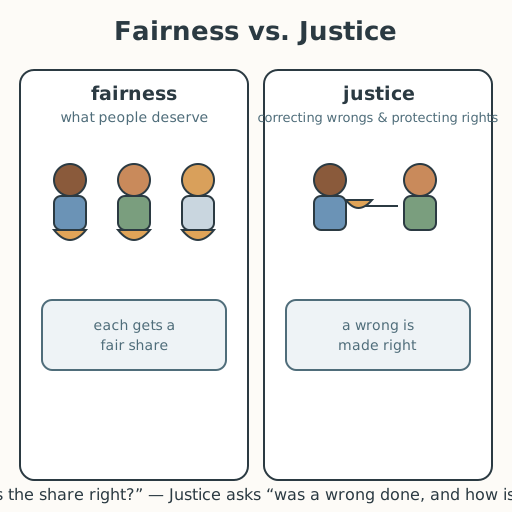
- Fairness-vs-justice poster · 1 A two-column poster — fairness ('what people deserve') vs justice ('correcting wrongs + protecting rights') — each with a simple icon and an example
- Example cards · 1 set per pair Scenarios to sort: a fair share of a harvest; returning a stolen item and repairing the harm; a rule that gives everyone a turn; a wrong that must be corrected
- Comparison page · 1 per learner A two-column page to record a fairness example and a justice example in the learner's own words
Low-tech / no-cost
- Two columns in the dirt Draw two columns — 'deserve' and 'correct a wrong / protect rights' — and place a stone for each spoken example in the matching column
- Acted examples Act out a fair share and a wrong being corrected; the group names which is fairness and which is justice
Enriched / lab & device
- A short historical or news reading · 1 A brief age-appropriate account (text or pictures) where a wrong is corrected and rights are protected, analyzed with the fairness-vs-justice lens
- A class fairness-and-justice gallery · 1 A shared display where learners post their examples and read each other's, noticing where fairness and justice overlap and differ
Works in different contexts
- large-group Sort one example together on the poster, then have pairs sort a card and share 'fairness or justice, and why' in one sentence
- multi-age Younger learners say 'fair share' or 'fixing a wrong'; older learners name the two parts of justice and give a fresh example of each
- self-directed A learner reads the poster, sorts the cards alone, and writes one fairness example and one justice example from their own life
- level-grouped Learners ready to extend find an example that is *both* fairness and justice and explain how the two overlap and where they differ
- outdoor-only Use two marked areas as 'fairness' and 'justice'; for each spoken example, learners stand in the matching area and say why
Lesson 4 — Fairness vs. Justice
Summary
Learners learn to distinguish fairness from justice: fairness is about what people deserve (a fair share, a fair turn, fair treatment), while justice is about correcting wrongs and protecting rights. They sort a worked example, then example cards, and record one of each from their own life.
Objectives
- Distinguish between fairness (what people deserve) and justice (correcting wrongs and protecting rights), using examples. (D09.S2.06.01)
Connection
Two different moments. In one, a harvest is shared so each family gets a fair portion — that is fairness: everyone gets what they deserve. In the other, something was stolen, and it is returned, and the harm is repaired, and a rule is put in place so it does not happen again — that is justice: correcting a wrong and protecting rights. Fairness is about the share; justice is about the wrong. They are cousins, not twins — and telling them apart is how we see both clearly.
Materials
- Fairness-vs-justice poster
- Example cards
- Comparison page
Preparation
- Print or draw the fairness-vs-justice poster (two columns, each with a simple icon and an example).
- Copy example cards for each pair and a comparison page for each learner.
- Prepare one spoken example of each (fairness and justice) for the opening.
Facilitator note
This lesson is written to the learner (“you”). The distinction to land: fairness is
about what people deserve — a fair share, a fair turn, fair treatment; justice is
about correcting wrongs and protecting rights — responding when harm has happened, and
guarding what people are owed. They overlap (a fair share is part of justice) but they
are not the same, and the standard asks learners to tell them apart with examples. Model
the sort as a worked example (Kirschner, Sweller & Clark, 2006). Keep it non-shaming:
examples of correcting wrongs are about repair, not blame. Distinguish evidence from
values: what happened and what was deserved or corrected are observable; that people
should get a fair share and that wrongs should be made right are values held by this
curriculum and by the children it serves — name them as values. Hold the question open,
and attach any example of wrong to hope: wrongs can be, and are, corrected. See
docs/facilitation.md.
Procedure
- Gather (5 min). You have weighed dilemmas and their consequences. Now two words people often use as if they were one: fairness and justice. Try to recall: what do you already think each one means? (Pause.) They are close — but different.
- Meet the distinction (10 min). Look at the poster. Fairness is about what people deserve: a fair share, a fair turn, fair treatment. Justice is about correcting wrongs and protecting rights: when harm has happened, justice responds — returns what was taken, repairs the harm, and guards what people are owed so it does not happen again. Fairness asks “is the share right?” Justice asks “was a wrong done, and how is it made right?”
- Worked example (10 min). Build the sort together. Example: “A shared harvest is divided so each family gets an equal portion.” Fairness or justice? (Fairness — a fair share.) Example: “Someone’s goat was taken; it is returned, the harm is repaired, and a rule is set so it cannot happen again.” Fairness or justice? (Justice — correcting a wrong and protecting rights.) Say why each belongs where it does.
- Practice with a partner (10 min). Take example cards. Sort each into fairness or justice, and for each say why: “This is ___ because ___.” If one is both, say how the two overlap in it.
- Record your own (10 min). On your page, write one real or invented fairness example (what someone deserved) and one justice example (a wrong corrected and a right protected), in your own words.
Differentiation
- Support: Provide a card with one column already filled and a sentence starter (“Fairness is when ___; justice is when ___”).
- Extension: Find an example that is both fairness and justice and explain in one sentence where the two overlap and where they differ.
Assessment
- Formative (observation): Can the learner state, for a given example, whether it is fairness or justice, and say why using “deserve” or “correct a wrong / protect rights”?
- Self-check: The learner asks, “Is my fairness example about what someone deserved, and is my justice example about a wrong corrected and a right protected?”
Home connection
Think of one moment at home or nearby that was fairness (a fair share) and one that was justice (a wrong made right), and tell someone the difference.
Resources
- Fairness and rights framing: CASEL social-awareness and responsible decision-making, https://casel.org/fundamentals-of-sel/
- Children’s rights, which justice protects, are set out in the UN Convention on the Rights of the Child: https://www.unicef.org/child-rights-convention
- On modeling a sort before independent practice: Kirschner, Sweller & Clark (2006), https://doi.org/10.1207/s15326985ep4102_1