Lesson 07 — Ordinary People, Changing What Was Unfair
Learners describe **how ordinary people have worked together to change something unfair**, using a historical or local example. They learn a four-part frame — the unfair thing, the ordinary people, the action together, the change — trace a worked example (the Green Belt Movement), then trace change-story cards and record one story.
Objectives
Objectives
- D09.S3.06.02 Describe how ordinary people have worked together to change something unfair, using a historical or local example.
Essential question
How have ordinary people worked together to change something unfair?
Key vocabulary
Materials
Standard materials
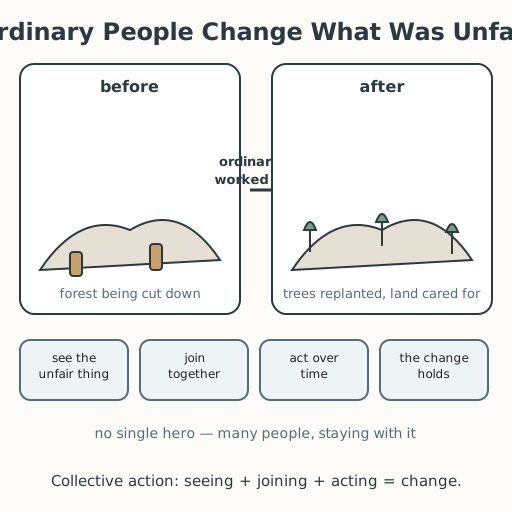
- Before-and-after change poster · 1 A two-panel diagram — 'before' (something unfair) and 'after' (it changed) — with the steps ordinary people took in between
- Change-story cards · 1 set per group Age-appropriate true accounts of ordinary people changing something unfair (the Green Belt Movement planting trees against deforestation; neighbors winning a shared well; students getting a dangerous crossing fixed) with 'who acted?' and 'what changed?' prompts
- Change-story page · 1 per learner A page to record one change story: the unfair thing, the ordinary people, what they did together, and what changed
Low-tech / no-cost
- A told change story Tell one true story aloud — the unfair thing, the ordinary people, the action, the change — and have learners retell the four parts
- Acted before-and-after Act out the unfair situation and then the changed one; the group names what the ordinary people did in between
Enriched / lab & device
- A short documentary clip or reading · 1 A brief age-appropriate account of a real collective-action story, analyzed with the four-part frame
- A class change-story gallery · 1 A shared display where learners post the stories they traced and read each other's, noticing what made each change happen
Works in different contexts
- large-group Trace one change story together on the poster, then have groups work a card and share 'the ordinary people and what changed' in one sentence
- multi-age Younger learners name the unfair thing and what changed; older learners name the steps ordinary people took together
- self-directed A learner reads a change-story card, fills the four-part page, and researches or recalls one local change story to add
- level-grouped Learners ready to extend compare two change stories and explain what made one succeed where the other struggled
- outdoor-only Walk a 'before' spot to an 'after' spot, naming at each step what ordinary people did together to move the change along
Lesson 7 — Ordinary People, Changing What Was Unfair
Summary
Learners describe how ordinary people have worked together to change something unfair, using a historical or local example. They learn a four-part frame — the unfair thing, the ordinary people, the action together, the change — trace a worked example (the Green Belt Movement), then trace change-story cards and record one story of their own.
Objectives
- Describe how ordinary people have worked together to change something unfair, using a historical or local example. (D09.S3.06.02)
Connection
No hero with a cape — just neighbors, or students, or farmers, deciding together that something unfair would not stay. A hillside being stripped of its trees; a road with no safe place to cross; a village with no clean well. Ordinary people see it, join together, and keep acting until it changes. That is collective action — and it has moved more of the world than any single ruler ever did.
Materials
- Before-and-after change poster
- Change-story cards
- Change-story page
Preparation
- Print or draw the before-and-after change poster (two panels + the steps between).
- Copy change-story cards for each group and a change-story page for each learner.
- Prepare one told change story (the Green Belt Movement, or a local example) for the opening.
Facilitator note
This lesson is written to the learner (“you”). The idea to land: ordinary people,
working together, can change something unfair — and history is full of it. Teach the
four-part frame — the unfair thing / the ordinary people / what they did together / what
changed — as a worked example (Kirschner, Sweller & Clark, 2006). Use true,
age-appropriate, non-shaming examples: the Green Belt Movement (founded 1977 by Wangari
Maathai with other women in Kenya, planting trees against deforestation — later spreading
to other African countries and planting over thirty million trees; she won the 2004 Nobel
Peace Prize); or a local story your learners know (a crossing fixed, a well won, a space
reclaimed). The point is how ordinary people do it, not hero-worship — name the many,
not one name. Attach hope, not despair: unfair things are changed. Distinguish
evidence from values: what happened, who acted, and what changed are facts we can
check; that people should act together against unfairness is a value this curriculum
holds and offers to learners as a value, not a command. Carry the environment lens
honestly: some of the most famous collective actions protect the shared environment —
trees, water, land — because the environment is part of the common good. See
docs/facilitation.md.
Procedure
- Gather (5 min). You have compared ways of deciding. Now: who actually changes things when they are unfair? Try to recall one time you saw a group of people change something together. (Pause.) Today you learn the pattern.
- Meet the four-part frame (10 min). Look at the poster. Every change story has four parts: the unfair thing (what was wrong), the ordinary people (no single hero — many), what they did together (organize, act, keep at it), and what changed. Ordinary people change unfair things by joining together and staying with it.
- Worked example (10 min). Trace one together. The unfair thing: a hillside being stripped of trees. The ordinary people: farmers and neighbors — mostly women. What they did together: in 1977, Wangari Maathai and others started the Green Belt Movement, planting trees together; it spread to other African countries and planted over thirty million trees. What changed: the land was re-greened, and the movement grew far beyond one hillside. (Maathai later won the 2004 Nobel Peace Prize.) Notice: ordinary people, acting together, over time.
- Practice with a partner (10 min). Take a change-story card. Fill the four parts: the unfair thing, the ordinary people, what they did together, and what changed. Say it aloud in one sentence each.
- Record your own (10 min). On your page, write one change story you know — from a card, from near home, or from a place you have heard of — using all four parts. This page is a portfolio piece for the unit.
Differentiation
- Support: Provide a card with two of the four parts filled in; the learner completes the others with a sentence starter (“The ordinary people were ___; what changed was ___”).
- Extension: Compare two change stories and explain what made one succeed where the other struggled (numbers, allies, persistence, timing).
Assessment
- Formative (observation): Can the learner name all four parts of a change story — the unfair thing, the ordinary people, the action together, and the change?
- Portfolio: The change-story page, kept as the unit’s collective-action artifact.
Home connection
Ask someone at home about a time ordinary people (not rulers) changed something unfair — nearby or in history — and name the four parts together.
Resources
- Green Belt Movement facts (founded 1977; over thirty million trees; 2004 Nobel Peace Prize): Nobel Prize — Wangari Maathai, https://www.nobelprize.org/prizes/peace/2004/maathai/facts/
- On modeling an analysis frame before independent practice: Kirschner, Sweller & Clark (2006), https://doi.org/10.1207/s15326985ep4102_1