Lesson 08 — Seeing Both Sides of a Conflict
Learners practice **analyzing a conflict to identify each side's needs and feelings**. They learn to ask, for each side, *what does this side feel?* and *what does this side need?* — on a worked example, then conflict cards in pairs, and record a two-sides analysis. Proposing a fair resolution follows in the next lesson.
Objectives
Objectives
- D09.S4.06.01 Analyze a conflict to identify each side's needs and feelings, and propose a fair resolution.
Essential question
How do I analyze a conflict to identify each side's needs and feelings?
Key vocabulary
Materials
Standard materials
- Two-sides poster · 1 A diagram with a conflict in the center and two panels, one per side, each with a 'feeling' and a 'need' line
- Conflict cards · 1 set per pair Realistic two-person or two-group conflicts (shared water, a public space used two ways, a borrowed item, two teams over one field) with a 'what does each side feel and need?' prompt
- Needs-and-feelings page · 1 per learner A page with two panels to record each side's feelings and needs for a given conflict
Low-tech / no-cost
- A spoken worked conflict Tell a conflict aloud; two learners stand as the sides and the group names each side's feeling and need
- A talking object Pass a stone or stick; the holder speaks for one side's feeling and need, then it passes to the other side
- A pointing round Hold up or lay out one feeling-word card and one need-word card per side; learners point to the card that matches each side — a seated, silent way to take part, no speech or standing needed
Enriched / lab & device
- A short film or scripted scene · 1 A brief scene of a conflict where each side's feelings and needs can be named, analyzed as a group
- A class conflict-analysis wall · 1 A shared display where learners post their two-sides analyses and read each other's, noticing shared needs across conflicts
Works in different contexts
- large-group Analyze one conflict together on the poster, then have pairs work a card and share 'each side's feeling and need' in one sentence
- multi-age Younger learners name the feelings; older learners name the needs underneath the feelings and how the two sides differ
- self-directed A learner reads the worked example, analyzes a conflict card alone, and fills both panels of the needs-and-feelings page
- level-grouped Learners ready to extend analyze a conflict where both sides' needs are partly legitimate and name what each side has in common
- outdoor-only Two learners stand as the two sides of a real or told conflict; the group names each side's feeling and need aloud, moving between them
Lesson 8 — Seeing Both Sides of a Conflict
Summary
Learners practice analyzing a conflict to identify each side’s needs and feelings. They learn to ask, for each side, what does this side feel? and what does this side need? — on a worked example, then conflict cards in pairs, and record a two-sides analysis. Proposing a fair resolution follows in the next lesson.
Objectives
- Analyze a conflict to identify each side’s needs and feelings. (D09.S4.06.01)
Connection
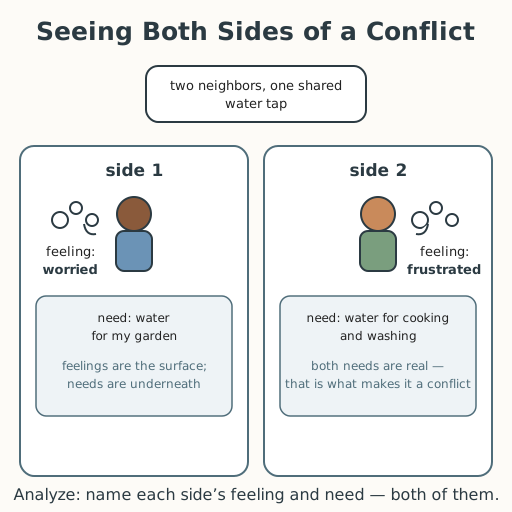
Two neighbors, one shared water tap, and not enough water for both on a dry day. One is worried about the garden; the other is frustrated about cooking and washing. A conflict is not one person right and the other wrong — it is two sets of feelings and needs bumping into each other. Before anyone can fix it, someone has to see both sides clearly. That seeing is what you will practice today.
Materials
- Two-sides poster
- Conflict cards
- Needs-and-feelings page
Preparation
- Print or draw the two-sides poster (conflict in the center, two side panels, each with a “feeling” and a “need” line).
- Copy conflict cards for each pair and a needs-and-feelings page for each learner.
- Prepare one told conflict for the opening.
Facilitator note
This lesson is written to the learner (“you”). The skill to land is a conflict-analysis
routine: for each side, name the feeling (what this side is experiencing) and the
need (what this side needs or cares about underneath the feeling). Model it once as a
worked example (Kirschner, Sweller & Clark, 2006). Keep it non-shaming and even-handed:
no side is “the bad one” — the analysis is about seeing, not judging, and both sides’
needs are usually partly legitimate. The egalitarian move is that every side gets
named, including the quieter or less powerful one — a conflict where one side’s voice is
missing cannot be analyzed fairly. Distinguish evidence from values: what each side
feels and needs is observable and inferable; that both sides’ needs deserve to be heard
is a value this curriculum holds and offers as such. Draw a clear safety boundary: if a
conflict involves harm, threat, or real danger, the first move is to bring in a trusted
adult — analysis and resolution of serious harm is not a child’s solo task. Resolution
comes next lesson; today is only seeing. See docs/facilitation.md.
Procedure
- Gather (5 min). You have studied fairness, justice, and change. Now a skill for real life: seeing a conflict from both sides. Try to recall a disagreement you saw — what did each side want? (Pause.) Today you practice naming it clearly.
- Meet the routine (10 min). Look at the poster. A conflict sits in the center. For each side, ask two questions: What does this side feel? (the emotion — worried, frustrated, hurt) and What does this side need? (the thing underneath — water, safety, a turn, to be heard). Feelings are the surface; needs are what is underneath. Analyzing means naming both, for both sides.
- Worked example (10 min). Analyze together. Conflict: “Two neighbors, one shared water tap.” Side 1: feeling — worried; need — water for the garden. Side 2: feeling — frustrated; need — water for cooking and washing. Name all four, and notice: both needs are real. That is what makes it a conflict, not a simple right-and-wrong.
- Practice with a partner (10 min). Take a conflict card. For each side, name the feeling and the need. Then say it aloud: “Side 1 feels ___ and needs ___; Side 2 feels ___ and needs ___.” Check each other: did you name both sides, not just the one you agree with?
- Record your own (10 min). On your page, fill both panels for a conflict you choose — each side’s feeling and need. Do not solve it yet; solving is the next lesson.
Differentiation
- Support: Provide a card with one side’s feeling and need filled in; the learner completes the other side, using a feeling word bank (worried, frustrated, hurt, left out) and a need word bank (safety, a turn, to be heard, fair share).
- Extension: Name what the two sides share (a need they have in common) — often the hidden bridge to a resolution.
Assessment
- Formative (observation): Can the learner name, for a given conflict, a feeling and a need for each side — not just one?
- Peer check: Partners check each other: “Did you name a feeling and a need for both sides?”
Home connection
Next time you see a disagreement at home or nearby, quietly name each side’s feeling and need before saying who is right.
Resources
- Restorative practice frames understanding conflict by naming needs and feelings: International Institute for Restorative Practices, https://www.iirp.edu/
- On modeling an analysis routine before independent practice: Kirschner, Sweller & Clark (2006), https://doi.org/10.1207/s15326985ep4102_1