Lesson 05 — Together and Fair: Carrying It Forward
Learners gather the year's work on cooperation, competition, and fairness into one closing commitment — cooperate when the goal is shared, compete only in fair play, and act so everyone has enough. They revisit why some have more than they need (systems and circumstances, never worth) and write a common-good commitment, then celebrate the whole year-end portfolio and look ahead to Grade 7.
Objectives
Objectives
- D02.S4.06.01 Compare cooperation and competition and explain when each helps or harms a group.
- D02.S4.06.02 Explain why some people have more than they need while others lack, in age-appropriate terms.
Essential question
How do cooperation, fair competition, and fairness help me act for the common good — and how will I carry it into Grade 7?
Key vocabulary
Materials
Standard materials
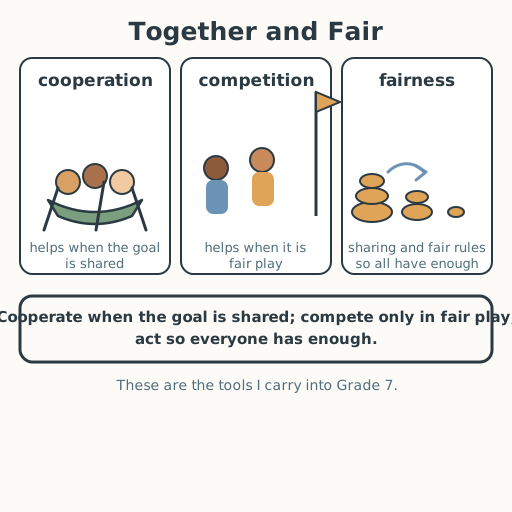
- Together and fair poster · 1 A poster of three panels — cooperation (figures rowing one boat), competition (a fair race), fairness (unequal piles being evened out) — with a banner of the three commitments
- My common-good commitment page · 1 per learner A page to write one act of cooperation, one commitment to fair play, and one fair action so more have enough
- Year-end portfolio folder or page · 1 per learner The gathered artifacts from Lessons 1–4, to celebrate as a whole
- Pencils and crayons · per learner
Low-tech / no-cost
- A spoken celebration circle Pass a token around and each learner names one commitment they will carry into Grade 7; no paper needed
- A real shared task and a fair sharing Carry something together (cooperation), run a fair race (competition), then share a small pile of found objects so all have enough (fairness); no paper needed
Enriched / lab & device
- A class celebration and gallery · 1 A closing celebration where the year-end portfolios are displayed and each learner shares one commitment
- A short clip or story of a community acting together · 1 A brief age-appropriate clip or story of people cooperating, playing fair, and sharing so all have enough, paused to name each mode
Works in different contexts
- large-group Model one commitment of each kind, then have learners write their own and share one in a closing circle
- multi-age Older learners model a commitment while younger learners name one way to cooperate, play fair, or share
- self-directed A learner writes their three commitments and a sentence about how they will carry the whole unit into Grade 7
- level-grouped Learners ready to extend connect cooperation, fair play, and fairness to one real situation and argue how the three work together for the common good
- outdoor-only Do a real shared task, a real fair race, and a real sharing of found objects, then name which mode each called for; no paper needed
Lesson 5 — Together and Fair: Carrying It Forward
Summary
Learners gather the year’s work on cooperation, competition, and fairness into one closing commitment — cooperate when the goal is shared, compete only in fair play, and act so everyone has enough. They revisit why some have more than they need (systems and circumstances, never worth) and write a common-good commitment, then celebrate the whole year-end portfolio and look ahead to Grade 7.
Objectives
- Compare cooperation and competition and explain when each helps or harms a group. (D02.S4.06.01)
- Explain why some people have more than they need while others lack, in age-appropriate terms. (D02.S4.06.02)
Connection
A crew rows one boat together — cooperation, because the goal is shared. Two runners race to one line — competition, fair and joyful, because the test is who is fastest. And down the street, one pantry overflows while another is nearly empty — a question of fairness, because the difference comes from systems and circumstances, never from anyone’s worth. These three are not separate subjects; they are three ways a person takes part in the world. The skill is choosing: cooperate when we need each other, compete only when it is fair play, and act so everyone has enough. That is the common good — and it is yours to carry into Grade 7, in a city, a village, a team, or a shared Earth.
Materials
- Together and fair poster
- My common-good commitment page
- Year-end portfolio folder or page
- Pencils and crayons
Preparation
- Print or draw the together-and-fair poster (three panels and a banner).
- Copy a common-good commitment page for each learner.
- Gather the learners’ year-end artifacts from Lessons 1–4 for the closing celebration.
Facilitator note
This is the unit’s closing capstone and celebration, written to the learner (“you”). It
retrieves cooperation-vs-competition and unequal-shares from Unit 3 (see L.06.003.09–10) and
gathers the whole year into one commitment — a spiral, not a repeat. Hold the ethical core
firmly and kindly: unequal shares come from systems and circumstances, never from a person’s
worth, and fairness is something people build together. Never ask learners to disclose their
own family’s resources. Keep the closing celebratory, not ranked: every portfolio is complete
and worthy; the measure is growth, not comparison (docs/philosophy.md §8). Model one commitment
of each kind first (Kirschner, Sweller & Clark, 2006). See docs/facilitation.md.
Procedure
- Gather and remember (5 min). Two questions you have carried this year: when does cooperation help or harm a group, and when does competition? And: why do some have more than they need while others lack? Quick recall, no page needed — say one answer for each. (Retrieval practice: recall before you look.)
- Meet the three panels (10 min). Look at the poster. Cooperation: figures row one boat — the goal is shared, so it helps; it harms when people hide their best ideas. Competition: two runners to one line — it helps when it is fair play; it harms when winning is all that matters. Fairness: three piles, different sizes, and an arrow evening them out — the difference comes from where you were born, the work a family could find and its pay, illness or disability, war or displacement, unfair rules. None of these is anyone’s worth. Fairness — sharing and fair rules — makes more people have enough. Worked example: a shared school garden (cooperate), a spelling match (compete fairly), a food drive or a fair rule so no one goes hungry (act fairly).
- Write your common-good commitment (15 min). On your page, write three things you will do in Grade 7: (a) one act of cooperation — a goal you will work on with others; (b) one commitment to fair play — a way you will compete kindly or cheer others; (c) one fair action — a way you will share or speak so more people have enough.
- Gather your portfolio and celebrate (20 min). Bring together your four year-end artifacts: your “who I am becoming” reflection, your goal-and-plan note, your values anchor card, and your belonging reflection. Add this commitment page. Look at the whole — this is you, a whole person, after a whole year. Share one thing you are proud of and one thing you will carry forward. (Learners who prefer may share in writing or to a partner instead of aloud.)
- Close (5 min). Who am I? Many parts, one whole self, with goals, values, and belonging. Who am I becoming? Someone who cooperates, plays fair, and acts so everyone has enough. Carry it into Grade 7 — and keep carrying it.
Differentiation
- Support: Provide one ready-made commitment of each kind to choose from; ask the learner to say one in their own words.
- Extension: Connect cooperation, fair play, and fairness to one real situation in the world, and write two sentences on how the three work together for the common good.
Assessment
- Summative (portfolio): Can the learner compare cooperation and competition (when each helps or harms), explain unequal shares through systems and circumstances (never worth), and produce a three-part common-good commitment?
- Self-check: The learner asks, “Did I name when each mode helps and harms? Did I explain the systems, not blame or shame any person? Did I end with a real commitment, not just a problem?”
Home connection
Bring home one commitment you will carry into Grade 7 and invite someone at home to name one of theirs — then celebrate the year together.
Resources
- Cooperative learning improves achievement and relationships (Slavin, Cooperative Learning; Johnson & Johnson on cooperation vs competition). Economic inequality is driven largely by structural factors — where one is born, work and pay, inherited wealth, health, and conflict — rather than individual worth (World Bank and UN data on inequality and poverty). The statement that no person’s worth is measured by their resources is a values commitment of this curriculum, not a scientific claim. For classroom SEL framing: https://casel.org/fundamentals-of-sel/