Lesson 01 — Holding Two Feelings at Once
Learners discover that two opposite feelings can be true at the same time — happy AND sad, excited AND nervous — and begin to name the mix in precise language. They learn the word "bittersweet," practice a both/and sentence, and find a mixed-feeling moment in their own lives without judging either side as the "wrong" one.
Objectives
Objectives
- D01.S1.07.01 Describe mixed or conflicting feelings, such as happy and sad at once, in precise language.
Essential question
Can I feel happy and sad at the same time — and how do I say so precisely?
Key vocabulary
Materials
Standard materials
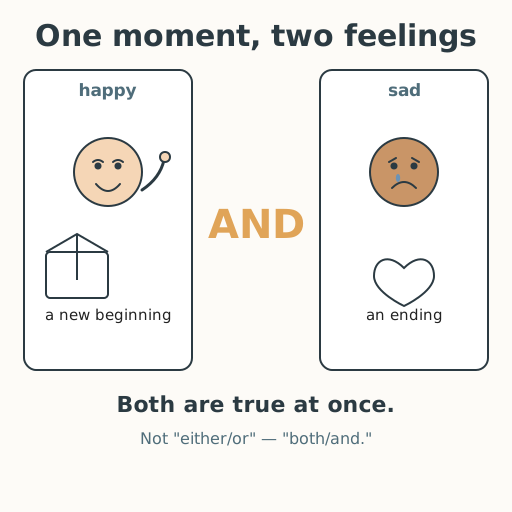
- Both/and poster · 1 One scene drawn twice — the same moment (a moving day, a farewell, an ending) — with a happy face on one side and a sad face on the other, joined by an "AND" not an "OR"
- Both/and page · 1 per learner A page with a large "AND" in the middle and two blank faces or boxes, one on each side, for the learner to fill in two feelings from the same moment
- Pencils and crayons · per learner
Low-tech / no-cost
- Two hands, one feeling each Hold one hand up for the first feeling and the other for the second, held together at once; no poster or page needed
- Voice and body Say the two feelings aloud in the same breath ("happy AND sad"), and describe how both live in the body at once
Enriched / lab & device
- A short film clip of a bittersweet farewell · 1 A brief scene (a last day, a departure, a season ending) to name the two feelings at once, discussed as a group
- Class 'both/and' wall · 1 A shared display where learners post their precise mixed-feeling sentences, building a growing word bank across the unit
Works in different contexts
- large-group Work one both/and example together on the poster, then have pairs fill their own page and share one sentence each in a whip-around
- multi-age Younger learners name two feelings; older learners name both feelings *and* the single situation that held them together
- self-directed A learner fills the both/and page for one real, safe moment of their own and writes one sentence naming both feelings together
- level-grouped Learners ready to extend distinguish "two feelings at once" from "one feeling that changes into another," and write one example of each
- outdoor-only Name a real both/and moment in nature — the last warm day of a season, a bird leaving its nest — and say the two feelings aloud together; no paper needed
Lesson 1 — Holding Two Feelings at Once
Summary
Learners discover that two opposite feelings can be true at the same time — happy AND sad, excited AND nervous — and begin to name that mix in precise language. They meet the word bittersweet, practice a both/and sentence, and find a mixed-feeling moment in their own lives — without judging either side as the “wrong” one.
Objectives
- Describe mixed or conflicting feelings — such as happy and sad at once — in precise language. (D01.S1.07.01)
Connection
You leave a place you love to begin something new: the last day of the season, a friend moving to another town, a grandmother’s house sold, the final game of a team you will never play on again. Your chest holds two things at once — joy at what is beginning and grief at what is ending. The word “and” does the honest work here: you are not either happy or sad. You are happy and sad, in the same breath, in the same body. Whether you live in a high-rise city or a mountain village, this is a feeling every person knows.
Materials
- Both/and poster
- Both/and page
- Pencils and crayons
Preparation
- Print or draw the both/and poster: one scene shown twice, with a happy face beside a sad face joined by a large “AND.”
- Copy a both/and page for each learner.
- Arrange a circle for discussion.
Facilitator note
This lesson is written to the learner (“you”). The idea to land is that two opposite
feelings can be true at once, and “and” is the honest word for it — not that a mixed
feeling is a problem to solve. Normalize it without pathologizing: holding two feelings is
a sign of growing emotional complexity, and it appears in every culture, though the words
for it differ (English’s “bittersweet,” the idea of “mono no aware” — a gentle sadness at
the passing of things — in Japanese tradition, and many others). Keep cultures side by side,
never ranked. Model one both/and sentence as a worked example before learners try their own
(Kirschner, Sweller & Clark, 2006). Invite only small, safe moments; never push a learner to
reveal a deep grief. See docs/facilitation.md and docs/art-style.md.
Procedure
- Gather (5 min). Last year you noticed that what a person feels and what they show can be different. Today you meet something new: a feeling that is two feelings at once. Has it ever happened to you — happy and sad in the same moment? (Pause and remember.)
- Meet the both/and (10 min). Look at the poster. Same scene, two sides: on one side a smile, on the other a tear — joined by a big AND. Not “or.” The word for this mix is bittersweet. Worked example: I feel happy that my team won the final match, AND sad that it is the last time we will all play together. Say it with me.
- Name your own mix (15 min). Think of one small, safe moment this month when you held two feelings at once. On your page, write or draw one feeling on each side of the AND, and finish one sentence: I feel ___ AND ___, because ___. Share with a partner if you are comfortable.
- The body holds both (10 min). Notice where each feeling lives in your body — a warm smile and a tight throat, a light chest and heavy shoulders. Two feelings, one body, both real. Write one word for where each one sits.
- Close (5 min). Feeling two things at once is not confusion and it is not weakness. It is the honest size of being human. Tomorrow you will find even more precise words for it.
Differentiation
- Support: Provide a word bank of feeling pairs (happy/sad, excited/nervous, proud/lonely) and the sentence starter “I feel ___ AND ___ because ___.”
- Extension: Write two mixed-feeling moments and notice what is the same and what is different about how the two feelings sit together.
Assessment
- Formative (observation): Can the learner name two opposite feelings from the same moment and join them with “and” rather than “or”?
- Self-check: The learner rereads their sentence and checks that it names two feelings from one moment, and that the “because” makes sense.
Home connection
Ask someone at home about a time they felt two opposite things at once — happy and sad in the same breath — and share one small example of your own if you like.
Resources
- The idea that emotions can be mixed, co-occurring, and named with precision is central to evidence-based social and emotional learning: CASEL’s self-awareness competency, https://casel.org/fundamentals-of-sel/; and the RULER approach (Recognizing, Understanding, Labeling, Expressing, Regulating emotions) from the Yale Center for Emotional Intelligence, https://www.rulerapproach.org/
- On modeling a new skill before independent practice: Kirschner, Sweller & Clark (2006), https://doi.org/10.1207/s15326985ep4102_1