Lesson 02 — The Precise Words for the Mix
Learners climb from a vague feeling word toward the precise language for a mixed feeling. They practice separating a mix into its two parts, choosing an exact joining word (and, but, because), and naming a one-word precise term such as "bittersweet" or "nostalgic" — learning that precise naming is what lets a feeling be understood, shared, and worked with.
Objectives
Objectives
- D01.S1.07.01 Describe mixed or conflicting feelings, such as happy and sad at once, in precise language.
Essential question
How do I move from a vague feeling to the exact words for a mixed one?
Key vocabulary
Materials
Standard materials
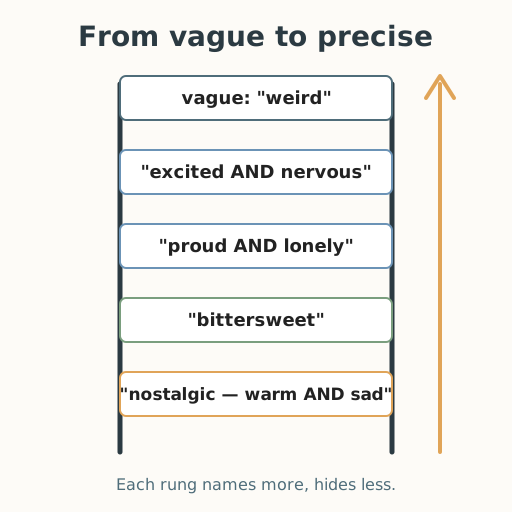
- Word-ladder poster · 1 A ladder from vague to precise — "weird" at the bottom, "excited AND nervous" and "proud AND lonely" and "bittersweet" and "nostalgic" higher up, with a short note for each
- Precise-words page · 1 per learner A page with a vague word at the top of a column and blank rungs below, for the learner to climb toward a more precise pair
- Pencils · per learner
Low-tech / no-cost
- Spoken ladder Say a vague word aloud, then climb it together — "weird… maybe excited and nervous" — one rung at a time; no paper needed
- Two-word clap Clap once for the first feeling and once for the second in a precise pair, then say the single word that joins them (and, but, because)
Enriched / lab & device
- A feelings thesaurus or dictionary · 1 per pair A printed or digital word list (mood meter / emotion wheel) to mine for precise words beyond the everyday set
- A class word wall · 1 A shared display where learners post each precise pair they find, sorted from vague to precise, growing all unit
Works in different contexts
- large-group Climb one ladder together aloud, then have pairs climb their own and share the top rung; collect the best precise pairs on the wall
- multi-age Younger learners give the two feelings in a pair; older learners also name the joining word (and, but, because) and a one-word precise term
- self-directed A learner takes a vague word of their own, climbs three rungs on the page, and writes one sentence using the most precise pair
- level-grouped Learners ready to extend distinguish pairs joined by "and" (both at once) from pairs joined by "because" (one feeling caused the other)
- outdoor-only Use the sky or a season as the subject — "strange weather" climbs to "fresh AND uneasy" — and say the ladder aloud; no paper needed
Lesson 2 — The Precise Words for the Mix
Summary
Learners climb from a vague feeling word (“weird,” “off,” “fine”) toward the precise language for a mixed feeling. They practice separating a mix into its two parts, choosing the exact joining word (and, but, because), and naming a one-word precise term such as bittersweet or nostalgic — learning that precise naming is what lets a feeling be understood, shared, and worked with.
Objectives
- Describe mixed or conflicting feelings in increasingly precise language — separating the parts, choosing a joining word, and reaching for exact terms. (D01.S1.07.01)
Connection
“I feel weird.” That sentence tells someone almost nothing, and it tells you almost nothing. “I feel excited and nervous about starting a new school” tells you exactly what is happening and what you might need. Precision is not fussiness; it is how a feeling becomes usable — like the difference between saying “bad weather” and “rain with high wind, coming from the sea.” In any life, on a farm or in a city, the more exactly you can name it, the more clearly you can respond to it.
Materials
- Word-ladder poster
- Precise-words page
- Pencils
Preparation
- Print or draw the word-ladder poster (vague at the bottom, precise at the top).
- Copy a precise-words page for each learner.
- Arrange pairs for the climbing practice.
Facilitator note
This lesson is written to the learner (“you”). The idea to land: precision is a skill that
can be taught and practiced, and it has a shape — split the mix into its parts, choose the
joining word, then reach for the exact term. Model the ladder as a worked example before
independent practice (Kirschner, Sweller & Clark, 2006). Acknowledge that words for precise
feeling-states exist in every language and are not all translatable one-to-one — which is why
we hold languages side by side as wealth, never as “better or worse” (the Japanese “mono no
aware,” the Portuguese “saudade,” the German “Fernweh,” the Hindi/Sanskrit “viraha” — the pang
of a loved one’s absence — the Tagalog “kilig” — the giddy shiver of excitement — and the
Arabic “tarab” — feeling stirred to fullness by music — all name nuances English must work
harder to reach). Naming precisely is a value this curriculum holds (RULER’s “Labeling”), but
whether to share a feeling aloud is always the learner’s choice — never pressure disclosure.
See docs/facilitation.md.
Procedure
- Gather (5 min). Last time you met the both/and — two feelings at once. Try to recall the word you learned for happy-and-sad together. (Pause.) Today you learn to name the mix with exact words.
- Climb the ladder (10 min). Look at the poster. The bottom rung says “weird” — a vague word that hides more than it shows. Climb: “weird” might really be “excited AND nervous.” Another rung up, “proud AND lonely.” Higher still, one exact word: bittersweet — happy and sad in the same moment. At the top, nostalgic — warm AND sad about something past. Watch how each rung names more.
- Worked example (10 min). Take a vague word you have actually used: “off,” “weird,” “fine.” Split it: what are the two feelings hiding inside? Choose the joining word — and (both at once), but (they pull against each other), because (one caused the other). Say the full sentence: I felt “weird” — really nervous AND proud about performing for the first time.
- Climb your own (15 min). On your page, write a vague word at the top, then climb three rungs toward precision: the two parts, the joining word, and (if you can) one exact term. Share your top rung with a partner and hear theirs.
- Close (5 min). A feeling you can name precisely is a feeling you can carry, share, and use. Add your best precise pair to the class word wall.
Differentiation
- Support: Provide a starter ladder with the first rung filled, and a short menu of exact terms (bittersweet, nostalgic, torn, ambivalent, relieved-but-sad) with one-line meanings.
- Extension: Distinguish two pairs for the same vague word — one joined by “and,” one by “because” — and explain how the joining word changes the meaning.
Assessment
- Formative (observation): Can the learner move from a vague word to a two-part pair with a joining word, and (ideally) a precise one-word term?
- Self-check: The learner asks, “Did I name two parts, choose a joining word, and say the same moment for both?”
Home connection
This week, when someone at home says “fine” or “weird,” gently try climbing the ladder together — “what are the two feelings inside that word?” — and see what you both find.
Resources
- On labeling emotions with precision as a core, evidence-based skill: the RULER approach, Yale Center for Emotional Intelligence, https://www.rulerapproach.org/; and CASEL’s self-awareness competency, https://casel.org/fundamentals-of-sel/
- On modeling a new skill before independent practice: Kirschner, Sweller & Clark (2006), https://doi.org/10.1207/s15326985ep4102_1