Lesson 08 — When a Label Narrows Me
Learners explain how stereotypes and labels can limit a person's sense of self — by narrowing what a person believes they may do, be, or become, and by getting "inside" as a voice that says "not for people like you." They name who benefits and who is left out, connect the narrowing to media's repeated images, and practice pushing back: redefining the label as one small part of a much larger whole.
Objectives
Objectives
- D01.S2.07.02 Recognize stereotypes and labels and explain how they can limit a person's sense of self.
Essential question
How can a stereotype or label limit a person's sense of self — and how do we push back?
Key vocabulary
Materials
Standard materials
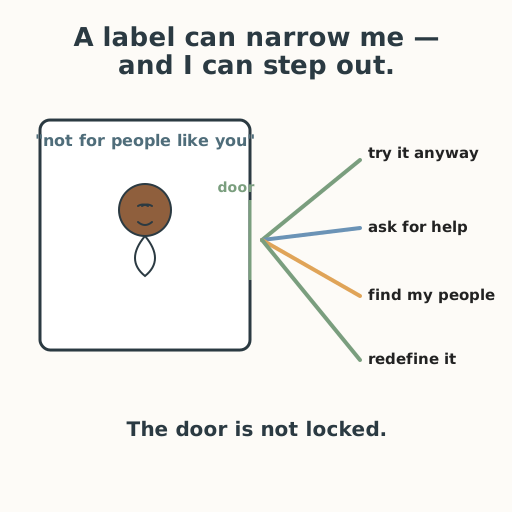
- Narrowing-box poster · 1 A figure standing inside a closing box labeled "not for people like you," with an open door on one side and many paths beyond it
- Limit-and-push-back cards · 1 set per group Scenarios where a label narrows a person (told they are "not the kind who" does math, leads, dances, is brave) with the prompt "how does it limit them, and what would you say back?"
- My-many-boxes page · 1 per learner A page for the learner to list the labels others have offered them, then rewrite each as one small part of a much larger whole
Low-tech / no-cost
- A chalk box with a door Draw a box on the ground and step into it, then draw a door and step out onto open ground; no poster needed
- Voice and body Say a limiting label aloud, then answer it aloud in a strong voice — "I am more than that one box"; no cards needed
Enriched / lab & device
- A short profile of someone who redefined a label · 1 A brief account of a real person who pushed back on a limiting label and did the thing they were told they could not, read and discussed
- A class 'more than one box' wall · 1 A shared display where learners post their rewritten labels, turning each narrow box into many open parts
Works in different contexts
- large-group Work one scenario together on the poster, then have groups take a card, name the limit, and practice one push-back line each
- multi-age Younger learners say what the label would stop them doing; older learners also name *how* a label gets inside (internalized) and a way to answer it
- self-directed A learner takes a limiting label, writes how it would narrow them, then rewrites it as one small part of a larger whole
- level-grouped Learners ready to extend explain the difference between a label *others* put on them and a label they have *taken inside*, and name a first step to loosen it
- outdoor-only Find a seedling growing through a crack or gap and compare yourself to it — a thing that grew past the narrow space it was given; no paper needed
Lesson 8 — When a Label Narrows Me
Summary
Learners explain how stereotypes and labels can limit a person’s sense of self — by narrowing what a person believes they may do, be, or become, and by getting “inside” as a voice that says “not for people like you.” They name who benefits and who is left out, connect the narrowing to media’s repeated images, and practice pushing back: redefining the label as one small part of a much larger whole.
Objectives
- Explain how stereotypes and labels can limit a person’s sense of self. (D01.S2.07.02)
Connection
A label is not just words. Tell a person often enough that they are “not the kind who” does math, or leads, or is brave, and the label can move inside them — until they begin to say it to themselves. Then it does real work: it shrinks the map of what they believe is possible. The good news is the door is not locked. A label can narrow you, but it cannot finish you — not if you learn to see it as one small box inside a much bigger life.
Materials
- Narrowing-box poster
- Limit-and-push-back cards
- My-many-boxes page
Preparation
- Print or draw the narrowing-box poster (a figure in a closing box with an open door).
- Copy limit-and-push-back cards for each group and a my-many-boxes page for each learner.
- Prepare one scenario to work together.
Facilitator note
This lesson is written to the learner (“you”). The ideas to land: (1) a stereotype or label
can limit a person’s sense of self — it narrows what they believe they may do or become, and it
can be internalized as an inner voice; (2) this narrowing is not evenly distributed — some
people are labeled more and get to be seen as individuals less, which is the egalitarianism
lens; and (3) the narrowing can be resisted — the door is not locked. The ethics lens asks
what it costs others when we repeat a limiting label; the technology lens notes that media
and feeds repeat the same narrow images until they feel inevitable. Hold the research honestly:
the “stereotype threat” finding (that worrying about confirming a negative stereotype can
under-cut performance; Steele & Aronson, 1995) is well known but its size and boundaries are
debated — teach it as “labels can get inside and weigh on a person,” not as a fixed law. Always
end in agency and hope: labels can narrow, but never finish. Keep examples low-stakes and
never require disclosure. Model one limit-and-push-back as a worked example (Kirschner, Sweller
& Clark, 2006). Distinguish evidence from values: that labels can limit is observable; that
every person deserves a wide, open sense of what is possible is a value this curriculum holds —
name it as one. See docs/facilitation.md and docs/art-style.md.
Procedure
- Gather (5 min). Last time you learned to spot a label. Today the harder question: what does a label do to a person? (Pause.) It can narrow the map of what they think is possible.
- Meet the narrowing box (10 min). Look at the poster: a person inside a closing box labeled “not for people like you.” Worked example: a learner is told “people like you aren’t good at math.” At first they answer back. But said often enough, the label moves inside — and soon they stop raising their hand. The box has narrowed what they believe they may do.
- Name the limit (15 min). In groups, take limit-and-push-back cards: told they are “not the kind who” leads, dances, is brave, or thinks deeply. For each, ask: How does this limit the person? (What would they stop trying?) And who benefits, who is left out? (Often the label protects someone else’s spot or keeps a gate closed.)
- Where the images come from (10 min). Discuss: why do these labels feel so true? Media and feeds repeat the same narrow images — the same faces doing the same things — until a type starts to look like a law. It is not a law. It is a habit of the images we are shown.
- Push back (10 min). On your page, list the labels others have offered you. Then rewrite each one: not “I am ___” but “one small part of me is ___, and I am also ___.” Practice one push-back line aloud with a partner: “I am more than that one box.”
- Close (5 min). A label can narrow you, but it cannot finish you. The door is open.
Differentiation
- Support: Provide sentence frames (“People say I am ___, but I am also ___, ___, and ___”) and work one card as a whole group first.
- Extension: Write about a label you have partly internalized, and name one concrete first step to loosen it — then test that step this week.
Assessment
- Formative (observation): Can the learner explain how a label narrows a person’s sense of self and offer one push-back that redefines it as a part, not the whole?
- Portfolio (artifact): The my-many-boxes page, kept for the unit’s stereotype-and-label analysis.
Home connection
Notice a moment this week when you or someone you love almost believed a limiting label — and try saying, out loud, “I am more than that one box.”
Resources
- On the “stereotype threat” finding (that worrying about confirming a negative stereotype can weigh on performance) — held with the research’s own cautions about effect size: Steele & Aronson (1995), Journal of Personality and Social Psychology.
- On media’s repeated narrow images, for classroom framing: Common Sense Education, News & Media Literacy, https://www.commonsense.org/education/digital-citizenship/topic/news-and-media-literacy
- On self-concept and social awareness, for classroom framing: CASEL, https://casel.org/fundamentals-of-sel/
- On modeling a new skill before independent practice: Kirschner, Sweller & Clark (2006), https://doi.org/10.1207/s15326985ep4102_1