Lesson 01 — Reading My Body's Signals
Learners notice and name three internal body signals — hunger, fatigue, and stress — accurately in themselves. They do a slow body scan, learn what each signal feels like in the body, and mark on their own body where each one shows up, without judging any signal as good or bad.
Objectives
Objectives
- D03.S1.07.01 Notice and name internal body signals such as hunger, fatigue, and stress accurately in themselves.
Essential question
How do I notice and name my body's internal signals — hunger, fatigue, and stress — accurately in myself?
Key vocabulary
Materials
Standard materials
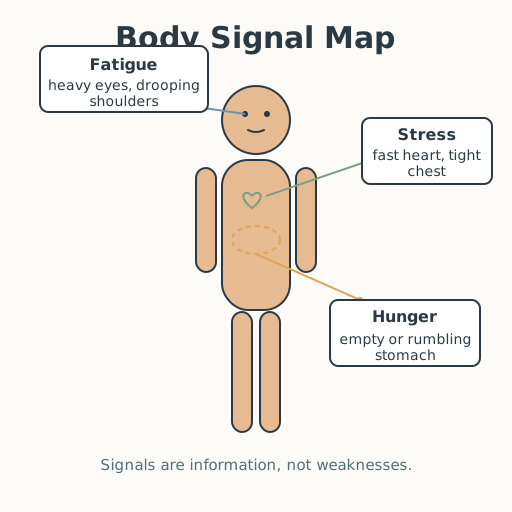
- Body signal map · 1 A large labeled diagram of a human body with three signals marked — an empty/rumbling stomach (hunger), heavy eyes and shoulders (fatigue), and a fast heart and tight chest (stress)
- My body signals page · 1 per learner A page with three columns — Hunger, Fatigue, Stress — and a small body outline for the learner to mark where each signal shows up in themselves
- Pencils and crayons · per learner
Low-tech / no-cost
- Voice and body Say each signal aloud and act out the body feeling (hand on stomach for hunger, heavy droop for fatigue, hand on chest for stress); no paper or diagram needed
- A partner as the map A learner names a signal and points to where they feel it on their own body; a partner checks the name against the three choices
Enriched / lab & device
- Timer or clock · 1 For a timed body-scan practice — one slow minute of noticing, then naming
- Class signal wall · 1 A shared display where learners post a note naming a signal they noticed and where it lived, building a word bank across the unit
Works in different contexts
- large-group Do one body scan together as a whole class — read the three signals aloud and have everyone point to where each shows up in their own body — before pairs work on their own pages
- multi-age Younger learners name one signal; older learners name all three and add one early warning sign for each
- self-directed A learner reads the three signals, does a slow body scan alone, and fills the page for one real, recent moment
- outdoor-only After sitting still, stand and notice the change: a signal can appear and pass. Name one signal in the open air; no paper needed
Lesson 1 — Reading My Body’s Signals
Summary
Learners notice and name three internal body signals — hunger, fatigue, and stress — accurately in themselves. They do a slow body scan, learn what each signal feels like in the body, and mark on their own body where each one shows up — without judging any signal as good or bad.
Objectives
- Notice and name internal body signals such as hunger, fatigue, and stress accurately in myself. (D03.S1.07.01)
Connection
You have probably felt all three of these today without stopping to name them: a hollow or rumbling feeling in your stomach before a meal, heavy eyelids when you stayed up late, and a fast heart right before something that mattered. These are not moods or guesses — they are signals your body sends, the way a dashboard light tells a driver that the tank is low. Whether you live in a high-rise city, a fishing village by the sea, or a mountain farm, the same three signals speak, and learning to read them accurately is the first step to caring for the body you live in.
Materials
- Body signal map
- My body signals page
- Pencils and crayons
Preparation
- Print or draw the body signal map: one body, three labeled signals.
- Copy a “My body signals page” for each learner.
- Arrange a circle or a quiet space for a slow body scan.
Facilitator note
This lesson is written to the learner (“you”). The idea to land is that internal body
signals are information, not weaknesses — hunger, fatigue, and stress are neutral facts
the body reports, and naming them accurately (not “I’m just off today” but “I’m hungry” or
“I’m tired”) is a skill. Normalize every body’s difference: some people feel hunger as a
hollow stomach, others as a headache or a dip in energy; the same signal can feel
different in different bodies, and all of it is normal. Model one body scan as a worked
example — name a signal from a safe, ordinary moment of your own — before learners try their
own (Kirschner, Sweller & Clark, 2006). Never ask a learner to reveal a private distress;
invite only small, ordinary signals. See docs/facilitation.md and docs/art-style.md.
Procedure
- Gather and recall (5 min). Last year you learned that the mind and the body are one thing talking to itself — that a worry can make a stomach feel tight. Today you turn the volume up on three signals that run in the background all day. Think: when did you last feel truly hungry? What told you?
- Meet the three signals (10 min). Look at the body signal map. Hunger — an empty or rumbling stomach. Fatigue — heavy eyelids, heavy shoulders, a body that wants rest. Stress — a fast heart, a tight chest, quick shallow breaths. Worked example: This morning I noticed my stomach felt hollow around mid-morning. That was hunger, not boredom. Say each signal and point to where it lives in your own body.
- Body scan (10 min). Sit still and close your eyes or look down. Slowly move your attention from your head to your toes. As you pass your stomach, ask: hunger? As you pass your eyes and shoulders, ask: fatigue? As you pass your chest, ask: stress? Notice what is actually there — not what you expect.
- Name it (15 min). On your page, mark where each of the three signals shows up in your body. Finish one sentence for each: I know I am hungry when ___. I know I am tired when ___. I know I am stressed when ___. Share one with a partner if you are comfortable.
- Close (5 min). Every body sends these signals, and no signal is a failure. Naming them accurately is the first move of caring for yourself. Tomorrow you will practice telling one signal apart from another.
Differentiation
- Support: Provide the sentence starters and a picture bank of the three signals; match each signal to a body part together first.
- Extension: For each signal, add one early warning sign — the small version that shows up before the signal is strong — and one helpful response.
Assessment
- Formative (observation): Can the learner name each of the three signals and point to where it shows up in their own body?
- Self-check: The learner rereads their three sentences and checks that each names a body feeling (not just “I felt bad”) and a real place in the body.
Home connection
Ask someone at home where they feel hunger, tiredness, and stress in their own body, and share one small example of your own. Notice: does the same signal show up differently in different people?
Resources
- On the mind–body connection this unit builds on, see CASEL’s self-awareness competency, https://casel.org/fundamentals-of-sel/
- On modeling a new skill before independent practice: Kirschner, Sweller & Clark (2006), https://doi.org/10.1207/s15326985ep4102_1