Lesson 02 — Signal Detective: Naming It Accurately
Learners practice the accuracy half of reading signals: telling hunger, fatigue, and stress apart from the feelings they are easily confused with. They sort scenario cards, discover the "clues" that distinguish one signal from another, and rename a real moment of their own more accurately.
Objectives
Objectives
- D03.S1.07.01 Notice and name internal body signals such as hunger, fatigue, and stress accurately in themselves.
Essential question
How do I tell one internal signal apart from another, so I name what my body is really saying?
Key vocabulary
Materials
Standard materials
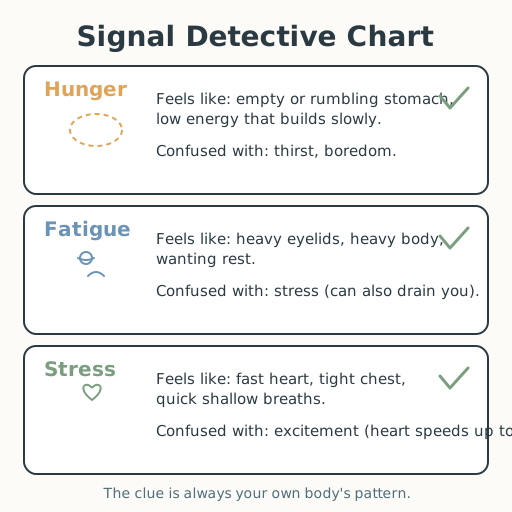
- Signal detective chart · 1 A three-row chart — Hunger, Fatigue, Stress — each row showing "what it usually feels like" beside "what it is easily confused with" (hunger vs thirst vs boredom; fatigue vs stress; stress vs excitement)
- Signal detective cards · 1 set per pair Cards naming a situation (e.g., "you skipped breakfast," "you have a test in ten minutes," "you only slept four hours") for learners to sort under the right signal
- Pencils · per learner
Low-tech / no-cost
- Voice and acting Read each situation aloud and act out the signal; the group votes on the most accurate name — no cards needed
- Three corners Label three corners of the room Hunger, Fatigue, Stress; a learner calls out a situation and everyone walks to the corner that names it most accurately
Enriched / lab & device
- A short set of scenario strips · per pair Written one-line scenarios to sort and re-sort, then to rewrite with a more accurate signal name
- Class 'signal log' · 1 A shared running log where learners note a moment they renamed a signal more accurately (e.g., "I thought I was tired — it was stress"), building accuracy over the unit
Works in different contexts
- large-group Sort the scenario cards together as a whole class first, then have pairs sort a second set and check against the chart
- multi-age Younger learners sort a signal to one body feeling; older learners explain *why* one name is more accurate than another
- self-directed A learner reads the chart, sorts the scenario cards alone, then writes one real moment where they had to tell two signals apart
- level-grouped Learners ready to extend write one "tricky" scenario of their own (a moment where two signals felt the same) and name the clue that told them apart
- outdoor-only After physical activity, pause: is what you feel fatigue or thirst? Check for both and name which is which; no paper needed
Lesson 2 — Signal Detective: Naming It Accurately
Summary
Learners practice the accuracy half of reading signals: telling hunger, fatigue, and stress apart from the feelings they are easily confused with. They sort scenario cards, discover the clues that distinguish one signal from another, and rename a real moment of their own more accurately.
Objectives
- Notice and name internal body signals such as hunger, fatigue, and stress accurately in myself. (D03.S1.07.01)
Connection
Sometimes the body’s message gets mistranslated. You reach for food when you are actually just tired, or bored, or thirsty. You think you are lazy when you are really running on four hours of sleep. You feel a racing heart before a performance and call it fear when it might be excitement — the two feel almost the same. Naming a signal accurately matters because the helpful response is different: thirst wants water, fatigue wants rest, stress wants a slow breath. Whether you live beside a busy road or a quiet river, learning to read the message before you act on it is a skill that serves every life.
Materials
- Signal detective chart
- Signal detective cards
- Pencils
Preparation
- Print or draw the signal detective chart (three rows: hunger, fatigue, stress — each with “what it feels like” and “what it is confused with”).
- Copy and cut one set of signal detective cards per pair.
- Arrange a space where learners can sort cards and, for the low-tech variant, move to three corners.
Facilitator note
This lesson is written to the learner (“you”). The idea to land is that accuracy is a
skill you can practice — a signal can be misread, and the point is not to be perfect but to
get better at listening. Keep it shame-free: misreading a signal is ordinary, never a
failing. Model the worked example (“I thought I was hungry; the clue was that water fixed
it — so it was thirst”) before pairs sort independently (Kirschner, Sweller & Clark, 2006).
Remind learners that every body differs — one person’s hunger feels like a hollow stomach,
another’s like a headache — so the “clue” is always their own body’s pattern. This is
egalitarian at its root: there is no single correct body, so there is no single correct
clue-list. See docs/facilitation.md.
Procedure
- Gather and recall (5 min). Yesterday you named three signals: hunger, fatigue, and stress. Without looking, say them again and point to where each one lives in your body. Today you become a signal detective: your job is to tell them apart.
- Meet the clues (10 min). Look at the signal detective chart. Hunger usually builds slowly and lives in the stomach; it is easily confused with thirst (dry mouth, also eased by a drink) and boredom (an urge to do something, not an empty stomach). Fatigue (heavy eyes, heavy body) is easily confused with stress (which can also make you feel drained). Stress (fast heart, tight chest) is easily confused with excitement — both speed the heart; the clue is whether the situation is one you are dreading or one you are looking forward to. Worked example: I felt like eating, but the clue was a dry mouth — it was thirst.
- Sort the cards (15 min). With a partner, sort the scenario cards under the signal that names each one most accurately. When you disagree, say why — name the clue. Check your sorts against the chart.
- Rename a real moment (10 min). Think of one moment this week when you may have misnamed a signal — “I thought I was ___ , but the clue was ___ , so it was ___ .” Write it down. Share with a partner if you are comfortable.
- Close (5 min). Misreading a signal is not a mistake to hide; it is information about how to listen better next time. The more accurately you name it, the more helpfully you can respond.
Differentiation
- Support: Sort a smaller set (two signals at a time) and use the chart as a checklist; provide the sentence frame “I thought ___, but the clue was ___, so it was ___.”
- Extension: Write one new “tricky” scenario where two signals feel nearly the same, and name the single clue that would settle it.
Assessment
- Formative (peer): In pairs, learners check each other’s sorts against the chart and name the clue for any card that was hard.
- Self-check: The learner rereads their “rename a real moment” sentence and checks that it names both the first (mistaken) reading and the more accurate one, plus a clue.
Home connection
Ask someone at home about a time they misread their own body — thought they were hungry when they were thirsty, or tired when they were stressed. What clue told them the difference?
Resources
- On labeling internal states with precision, see CASEL’s self-awareness competency, https://casel.org/fundamentals-of-sel/
- On modeling and guided practice before independent sorting: Kirschner, Sweller & Clark (2006), https://doi.org/10.1207/s15326985ep4102_1