Lesson 08 — Fueling a Growing Body: Why Restriction Harms
Learners learn why restricting food harms a growing body — slowed growth, weaker bones, tiredness, and trouble concentrating — and that eating disorders are serious, treatable illnesses, never a choice or a failure. They close by naming one way to fuel their own growing body and one trusted adult to talk to, with no shame and no judgment of any body.
Objectives
Objectives
- D03.S3.07.01 Describe how energy needs differ among bodies and activities, and why restricting food can harm a growing body.
Essential question
Why does restricting food harm a growing body, and how do I think about food and my body without shame?
Key vocabulary
Materials
Standard materials
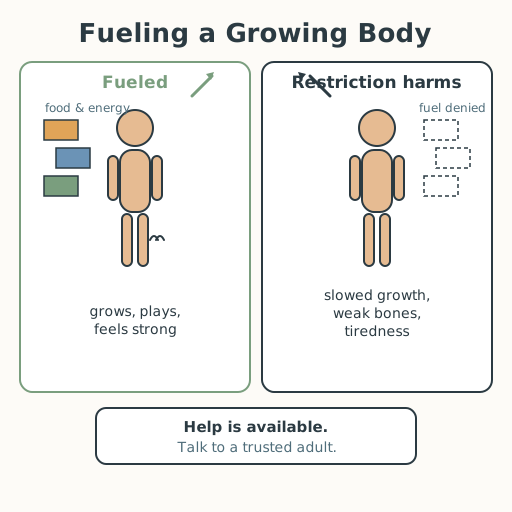
- Fueled vs restricted diagram · 1 Two panels — a growing body receiving fuel (building blocks and energy, with a growth arrow and strong bones) and a growing body denied fuel (slowed growth, weak bones, tiredness, trouble concentrating) — always framed as what restriction does, never as a judgment on any body
- My fuel-and-care page · 1 per learner A page where learners write one way to fuel their growing body, one way they already care for it, and one trusted adult they could talk to
Low-tech / no-cost
- Voice and acting Tell the two panels as a story — a body given enough fuel grows and plays; a body denied fuel gets tired and slow — with no diagram needed
- Hands as the building blocks Mime stacking "fuel" blocks to build a strong body; mime removing them to show what restriction takes away
Enriched / lab & device
- A short, respectful clip on eating disorders and recovery · 1 A video explaining that eating disorders are treatable illnesses and that asking for help is brave (verify it is accurate, age-appropriate, and shame-free)
- Local help-resource list · 1 A facilitator-prepared list of trusted adults and local or national helplines for anyone who needs support — shared privately, never as a class reading
Works in different contexts
- large-group Discuss the diagram together; keep the closing private — learners write their trusted adult on their own page and do not read it aloud
- multi-age Older learners can carry the "serious but treatable" message clearly; younger learners focus on "enough fuel to grow, and ask a trusted adult if worried"
- self-directed A learner reads the two panels, writes one way to fuel their body and one trusted adult, and is reminded that help is available and worth asking for
- level-grouped Learners ready to extend distinguish fact from value: which statements here are evidence about bodies, and which are values about how to treat people
- outdoor-only Use the rest-vs-move feeling from the last lesson: a body denied fuel cannot grow or play its best — say it plainly, then name one trusted adult to talk to; no paper needed
Lesson 8 — Fueling a Growing Body: Why Restriction Harms
Summary
Learners learn why restricting food harms a growing body — slowed growth, weaker bones, tiredness, and trouble concentrating — and that eating disorders are serious, treatable illnesses, never a choice or a failure. They close by naming one way to fuel their own growing body and one trusted adult to talk to, with no shame and no judgment of any body.
Objectives
- Describe how energy needs differ among bodies and activities, and why restricting food can harm a growing body. (D03.S3.07.01)
Connection
You learned that a growing body is a building under construction, needing extra fuel. So what happens if the building is denied its materials? The work slows or stops. A growing body that is not given enough food can grow more slowly, build weaker bones, feel tired and dizzy, and find it harder to focus and remember. Sometimes this happens not because food is unavailable but because a person, often in pain about their body, restricts what they eat on purpose — and that can become an eating disorder, a serious illness that is not a choice, not a weakness, and not anyone’s fault. The honest, hopeful truth: eating disorders are treatable, and asking for help early is one of the bravest things a person can do.
Materials
- Fueled vs restricted diagram
- My fuel-and-care page
Preparation
- Print or draw the fueled-vs-restricted diagram.
- Copy a “My fuel-and-care page” for each learner.
- Prepare (privately) a list of trusted adults and local or national helplines to offer anyone who asks — never read aloud as a class list.
Facilitator note
This lesson is written to the learner (“you”). It must be handled with tenderness and without
any hint of blame. The facts to land: undernutrition during the growing years can delay growth
and puberty, weaken bones, and cause tiredness and poor concentration; eating disorders are
serious illnesses with both mental and physical harm, and they are treatable (Nemours
KidsHealth, 2022; WHO, 2026). The values to hold as values, distinct from those facts: every
body deserves dignity; no body is a failure; and help is always worth asking for. Never
comment on any learner’s body or eating, never teach calorie-counting or “good/bad food”
language, and never require disclosure. Watch for distress; if a learner shares that they or a
friend may be struggling, respond calmly, thank them for their courage, and connect them to a
trusted adult or support service in private — do not promise secrecy. Note that media and
advertising constantly push narrow, edited images of bodies; naming that pressure is part of
caring for oneself. See docs/facilitation.md.
Procedure
- Gather and recall (5 min). You learned that energy needs differ among bodies and activities, and that a growing body needs extra fuel. Today you ask the honest question: what happens if a growing body is denied the fuel it needs?
- Meet the two panels (10 min). Look at the fueled-vs-restricted diagram. Fueled, a growing body gets the food and energy it needs: it grows, plays, and feels strong. Restricted, the same body is denied fuel: growth slows, bones weaken, the body feels tired and dizzy, and thinking gets foggy. This is what restriction does — it is never a comment on any person’s worth.
- Name it without blame (10 min). When a person restricts food on purpose, especially because they are in pain about their body, it can become an eating disorder. Say it plainly: an eating disorder is a serious illness — like any illness — and it is not a choice, not a weakness, and not anyone’s fault. The good news is that it is treatable, and catching it early helps a person recover.
- Write your fuel-and-care (10 min). On your page, write: one way you will fuel your growing body (enough food and water, not too little); one way you already care for your body; and one trusted adult you could talk to if you or a friend ever felt food or body worry was taking over. This is private — you do not have to share it.
- Close (5 min). Your body is not a project to shrink or fix; it is the place you live, and it is growing on purpose. If food or body worries ever feel too heavy, that is a signal to ask a trusted adult — and asking is strength, not weakness.
Differentiation
- Support: Use the sentence starters “One way I fuel my body is ___. A trusted adult I can talk to is ___.” Keep the focus on fueling and asking for help.
- Extension: Separate fact from value: write one fact about restriction from the lesson and one value about how people deserve to be treated, and label each clearly.
Assessment
- Formative (observation): Can the learner explain, without blame, why restriction harms a growing body and name one trusted adult to talk to?
- Portfolio: The “fuel-and-care” note (one way to fuel, one way they care for their body, one trusted adult), kept privately as a portfolio artifact.
Home connection
If it feels safe, share with a trusted adult one thing you learned about why a growing body needs fuel. You do not need to share anything personal. Remember: a trusted adult is always a good person to talk to.
Resources
- On eating disorders as serious, treatable illnesses and how restriction harms a growing body: Nemours KidsHealth — Eating Disorders (for teens), https://kidshealth.org/en/teens/eat-disorder.html
- On food as energy and growth material: WHO — Healthy diet fact sheet, https://www.who.int/news-room/fact-sheets/detail/healthy-diet
- On adolescence as a time of rapid growth: WHO — Adolescent health, https://www.who.int/health-topics/adolescent-health
- On growth as a range of normal: WHO — Child Growth Standards, https://www.who.int/toolkits/child-growth-standards