Lesson 07 — Energy Needs Differ Among Bodies and Activities
Learners discover that energy needs differ among bodies and activities — bigger bodies and more active days need more fuel, and a growing body needs extra fuel on top of its daily activity. They match bodies-and-activities to fuel amounts and name their own day, without counting, judging, or ranking any body.
Objectives
Objectives
- D03.S3.07.01 Describe how energy needs differ among bodies and activities, and why restricting food can harm a growing body.
Essential question
How do energy needs differ among bodies and activities, and why does fueling a growing body matter?
Key vocabulary
Materials
Standard materials
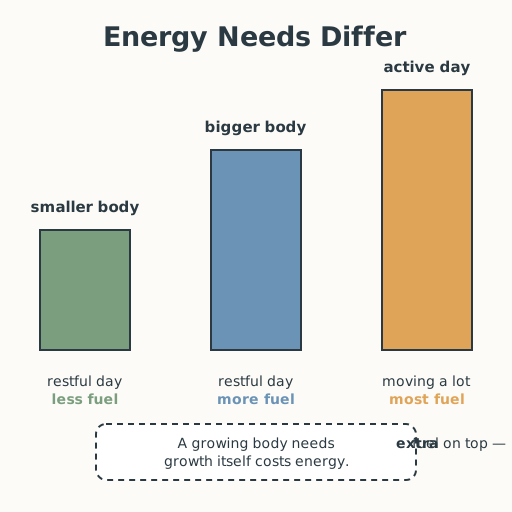
- Fuel gauge chart · 1 A chart with three bars of different heights — a smaller body on a restful day, a bigger body on a restful day, and a body on a very active day — each labeled with the idea that different bodies and days need different amounts of fuel
- Energy needs page · 1 per learner A page where learners match a body-and-activity to a fuel amount, then write one sentence about their own day
Low-tech / no-cost
- Voice and counting Describe the three bars with words (small, medium, large) and use a count or a hand level instead of a printed chart
- Drawn fuel-bar figures Draw three stick figures of different sizes (or reuse the lesson's SVG) to show "less fuel / more fuel," always framed as different, never as better or worse — never use live learners' bodies as the comparison
Enriched / lab & device
- A short clip on how the body uses energy · 1 A science clip on energy as fuel for movement, growth, and keeping warm (verify it is accurate and shame-free)
- Food labels or a nutrition table (optional) · a few To notice that foods carry different amounts of energy, always without counting or judging any body
Works in different contexts
- large-group Read the fuel gauge chart together and sort a few body-and-activity examples aloud before learners work on their own pages
- multi-age Younger learners match one activity to one fuel amount; older learners explain *why* a bigger or more active body needs more fuel
- self-directed A learner reads the chart, does the matching page alone, and writes one sentence about their own day and what their body needs
- level-grouped Learners ready to extend connect energy needs to the growth spurt from the last lesson — a growing body needs extra fuel on top of its daily activity
- outdoor-only Feel it directly: rest quietly, then move hard for a minute. Notice that your body asked for more fuel after moving — no paper needed
Lesson 7 — Energy Needs Differ Among Bodies and Activities
Summary
Learners discover that energy needs differ among bodies and activities — bigger bodies and more active days need more fuel, and a growing body needs extra fuel on top of its daily activity. They match bodies-and-activities to fuel amounts and name their own day, without counting, judging, or ranking any body.
Objectives
- Describe how energy needs differ among bodies and activities, and why restricting food can harm a growing body. (D03.S3.07.01)
Connection
Food is fuel. Just as a truck carrying a heavy load uses more fuel than a bicycle on a flat road, a bigger body and a more active day use more energy than a smaller body at rest — and a body that is growing is like a building under construction: it needs extra material and extra fuel on top of everything else. There is no single “right” amount of food for every person, because bodies and days differ — the farmer hauling sacks, the student walking kilometers to school, and the fisher paddling at dawn all need different amounts. Energy needs are individual and real, not a number to compete over.
Materials
- Fuel gauge chart
- Energy needs page
Preparation
- Print or draw the fuel gauge chart (three bars of different heights, clearly labeled).
- Copy an energy needs page for each learner.
- Arrange a space where learners can also feel the difference between rest and movement.
Facilitator note
This lesson is written to the learner (“you”). The idea to land is that energy needs are
individual and differ by body size and activity — and this is neutral science, never a ranking
of bodies. The evidence: human energy requirements vary with age, sex, body size, and
physical activity level, and rise steeply during the adolescent growth spurt, when energy is
spent on growth itself (FAO/WHO/UNU, 2004). Keep it strictly non-judgmental: a bigger body
needing more fuel is a fact, not a comment on anyone; no learner should be asked to count
calories, weigh themselves, or compare bodies. Use “different, not better or worse” as the
refrain. This lesson sets up the next one honestly: because a growing body needs fuel,
restricting food harms it. See docs/facilitation.md.
Procedure
- Gather and recall (5 min). You have been reading signals and moving your body. Today you meet what powers all of it: energy from food. Think: what did your body do today that needed energy?
- Meet the fuel gauge (10 min). Look at the fuel gauge chart. Three bars: a smaller body on a restful day needs less fuel; a bigger body on a restful day needs more; a body on a very active day needs the most. Why? More body to run means more energy; more movement means more energy. And there is one more bar hiding in the picture: a growing body needs extra fuel, because growth itself costs energy.
- Match bodies and activities (15 min). On your page, match each body-and-activity to a fuel amount: resting and reading; walking to school; hauling water; training hard for a match; being mid-growth-spurt. Explain your matches to a partner.
- Name your own day (10 min). Write one sentence: Today my body ___ (rested / moved a little / moved a lot), so it needs ___ fuel — enough, not too little. Share if you are comfortable.
- Close (5 min). Different bodies, different days, different fuel — and none of it is a ranking. Tomorrow you will ask the important next question: what happens if a growing body is denied the fuel it needs?
Differentiation
- Support: Use a simpler two-bar version (rest day vs active day) and the sentence starter “When I ___, my body needs ___.”
- Extension: Connect to the growth spurt from the last lesson: explain why a growing body needs extra fuel even on a restful day.
Assessment
- Formative (observation): Can the learner explain why a bigger or more active body needs more fuel, and name the extra fuel a growing body needs?
- Self-check: The learner rereads their own-day sentence and checks that it names both the activity and the fuel need — enough, not too little.
Home connection
Ask someone at home what their body did today and notice together how a more active day means more fuel. Share your own-day sentence if you like.
Resources
- On energy needs varying by age, sex, body size, and activity level, and rising during growth: FAO/WHO/UNU, “Human energy requirements” (2004), https://www.fao.org/4/y5686e/y5686e00.htm
- On food as the body’s energy and growth material: WHO — Healthy diet fact sheet, https://www.who.int/news-room/fact-sheets/detail/healthy-diet