Lesson 03 — Repair: Apologize, Listen, Agree
Learners meet the repair conversation as three steps — apologize with accountability, listen to how it felt for the other person, and agree together on next steps. They learn that repair is not erasing what happened but naming it, hearing the hurt, and choosing a different next step, and they practice the first real sentence of each step.
Objectives
Objectives
- D02.S1.07.02 Repair a relationship after a disagreement by apologizing, listening, and agreeing on next steps.
Essential question
After a disagreement, how do I repair the relationship — apologize, listen, and agree on next steps?
Key vocabulary
Materials
Standard materials
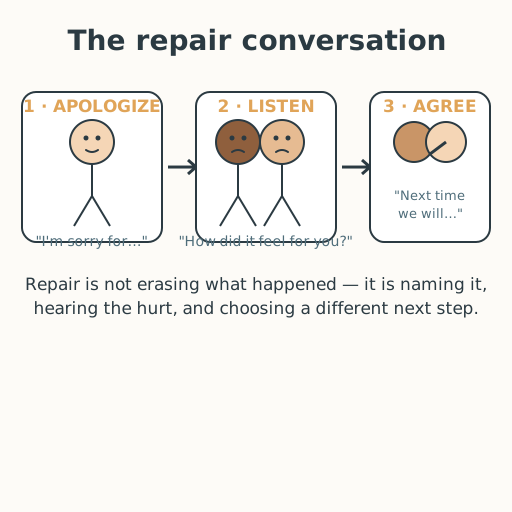
- Repair poster · 1 Three steps — apologize, listen, agree on next steps — drawn as a flow with a small figure at each
- Repair card · 1 per learner A card with the three steps and sentence starters for each
- Pencils and paper · per learner
Low-tech / no-cost
- Voice and body Say the three steps aloud and act them out with a partner; no poster or card needed
- Three stones or chalk marks Mark three spots on the ground, one per step, and move from apologize to listen to agree
Enriched / lab & device
- Class 'repair' wall · 1 Learners post one real or invented repair sentence for each step, building a shared bank across the unit
- A short, respectful clip of a repair conversation · 1 A scene where a character apologizes sincerely and listens before agreeing on next steps (verify the clip is appropriate)
Works in different contexts
- large-group Model one full repair conversation for the whole group on the poster, then have pairs practice one step each and rotate
- multi-age Younger learners practice the apology step; older learners practice the full three-step conversation and name the difference each step makes
- self-directed A learner writes a full three-step repair for an invented, safe disagreement, using the sentence starters
- level-grouped Learners ready to extend distinguish an accountable apology ("I did X, and it hurt you") from a hollow one ("sorry you felt that way") and explain the difference
- outdoor-only Move through the three marked spots on the ground, speaking one line at each; no paper needed
Lesson 3 — Repair: Apologize, Listen, Agree
Summary
Learners meet the repair conversation as three steps — apologize with accountability, listen to how it felt for the other person, and agree together on next steps. They learn that repair is not erasing what happened but naming it, hearing the hurt, and choosing a different next step, and they practice the first real sentence of each step.
Objectives
- Repair a relationship after a disagreement by apologizing, listening, and agreeing on next steps. (D02.S1.07.02)
Connection
Every relationship gets bent at some point: a sharp word, a borrowed thing returned broken, a promise forgotten, a boundary crossed. What happens after decides whether the relationship heals or quietly breaks. Repair is a skill, not magic — and people everywhere have worked out versions of it. Many traditions repair harm by restoring the relationship rather than only punishing: peacemaking circles among Indigenous nations, the Diné (Navajo) principle of hózhó — restoring balance and harmony — and the way modern restorative practices ask three questions: What happened? Who was harmed? How do we make it right? The same three steps run through all of them: name it honestly, hear the hurt, and agree on what comes next.
Materials
- Repair poster
- Repair card
- Pencils and paper
Preparation
- Print or draw the repair poster (three steps).
- Copy a repair card for each learner.
- Arrange pairs for practice.
Facilitator note
This lesson is written to the learner (“you”). The idea to land is that repair is a
three-step skill — an accountable apology, real listening, and an agreed next step — and it
restores a relationship rather than only ending the conflict. Use invented, safe
disagreements (a forgotten promise, a borrowed item, an overheard remark), never a real
classmate’s conflict, and never require a learner to confess anything. Hold the
global/anthropological lens honestly: present restorative practices, Diné peacemaking, and
related traditions side by side as living knowledge, never as curiosities or a ranking;
the “what happened / who was harmed / how do we make it right” questions are a modern
restorative frame (Zehr; IIRP), and Diné hózhó is a real principle of balance — teach both
with respect and invite learners to name repair practices from their own cultures. Model
the full conversation once as a worked example before pairs practice (Kirschner, Sweller &
Clark, 2006). Note that an apology is not the same as being forgiven — the other person
chooses; our job is the honest offer and the changed next step. See docs/facilitation.md
and docs/art-style.md.
Procedure
- Gather and recall (5 min). You can set a boundary and read one. What happens when a boundary still gets crossed, or a disagreement leaves things bent? Today: repair — the skill that restores a relationship after a break.
- Meet the three steps (10 min). Look at the poster. Step 1 — Apologize with accountability: “I’m sorry I ___ . It was wrong, and it hurt you.” Not “sorry you felt that way” — that blames the other person’s feelings. Step 2 — Listen: “How did it feel for you?” Then stay quiet and hear the answer, without defending yourself. Step 3 — Agree on next steps: “Next time I will ___ . What do you need from me?” Worked example, said aloud: “I’m sorry I read your notebook without asking. How did it feel for you? … I hear that it felt like a break of trust. Next time I will ask first, and you can tell me what you need from me to trust me again.”
- Write your first sentences (15 min). Choose one small, invented disagreement. On your card, write one real sentence for each step — an accountable apology, a listening question, and a next step. Use the starters.
- Practice aloud (10 min). In pairs, take turns speaking your three sentences. The listener’s only job is to hear — no defending, no interrupting. Afterward, name one thing that felt different about being truly listened to.
- Close (5 min). Repair does not erase what happened. It names it, hears the hurt, and chooses a different next step. That is how trust grows back. Tomorrow you will practice the whole conversation, start to finish.
Differentiation
- Support: Provide the three sentence starters in large print; practice only the apology step first, then add listening.
- Extension: Write two versions of an apology — accountable and hollow — and explain in one sentence why the accountable one can rebuild trust while the hollow one cannot.
Assessment
- Formative (observation): Does the learner produce an accountable apology that names their own action, a listening question, and a concrete next step?
- Self-check: The learner rereads their three sentences and checks: does the apology name what I did (not the other person’s feelings)? Does the next step name my future action?
Home connection
Ask someone at home how people in your family or community make things right after a disagreement — a word, a custom, a ritual — and share the three repair steps you learned.
Resources
- On restorative practices and repairing harm by restoring relationship: Zehr, Changing Lenses; and the International Institute for Restorative Practices, https://www.iirp.edu/
- On modeling a new skill before independent practice: Kirschner, Sweller & Clark (2006), https://doi.org/10.1207/s15326985ep4102_1