Lesson 04 — Practicing the Repair Conversation
Learners put the three repair steps into one continuous conversation, start to finish, using invented, safe scenarios. They practice the full loop — accountable apology, real listening, an agreed next step — and learn that the last, quiet step is follow-through: doing the next step you promised, which is what actually rebuilds trust.
Objectives
Objectives
- D02.S1.07.02 Repair a relationship after a disagreement by apologizing, listening, and agreeing on next steps.
- D02.S1.07.01 Set and respect personal boundaries and recognize when a peer has set one.
Essential question
Can I run a full repair conversation — from apology to listening to an agreed next step — and then actually follow through?
Key vocabulary
Materials
Standard materials
- Repair scenario cards · 1 set Short, invented, safe disagreement scenes, each with two roles, for practicing the full conversation
- Repair card (from Lesson 3) · 1 per learner The three steps and sentence starters, for reference during practice
- Pencils and paper · per learner
Low-tech / no-cost
- Voice and body Invent a disagreement together and run the conversation aloud; no cards needed
- Two chairs Seat partners facing each other to mark the speaker and listener roles
Enriched / lab & device
- Video or audio recording device · 1 per pair Record one practice conversation (with both partners' agreement) and replay it to notice what worked; delete afterward
- Class 'repair' wall · 1 Learners post their strongest next-step sentence, building a shared bank of follow-through commitments
Works in different contexts
- large-group Run one fishbowl conversation in the middle with the group watching for each step, then have pairs practice in parallel
- multi-age Younger learners play the listener; older learners model the apologizer and the next-step agreement, then swap
- self-directed A learner writes a full script for an invented disagreement and reads both roles aloud, checking each step
- level-grouped Learners ready to extend add a fourth move — checking back later to confirm the follow-through — and explain why it matters
- outdoor-only Use two facing stones or seats outdoors; walk the three steps on the ground as you speak them
Lesson 4 — Practicing the Repair Conversation
Summary
Learners put the three repair steps into one continuous conversation, start to finish, using invented, safe scenarios. They practice the full loop — accountable apology, real listening, an agreed next step — and learn that the last, quiet step is follow-through: doing the next step you promised, which is what actually rebuilds trust.
Objectives
- Repair a relationship after a disagreement by apologizing, listening, and agreeing on next steps. (D02.S1.07.02)
- Respect a boundary someone else has set, including the boundaries that remain after repair. (D02.S1.07.01)
Connection
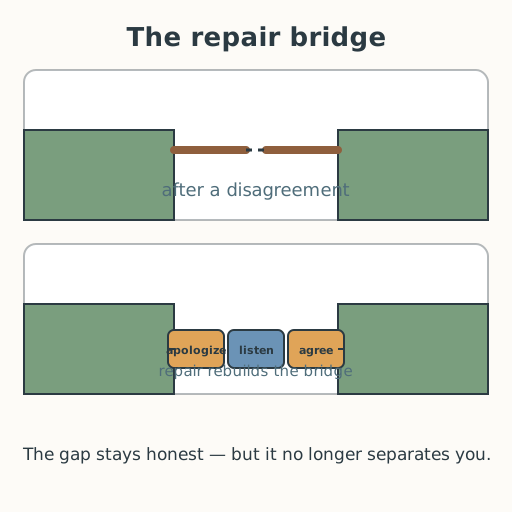
The bridge that broke between two people is rebuilt one plank at a time — and the last plank is the one no one sees: you do the thing you promised. A repair conversation that ends in “next time I will ask first” means nothing if, next time, you read their notebook again. This is true in a friendship, a family, a classroom, a neighborhood, anywhere people keep promises to one another. The words open the door; the follow-through walks through it.
Materials
- Repair scenario cards
- Repair card (from Lesson 3)
- Pencils and paper
Preparation
- Copy the repair scenario cards (one per pair).
- Re-copy the repair card as a reference.
- Arrange pairs facing each other.
Facilitator note
This lesson is written to the learner (“you”). The idea to land is that a repair
conversation is a single loop — apologize, listen, agree — and it is only complete when the
agreed next step is actually done. Use invented, safe scenarios; never script a real
classmate’s conflict, and never role-play anything like trauma. The fishbowl (whole-group
watch) is a good structure in large groups: model once, then let pairs run in parallel
(Kirschner, Sweller & Clark, 2006). Watch for the hollow apology (“sorry you felt that
way”) and coach it toward accountability (“I did X, and it hurt you”). Honor the
egalitarian lens: repair is between equals — no one “wins” a repair, and the listener’s
choice to forgive or not is theirs alone. Note that boundaries stay real after repair:
making up does not erase a boundary; if someone still says no, you still stop. See
docs/facilitation.md and docs/art-style.md.
Procedure
- Gather and recall (5 min). Name the three repair steps without looking — apologize, listen, agree. (Retrieval: this is the third time you have touched them.) Today you run all three as one conversation, then add the hidden fourth step.
- Watch a full repair (10 min). Two volunteers (or you and a partner) run one scenario in the middle while everyone watches for each step: Did the apology name their own action? Did the listener hear without defending? Did they agree on a concrete next step? Use a scenario card.
- Practice the loop (20 min). In pairs, take a scenario card and run the full conversation. Swap roles and run it again the other way. Go slowly; the silence in the “listen” step is doing real work. Try at least two scenarios.
- The hidden fourth step (10 min). The repair is not finished when the words stop. It finishes when you do the next step. Write one line: I promised “next time I will ___,” and the way I will keep that promise is ___ . A repair without follow-through is just words.
- Boundaries still stand (5 min). Close by naming it plainly: making up does not erase a boundary. If someone says no — before, during, or after repair — you still stop.
- Close (5 min). You can now set a boundary, read one, and repair after a break. Next you turn outward: how another person’s whole life shapes the way they see things.
Differentiation
- Support: Run only the apology and listen steps first; provide the next-step sentence starter (“Next time I will ___ instead of ___”).
- Extension: Add a “check-back” fourth move — returning a week later to ask “did I keep my word?” — and write why checking back matters to trust.
Assessment
- Formative (observation): Does the learner run all three steps in order, with an accountable apology, a quiet listening turn, and a concrete next step?
- Peer check: The listening partner says back one thing they heard and one next step they would actually accept.
- Self-check: The learner checks their follow-through line names a real, doable action.
Home connection
Ask someone at home about a promise that mattered because the person actually kept it — and notice, this week, one small promise you can keep as follow-through.
Resources
- On restorative practices and follow-through as the completion of repair: Zehr, Changing Lenses; International Institute for Restorative Practices, https://www.iirp.edu/
- On modeling and guided practice for a new skill: Kirschner, Sweller & Clark (2006), https://doi.org/10.1207/s15326985ep4102_1