Lesson 03 — Unsupported Claims and Probing Questions
Learners identify unsupported claims in everyday speech and ask probing questions — questions that press for the missing support or test an assumption — without attacking the speaker. They practice kind, curious questioning on claims from many regions and language traditions.
Objectives
Objectives
- D04.S1.07.01 Evaluate a speaker's reasoning, identifying unsupported claims and asking probing questions.
Essential question
How do I spot an unsupported claim and ask a question that probes for the missing support?
Key vocabulary
Materials
Standard materials
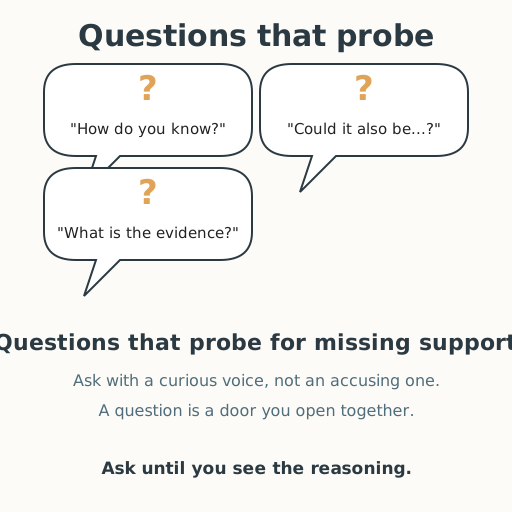
- Question-stem cards · 1 set Cards with probing question stems — "How do you know…?", "What evidence…?", "Could it also be…?"
- Claim cards · 1 set Six short claims, some unsupported, to probe (health, school, weather, money, food, technology)
- Probing page · 1 per learner A page with one claim and a space to write two probing questions
Low-tech / no-cost
- Voice Say the question stems aloud and practice asking them to a partner; no cards needed
- Chalk or stick in dirt Write the claim in the dust and one probing question beside it
Enriched / lab & device
- Recorded claims · 1 set Short audio or video claims to pause and probe with the question stems
- Question bank on a device · 1 per pair A shared list of probing question stems to copy and adapt
Works in different contexts
- large-group Model one probing question aloud, then do a whole-group "question warm-up" where every learner voices one stem before pairs work
- self-directed A learner reads each claim, writes two probing questions, and checks them against the stem cards
- multi-age Younger learners ask one "how do you know?" question; older learners add a "could it also be…?" alternative-view question
- outdoor-only Probe a real claim from the day (a sign, a rumor, a price) aloud using the stems; no paper needed
Lesson 3 — Unsupported Claims and Probing Questions
Summary
Learners move from finding weak links to asking about them. They name an unsupported claim, then ask a probing question — a question that presses for missing support or tests a hidden assumption — in a way that is curious rather than hostile. They practice on everyday claims from many regions.
Objectives
- Identify an unsupported claim in everyday speech and ask a probing question that presses for missing support or tests an assumption. (D04.S1.07.01)
Connection
When a claim has no support, you have two choices: accept it silently, or ask. The question “How do you know?” is one of the most powerful tools a person owns. It is how you protect yourself and others from a false cure, a bad deal, or a rumor — and it works the same in a pharmacy in Nairobi, a repair shop in Hanoi, or a family kitchen anywhere. A probing question is not an attack; it is a door you open together.
Materials
- Question-stem cards
- Claim cards
- Probing page
Preparation
- Make question-stem cards: “How do you know…?”, “What is the evidence…?”, “Could it also be…?”, “Who says so, and why should we trust them…?”, “What would change your mind…?”
- Prepare six short claims, some unsupported. Adaptable set: a health cure with no evidence, a “this brand is best” claim, a school rumor, a weather prediction, a money tip, a claim about a device.
- Copy a probing page for each learner.
Facilitator note
This lesson is written to the learner (“you”). The idea to land is that a probing
question asks for the missing support or tests an assumption — and it can be asked
kindly. Model the tone as much as the words: “I wonder how we know that,” not “prove
it!” Use worked examples before practice (Kirschner, Sweller & Clark, 2006). Where
questioning adults is culturally risky, frame questions as wondering together, and
offer an anonymous “wonder box” for written questions (see docs/contexts.md). The four
lenses: ethics (questioning to protect, not to wound); egalitarianism (anyone can ask;
questioning power, gently, is a shared right); global (question-stems travel across
languages); social-emotional (curiosity feels different from attack — practice the warm
tone). Keep claims small and safe.
Procedure
- Gather (5 min). Recall last lesson’s broken chains. Today you do something about them: you ask. What question would you ask when a chain has no evidence?
- Meet the probing question (10 min). A probing question asks for missing support or tests an assumption. Read the stems on the cards. Worked example: someone says “This phone is the best.” Probing questions: “How do you know?” “What evidence do you have?” “Could another phone also be good for a different reason?” Say them with a warm voice.
- Probe six claims (15 min). With a partner, take the claim cards. For each, first say whether the claim is supported or unsupported, then ask two probing questions using the stems. Write your best two on your page.
- Wonder together (10 min). Choose one claim and role-play: one partner states the claim, the other asks a probing question, then they switch. Notice the tone — how does a question feel when it is curious rather than accusing?
- Close (5 min). You now have a habit, not just a skill: when a claim has no support, you ask — kindly, and you keep asking until you see the reasoning.
Differentiation
- Support: Provide the stem cards plus a sentence starter (“I wonder how we know…”) and let learners ask just one question per claim.
- Extension: For one claim, ask a question that tests a hidden assumption (“You assume… — is that always true?”) and write it down.
Assessment
- Formative (observation): Can the learner name a claim as unsupported and ask a question that genuinely probes for support or tests an assumption?
- Peer-check: Partners rate each other’s questions with three checks: does it ask for support? is it kind? is it on the real claim?
Home connection
Practice one “How do you know?” this week — asked gently to a friend, a sibling, or yourself — and notice what the answer reveals about the support behind a claim.
Resources
- On asking for and evaluating the support behind a claim as a media- and information-literacy habit: UNESCO Media and Information Literacy (MIL), https://www.unesco.org/en/media-information-literacy; and Common Sense Education, “News & Media Literacy,” https://www.commonsense.org/education/digital-citizenship/topic/news-and-media-literacy
- On modeling before practice: Kirschner, Sweller & Clark (2006), https://doi.org/10.1207/s15326985ep4102_1