Lesson 04 — Deliver a Presentation on Evidence
Learners plan and deliver a short presentation adapted to a chosen audience and purpose, supporting each point with evidence. They self-assess and peer-assess using a checklist, then revise one point on the spot — the same evaluate-then-build loop they used as listeners.
Objectives
Objectives
- D04.S1.07.02 Deliver a presentation adapted to an audience and purpose, using evidence to support points.
- D04.S1.07.01 Evaluate a speaker's reasoning, identifying unsupported claims and asking probing questions.
Essential question
How do I adapt a short presentation to an audience and purpose, and support every point with evidence?
Key vocabulary
Materials
Standard materials
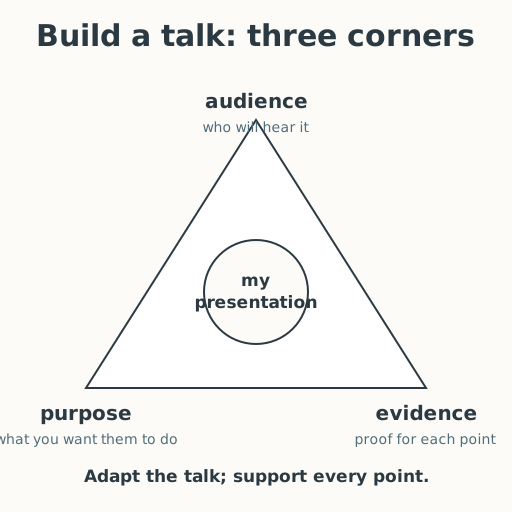
- Audience/purpose/evidence planner · 1 per learner A one-page planner with three boxes — audience, purpose, evidence — and a space for the main points
- Presentation checklist · 1 per learner A short list of checks — claim clear, points supported, adapted to audience, voice and pace
- Timer · 1 For pacing practice (about 60–90 seconds per speaker)
Low-tech / no-cost
- Voice and body Stand, speak, and use hands; no planner or timer needed — a partner counts silently
- A stick or stone as a 'microphone' Pass an object to mark whose turn it is to speak
Enriched / lab & device
- Device with a camera · 1 per group Record a practice talk and replay it to self-assess voice, pace, and evidence use
- Projector or large screen · 1 Optional; to show a single supporting image or slide if available
Works in different contexts
- large-group Divide the class so every learner speaks to a small circle of 4–5 rather than the whole room, then rotate
- self-directed A learner plans a talk, records it on a phone, and replays it against the checklist
- multi-age Younger learners present one point with one piece of evidence; older learners present two points and name their audience and purpose aloud
- outdoor-only Present standing in a circle outdoors; use a found object as the "microphone" and the sky as the audience's view
Lesson 4 — Deliver a Presentation on Evidence
Summary
Learners turn the listening skills of the first three lessons around: they now build an argument for others to evaluate. Each plans a short talk adapted to a chosen audience and purpose, supports every point with evidence, delivers it, and revises one point after feedback.
Objectives
- Deliver a short presentation adapted to an audience and purpose, supporting points with evidence. (D04.S1.07.02)
- Apply the evaluation skills from earlier lessons to one’s own and peers’ presentations. (D04.S1.07.01)
Connection
Speaking to be understood is the mirror of listening carefully. The same chain you have been checking in others — claim, reason, evidence — is now yours to build. You already adapt without thinking: you explain a rule one way to a small child and another way to a grandparent. A presentation just makes that adaptation deliberate: who am I speaking to, why am I speaking, and what evidence will convince them?
Materials
- Audience/purpose/evidence planner
- Presentation checklist
- Timer
Preparation
- Copy the planner and checklist for each learner.
- Arrange small circles of 4–5 for delivery.
- Prepare an example topic list (a small, safe claim learners care about) for those who need a starting point.
Facilitator note
This lesson is written to the learner (“you”). The idea to land is that a good
presentation is built, not performed: audience, purpose, and evidence come first. Model
a 60-second talk once — stating the audience and purpose aloud, then giving two points
with evidence — before learners plan their own (Kirschner, Sweller & Clark, 2006).
Keep topics small and safe; offer a topic list so no one is stuck. The four lenses:
ethics (support claims honestly, no invention); egalitarianism (every voice gets a
turn and a respectful hearing — no ranking); global (topic list spans regions and
languages); technology (if recording, use it for self-assessment, not to shame).
Expression modes: “deliver” means express the argument however works best — spoken
aloud, signed, written or typed and shown, drawn as a poster, or produced with a
communication device (AAC). No mode is more correct than another; assess the argument,
not the voice. See docs/facilitation.md.
Procedure
- Gather (5 min). Recall the chain: claim → reason → evidence. Today you build a chain of your own and speak it to others. What is a topic you could talk about for one minute?
- Plan the talk (15 min). On your planner, fill three boxes. Audience: who will hear this? (A class, a younger sibling, a neighbor, a committee.) Purpose: what do you want them to do or believe? Evidence: two pieces of proof for each point. Write two points, each with evidence.
- Model and rehearse (10 min). Watch or hear the 60-second model once. Then rehearse yours with a partner: state your audience and purpose (spoken, signed, or written), give your two points, and end with your claim. Use the timer — about 60–90 seconds.
- Deliver (15 min). In your circle of 4–5, take turns. “Deliver” can be spoken, signed, shown as a poster, or shared with a communication device — you choose the mode that lets you say your argument best. Listeners use the checklist: claim clear? points supported? adapted to the audience? clear and paced?
- Revise one point (10 min). Use one piece of feedback to change one point — add evidence, or reword for the audience. Say what you changed and why.
Differentiation
- Support: Allow a one-point, 45-second talk; provide sentence frames (“My claim is…, my evidence is…”) and a pre-chosen audience. Offer a non-spoken delivery path — a written, drawn, signed, or device-assisted (AAC) presentation — as a first-class option, never a fallback.
- Extension: Deliver a two-minute version to a different audience and explain how the adaptation changed the evidence chosen.
Assessment
- Performance: The delivered talk — spoken, signed, written/poster, or device-assisted — checked against the presentation checklist. Assess the argument and its adaptation to audience/purpose, not the mode of expression.
- Peer-check: The checklist, completed by listeners, naming one strength and one suggested change.
- Self-check: The learner names the one revision they made and why.
Home connection
Tell someone at home one thing you learned today, first the way you would tell a friend, then the way you would tell a much younger child — and notice how you adapted it.
Resources
- On planning and delivering a short, evidence-supported talk: International Listening Association, https://listen.org/; and CASEL relationship skills, https://casel.org/fundamentals-of-sel/
- On modeling before practice: Kirschner, Sweller & Clark (2006), https://doi.org/10.1207/s15326985ep4102_1