Lesson 12 — Translation: Carrying Words Across Languages
Learners define translation — carrying meaning from a source language into a target language — and discover that something is always gained and something lost. They trace the real journeys of words like "tea/chai" and "mother," and practice translating an idea word-for-word and then naturally.
Objectives
Objectives
- D04.S4.07.01 Explain what translation and interpretation are and describe when each is needed in everyday life.
Essential question
What is translation, what is gained or lost in it, and when do we need it in everyday life?
Key vocabulary
Materials
Standard materials
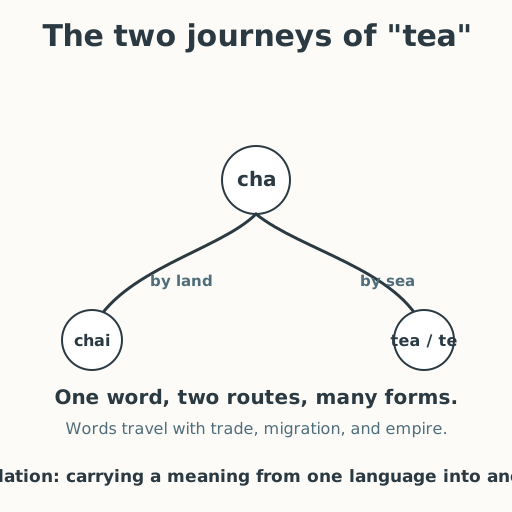
- Word-journey poster · 1 One word (e.g., "tea"/"chai") with its two journeys drawn — by sea and by land — to show words travel and change
- Translation trios page · 1 per learner A page with one idea and three boxes — the idea in the home language, a word-for-word gloss, and a natural translation
- Example set (tea, mother, thank you) · 1 set Three everyday words with their forms in several languages, showing what is gained or lost
Low-tech / no-cost
- Voice Say the same word in three languages aloud and notice what stays and what changes; no page needed
- A map or drawing in the dirt Draw the two routes of the word "tea" — by sea and by land — and place the word forms along each
Enriched / lab & device
- A translation app on a device · 1 per pair Optional: test a machine translation of one sentence and discuss what it gained or lost
- A bilingual person or recorded speaker · 1 If available, a community member shares how a word in their language does not match exactly in another
Works in different contexts
- large-group Trace one word's journey together on the poster, then have pairs fill translation trios and share
- self-directed A learner fills the trios page for three ideas and writes one sentence about what is gained or lost
- multi-age Younger learners match a word across three languages; older learners also write the word-for-word gloss and name what is lost
- outdoor-only Trace the word's two journeys on the ground with stones; speak the forms aloud at each stop
Lesson 12 — Translation: Carrying Words Across Languages
Summary
Learners define translation — carrying meaning from a source language into a target language — and discover that something is always gained and something lost. They trace the real journeys of everyday words like “tea/chai” and “mother” across the world, and practice translating one idea word-for-word and then naturally.
Objectives
- Explain what translation is and what is gained or lost in it, and describe when it is needed in everyday life. (D04.S4.07.01)
Connection
The word for the drink in your cup has traveled the world twice. It left China as cha and walked overland through Central and South Asia, becoming chai in many languages; it also left by sea from a southern port as te, becoming tea, thé, and Tee in others. The same drink, two journeys, many words. Translation is that journey in reverse: taking a meaning from one language and carrying it into another — and every carrier knows that something is always gained, and something always left behind.
Materials
- Word-journey poster
- Translation trios page
- Example set (tea, mother, thank you)
Preparation
- Make or print the word-journey poster showing the two routes of “tea.”
- Copy the trios page and example set for each learner.
Facilitator note
This lesson is written to the learner (“you”). The idea to land is that translation
carries meaning across languages, and it is a craft of choices because exact equivalence
is rare — something is always gained or lost (Everett, 2012; WALS “tea,” S-169). Model
one trio as a worked example before practice (Kirschner, Sweller & Clark, 2006). Always
begin in the learners’ home language, and hold multilingualism as wealth, never deficit
(UNESCO, S-019). The four lenses: ethics (a translator must be faithful to the
speaker’s meaning, not twist it); egalitarianism (no language is “untranslatable in a
lesser way” — every language has riches another lacks); global (words travel with
trade, migration, and empire — trace the routes); critical-thinking (word-for-word is
not the same as faithful). See docs/facilitation.md.
Procedure
- Gather (5 min). Think of a word in your home language that has no exact match in another language you know. What would you have to explain to translate it?
- Trace a word’s journey (10 min). Look at the poster. One word, two routes: cha by land became chai; te by sea became tea, thé, Tee. What stayed? What changed? This is what translation works with — words that never match exactly.
- Meet the trio (10 min). On your page, take one idea (a greeting, a proverb, a feeling). Box 1: the idea in your home language. Box 2: a word-for-word gloss — each word translated literally. Box 3: a natural translation — how a speaker would really say it. Worked example first, together.
- Find what is gained and lost (10 min). With a partner, compare boxes 2 and 3. What does the gloss miss? What does the natural version add? Write one sentence: “In translating ___, we gain ___, but we lose ___.”
- Close (5 min). Translation is a bridge we build every day — for a sign, a medicine label, a story. Tomorrow you will meet its live, spoken partner: interpretation.
Differentiation
- Support: Provide the idea and the word-for-word gloss; learners write only the natural translation.
- Extension: Translate the same idea into a third language you or a partner knows, and note a new thing lost or gained.
Assessment
- Formative (observation): Can the learner define translation and name one thing gained and one thing lost?
- Self-check: The learner rereads their “we gain / we lose” sentence and confirms it names a real difference between the gloss and the natural version.
Home connection
Ask someone at home for a word in your language that has no exact match in another, and try to translate it together — what would you have to explain?
Resources
- On the tea/chai word routes: WALS Online, “Tea” (ch. 138), https://wals.info/chapter/138
- On language as a cultural tool and translation as always gaining/losing: Everett (2012), Language: The Cultural Tool; and UNESCO, International Mother Language Day, https://www.unesco.org/en/days/mother-language
- On modeling before practice: Kirschner, Sweller & Clark (2006), https://doi.org/10.1207/s15326985ep4102_1