Lesson 11 — Peer Feedback That Helps: Give and Use It
Learners give and use peer feedback to improve a draft, using sentence frames that make feedback specific, kind, and useful. They revise one part of their own writing and explain the choice they made — turning feedback into authorship.
Objectives
Objectives
- D04.S3.07.02 Give and use peer feedback to improve a piece of writing, and explain the choices made.
- D04.S3.07.01 Develop ideas with relevant, well-chosen details and precise language across a range of genres.
Essential question
How do I give feedback that helps a writer improve, use feedback on my own writing, and explain the choices I made?
Key vocabulary
Materials
Standard materials
- Feedback sentence frames · 1 set Stems like "I noticed…", "I wonder…", "What if you…", "This works because…"
- Feedback loop page · 1 per learner A page to record feedback given, feedback received, and one revision with a reason
- Draft from the genre lesson · 1 per learner The learner's own genre page from Lesson 10, ready to revise
Low-tech / no-cost
- Voice Give feedback aloud using the stems; no page needed
- Two partners and a shared draft Read the draft aloud and say one "I noticed" and one "What if"; swap roles
Enriched / lab & device
- Digital comment tool · 1 per pair Leave margin comments on a shared document using the sentence frames
- Model feedback video or example · 1 Optional: a short example of helpful vs unhelpful feedback to compare
Works in different contexts
- large-group Model helpful feedback on a volunteer draft, then have pairs exchange and use the frames
- self-directed A learner uses the frames to self-assess their own draft, then revises one part with a reason
- multi-age Younger learners give one "I noticed" and one "What if"; older learners also explain the writer's choice they would keep
- outdoor-only Exchange drafts and speak the feedback aloud, walking through the three stems in a circle
Lesson 11 — Peer Feedback That Helps: Give and Use It
Summary
Learners give and use peer feedback to improve a draft, using sentence frames that make feedback specific, kind, and useful. They revise one part of their own writing and explain the choice they made — so feedback becomes authorship, not correction.
Objectives
- Give and use peer feedback to improve a piece of writing, and explain the choices made. (D04.S3.07.02)
- Apply precise-language revision while responding to feedback. (D04.S3.07.01)
Connection
A writer alone sees what they meant to write; a reader sees what is actually on the page. That is why good writers trade drafts — in a newsroom in Lagos, a poets’ circle in Kyiv, or a classroom anywhere. The trick is that feedback works only when it is specific (“the detail about the tin roof made me feel the heat”), kind (it respects the writer’s aim), and useful (it suggests a next step). And the writer keeps the final word: you decide which advice to take, and you can say why.
Materials
- Feedback sentence frames
- Feedback loop page
- Draft from the genre lesson
Preparation
- Copy the feedback frames and the loop page for each learner.
- Have learners bring their genre-page drafts from Lesson 10.
Facilitator note
This lesson is written to the learner (“you”). The idea to land is that feedback is a
gift with three parts — specific, kind, useful — and the writer stays the author. Model
the three stems on a sample draft before learners practice (Kirschner, Sweller & Clark,
2006; Hattie’s feedback finding, S-012). Protect writers: feedback comments on the text,
never the person, and every writer chooses what to accept and explains why. The four
lenses: ethics (honest but kind; no fake praise, no cruelty); egalitarianism (every
draft deserves a careful reader, and every reader’s view counts — mastery, not ranking);
social-emotional (receiving feedback can sting; name that and keep the focus on the
work); critical-thinking (choosing which advice to take is judgment). See
docs/facilitation.md.
Procedure
- Gather (5 min). Think of a time someone told you how to make something better. What made that advice easy to hear — or hard?
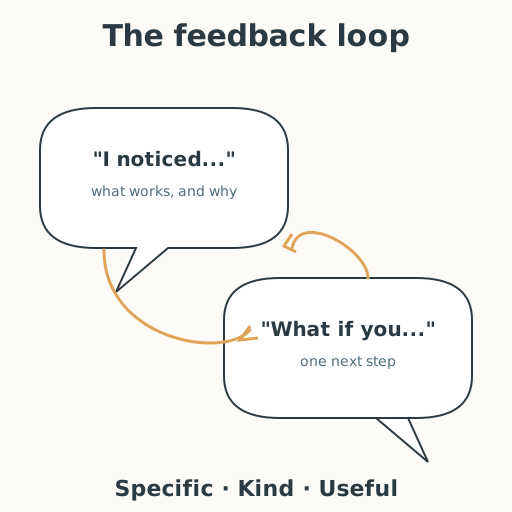
- Meet the frames (10 min). Read the sentence frames. Helpful feedback is specific (points to a place), kind (respects the aim), and useful (suggests a next step). Worked example on a sample draft: “I noticed the detail about the roof made me feel the heat — it works because it is specific.” and “What if you added one more sensory detail to the storm?”
- Give feedback (15 min). Trade drafts with a partner. Read carefully. On the loop page, write one “I noticed…” (what works and why) and one “What if you…” (a next step), using the frames. Then switch roles.
- Use feedback (10 min). Read what your partner wrote. Choose one suggestion to use — or choose not to, and say why. Revise one part of your draft. Under your revision, write one sentence: “I changed ___ because ___.”
- Close (5 min). You have given a gift and used one. Feedback made your writing yours in a deeper way. Next lesson the unit turns to the many languages of the world.
Differentiation
- Support: Provide the frames with blanks (“I noticed ___ because ___”) and accept one sentence of feedback and one small revision.
- Extension: Explain two choices — one you accepted and one you declined — with a reason for each.
Assessment
- Peer-check: The feedback given is checked against the three parts (specific, kind, useful).
- Portfolio: The loop page with the revision and the “I changed ___ because ___” sentence, kept as evidence of using feedback.
- Self-check: The learner rereads their revision and confirms they can explain the choice.
Home connection
Ask someone at home for one piece of feedback on something you made or wrote, then say back what you will change and why.
Resources
- On feedback as one of the strongest influences on learning: Hattie, Visible Learning (2008), https://en.wikipedia.org/wiki/John_Hattie; and on explicit instruction for revision: Graham & Perin (2007), “Writing Next,” https://all4ed.org/reports-factsheets/writing-next/
- On modeling before practice: Kirschner, Sweller & Clark (2006), https://doi.org/10.1207/s15326985ep4102_1