Lesson 03 — Multi-Step Proportion Problems
Learners solve multi-step proportion problems by chaining proportional tools — a unit rate, a scale, and a percentage — one step at a time. They lay each step on a double number line, keep the constant of proportionality in view, and explain the order of their steps.
Objectives
Objectives
- D05.S1.07.01 Use proportional relationships, including unit rates, scale, and percentages, to solve multi-step problems in real contexts.
Essential question
How do I chain unit rates, scale, and percentages into one multi-step solution?
Key vocabulary
Materials
Standard materials
- Multi-step problem cards · 1 set per pair Real problems that need two or more proportional steps (scale a recipe, apply a percentage, convert units)
- Double number line page · 1 per learner A page with blank double number lines to lay out each proportion
- Counters · per pair To build and scale a share before writing the numbers
Low-tech / no-cost
- A stick or string number line Mark two parallel lines with stones to show proportional amounts growing together
- Voice and body Narrate each step aloud ("first scale the recipe, then take 20% off") before writing
Enriched / lab & device
- A proportion-builder tool · 1 per group A slider or spreadsheet that scales both quantities of a proportion together, where devices allow
- A multi-step problem game · 1 per group Cards where learners order the steps of a multi-step proportion problem and justify each step
Works in different contexts
- large-group Solve one multi-step problem together on a double number line, then have pairs work cards and check each other
- multi-age Younger learners scale a share with counters while older learners write each proportional step
- self-directed A learner works the problem cards alone, laying each step on a double number line and checking against the worked example
- level-grouped Learners ready to extend solve problems mixing scale and percentage and explain the order of operations chosen
- outdoor-only Use found objects and a marked line outdoors to scale a real quantity, then apply a percentage aloud
Lesson 3 — Multi-Step Proportion Problems
Summary
Learners solve multi-step proportion problems by chaining proportional tools — a unit rate, a scale, and a percentage — one step at a time. They lay each step on a double number line, keep the constant of proportionality in view, and explain the order of their steps.
Objectives
- Solve a multi-step real problem using proportional relationships (unit rate, scale, and percentage) and explain the reasoning. (D05.S1.07.01)
Connection
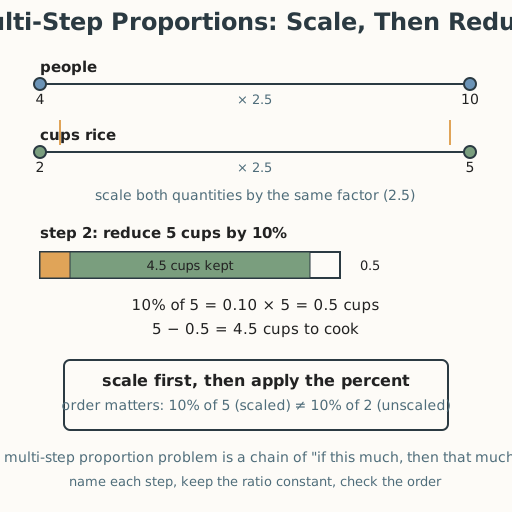
A cook makes rice for 4 people using 2 cups of rice. A crowd of 10 is coming, so the cook scales up: 2 cups × (10 ÷ 4) = 5 cups. Then the cook realizes 10% will not eat rice, so they reduce: 10% of 5 cups is 0.5 cups, leaving 4.5 cups. Two proportional steps — scaling, then a percentage — turn one recipe into the right amount for a real crowd. Planning a feast, a trip, a building, or a budget is always a chain of such “if this much, then that much” steps, and the same chain-reasoning appears in proportional records from ancient Egypt to a modern kitchen.
Materials
- Multi-step problem cards
- Double number line page
- Counters
Preparation
- Copy multi-step problem cards and double number line pages.
- Have worked examples ready: scale a 4-person recipe to 10 people, then reduce by 10%.
- Recall from earlier lessons: unit rates (Lesson 1) and percentages (Lesson 2).
Facilitator note
This lesson is written to the learner (“you”). The ideas to land: (1) a proportional
relationship keeps a constant ratio — both quantities multiply by the same factor; (2) a
multi-step problem is a chain where each step is itself a proportion; and (3) laying each
step on a double number line keeps the reasoning visible and checkable. Because this is the
unit’s capstone for S1, use a worked example first, then guided practice, then independent work
(Kirschner, Sweller & Clark, 2006). Watch for the slips of multiplying one quantity but not the
other, and of applying a percentage to the wrong (pre-scale) amount. Retrieval: ask learners to
recall unit rates and percentages — this lesson joins them. The critical-thinking lens
(docs/philosophy.md §7): naming which step comes first (scale, then reduce) is honest
reasoning; different orders can give different answers, so order matters. The global lens:
proportional “chain” problems — scaling a share, then taking a fraction — appear in the Rhind
Papyrus’s bread-and-beer problems and in the proportional rules for scaling altars in the Indian
Baudhayana Sulba Sutra; chaining proportions is a human universal.
Procedure
- Gather (5 min). You have two tools so far: the unit rate (“per one”) and the percent (“per hundred”). Today you chain them to solve one real problem with several steps.
- Meet the proportional relationship (10 min). A proportional relationship keeps a constant ratio. If 2 cups of rice feed 4 people, then cups and people always keep the ratio 2 : 4 = 1 : 2 — one cup per two people. That “one cup per two people” is the constant of proportionality. Scale up by multiplying both quantities by the same factor.
- Worked example — scale (10 min). 2 cups for 4 people, but 10 people are coming. The factor is 10 ÷ 4 = 2.5. Multiply both: 2 × 2.5 = 5 cups, and 4 × 2.5 = 10 people. Lay this on a double number line: cups 2 → 5, people 4 → 10, with the same ×2.5 jump.
- Worked example — percent (10 min). Now reduce by 10% for those who won’t eat rice. 10% of 5 cups = 0.10 × 5 = 0.5 cups. So the final amount is 5 − 0.5 = 4.5 cups. Order matters: you reduce after scaling, because 10% of 5 (scaled) differs from 10% of 2 (unscaled).
- Practice with a partner (10 min). Take your problem cards. For each, identify the steps, lay them on a double number line, and solve. Check each other: did you scale both quantities, and apply the percent to the right amount?
- Close (5 min). A multi-step proportion problem is a chain of “if this much, then that much.” Name each step, keep the ratio constant, and check that your order makes sense.
Differentiation
- Support: Use two-step problems with friendly numbers (double, then halve) and a ready-made double number line; describe each step aloud so learners with low vision can follow by listening.
- Extension: Solve problems mixing scale, unit rate, and percentage with a unit conversion thrown in, and explain why the order of steps matters.
Assessment
- Formative (observation/performance): Can the learner identify the proportional steps, lay them out, and solve a multi-step problem with a correct final amount and a justified order?
- Self-check: The learner asks, “Did I scale both quantities by the same factor? Did I apply the percent to the right (post-scale) amount, and can I explain my order of steps?”
Home connection
At home, scale a real recipe or plan to a different number of people, then adjust for one person who won’t eat part of it — and write down each proportional step you took.
Resources
- Proportional relationships and multi-step ratio reasoning are standard in middle-grades
mathematics; see John A. Van de Walle, Elementary and Middle School Mathematics (10th ed.,
2019). The notes that the Rhind Papyrus (Egypt, c. 1650 BCE) contains proportional bread/beer
problems (MacTutor, “Mathematics in Egyptian Papyri,” S-288) and that the Baudhayana Sulba
Sutra (India) gives proportional rules for scaling altars (MacTutor, “The Indian Sulbasutras,”
S-292) are documented history; treating all traditions as worthy is a value
(
docs/philosophy.md§4). The claim that explaining one’s reasoning is good is a value commitment.