Lesson 04 — Operating with Fractions and Decimals
Learners perform all four operations with fractions and decimals, seeing each on a model first, then stating and applying the rule: common denominators for add/subtract, multiply across for multiplication, "multiply by the reciprocal" for division, and place value for decimals. They explain each step in words.
Objectives
Objectives
- D05.S1.07.02 Perform all four operations with rational numbers such as fractions, decimals, and integers, and explain each step of the reasoning.
Essential question
How do I add, subtract, multiply, and divide fractions and decimals — and explain each step?
Key vocabulary
Materials
Standard materials
- Fraction and decimal operation cards · 1 set per pair Real situations (sharing, measuring, cooking, money) that call for each of the four operations
- Operation recording page · 1 per learner A page with worked steps to complete and explain in words
- Fraction strips or area models · per pair To see fraction operations before writing the rule
Low-tech / no-cost
- Folded paper Fold and shade paper to show fraction multiplication (a fraction of a fraction) and division
- Voice and body Say each step aloud ("multiply tops, multiply bottoms; flip and multiply") as a shared chant
Enriched / lab & device
- A fraction-and-decimal operation game · 1 per group Cards pairing an operation with its worked steps and its real situation, for repeated play
- A calculator · 1 per group To check decimal operations and estimate before exact work, where devices allow
Works in different contexts
- large-group Model one operation per pair of examples on a large strip, then have pairs work cards and check each other
- multi-age Younger learners fold and shade paper while older learners write the numeric steps and explain them
- self-directed A learner works the recording page alone, completing each step and checking against the worked examples
- level-grouped Learners ready to extend combine fractions and decimals in one problem and convert between them
- outdoor-only Use folded leaves or a marked stick as fraction models and describe each operation aloud
Lesson 4 — Operating with Fractions and Decimals
Summary
Learners perform all four operations with fractions and decimals, seeing each on a model first, then stating and applying the rule: common denominators for add/subtract, “multiply across” for multiplication, “multiply by the reciprocal” for division, and place value for decimals. They explain each step in words.
Objectives
- Add, subtract, multiply, and divide fractions and decimals, and explain each step of the reasoning. (D05.S1.07.02)
Connection
A cook halves a recipe: 1/2 cup of sugar × 1/2 = 1/4 cup. A builder cuts a board 2 metres long into pieces of 1/2 metre each — that is 2 ÷ 1/2 = 4 pieces. A shopkeeper adds prices written as decimals: 1.20 + 0.85 = 2.05. Fractions and decimals are two languages for the same numbers, and the four operations — add, subtract, multiply, divide — work in both. They run through cooking, building, buying, and measuring in every place people live. Decimal fractions were written down in China, India, and the Arab world long before Europe; the Flemish writer Simon Stevin helped popularize them in Europe in 1585, but the idea is a shared human invention.
Materials
- Fraction and decimal operation cards
- Operation recording page
- Fraction strips or area models
Preparation
- Copy operation cards and recording pages.
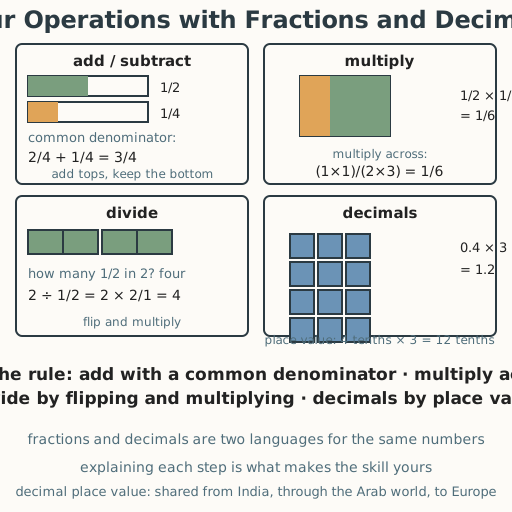
- Have worked examples ready: 1/2 + 1/4 = 3/4; 1/2 × 1/3 = 1/6; 2 ÷ 1/2 = 4; 0.4 × 3 = 1.2.
- Recall from Grade 6: fractions, decimals, and the four operations with whole numbers.
Facilitator note
This lesson is written to the learner (“you”). The ideas to land: (1) add/subtract fractions
by first making a common denominator, then adding the numerators; (2) multiply fractions
by multiplying across (numerators × numerators, denominators × denominators), which is “a fraction
of a fraction”; (3) divide by a fraction by multiplying by its reciprocal (“how many of
these fit in that”); and (4) decimal operations follow whole-number rules plus place value.
Because these are foundational skills, use explicit instruction, worked examples, and guided
practice before independent work (Kirschner, Sweller & Clark, 2006). Watch for the slips of
adding denominators when adding fractions, and of forgetting to flip the divisor when dividing.
Retrieval: ask learners to recall ratios and unit rates — a unit rate like (2/3) ÷ (1/4) is
fraction division in disguise. The global lens: decimal place-value notation developed in India
(by the 7th century CE) and was transmitted through the Arab world to Europe; Simon Stevin’s
De Thiende (1585) argued for decimal fractions in commerce — the ideas are shared human
achievements. The egalitarian lens (docs/philosophy.md §4): these operations are tools everyone
can own; there is no “math person” — only people who have or haven’t yet been shown the steps.
Procedure
- Gather (5 min). Fractions and decimals are two ways to write the same amounts. Today you work all four operations in both, and you explain why each step works.
- Meet the models (10 min). Use your strips. To add 1/2 + 1/4, you need the same-size pieces: 1/2 = 2/4, so 2/4 + 1/4 = 3/4. To multiply 1/2 × 1/3, shade 1/3 of a strip, then take 1/2 of that shaded part — you get 1/6. To divide 2 ÷ 1/2, ask “how many halves fit in 2 wholes?” — four of them.
- Worked example — add/subtract (8 min). 1/2 + 1/4 → common denominator 4 → 2/4 + 1/4 = 3/4. Rule: find a common denominator, add the numerators, keep the denominator.
- Worked example — multiply and divide (10 min). 1/2 × 1/3 → multiply across: (1×1)/(2×3) = 1/6. 2 ÷ 1/2 → multiply by the reciprocal: 2 × 2/1 = 4. Rule for division: flip the second fraction and multiply.
- Worked example — decimals (7 min). 0.4 × 3 → 4 tenths × 3 = 12 tenths = 1.2. Keep the decimal point’s place. Check by estimating: 0.4 is about half, and half of 3 is 1.5 — 1.2 is close.
- Practice with a partner (10 min). Take your operation cards. For each, model it, write the steps, and say the rule in your own words. Trade and check each other’s steps and explanations.
- Close (5 min). Add/subtract with a common denominator; multiply across; divide by multiplying by the reciprocal; decimals by place value. Explaining each step is what makes it yours.
Differentiation
- Support: Use halves and quarters only, with strips to model every step; describe each step aloud so learners with low vision can follow by listening.
- Extension: Combine fractions and decimals in one problem (convert between forms), and divide a mixed number by a fraction with a written explanation.
Assessment
- Formative (observation/self): Can the learner perform each of the four operations with fractions and decimals and explain the rule behind each step?
- Self-check: The learner asks, “Did I use a common denominator to add? Did I multiply across? Did I flip and multiply to divide? Did I keep the decimal point in the right place, and does my estimate match?”
Home connection
At home, find a real amount written as a fraction or decimal (a recipe, a price, a measurement) and do one operation with it — double it, halve it, or split it among people — writing the steps.
Resources
- Fraction and decimal operations are standard in middle-grades mathematics; see John A. Van de
Walle, Elementary and Middle School Mathematics (10th ed., 2019). The notes that decimal
place-value notation developed in India (by the 7th century CE), was transmitted through the
Arab world (MacTutor, “Indian numerals,” S-295), and was popularized in Europe by Simon Stevin
(De Thiende, 1585) (MacTutor, “Simon Stevin,” S-294) are documented history; treating all
traditions as worthy is a value (
docs/philosophy.md§4). The claim that anyone can learn these operations with clear steps is a value commitment, not a mathematical fact.