Lesson 12 — Circles and the Number π
Learners measure round objects and discover that circumference is always about 3.14 times the diameter — the number π. They use C = πd (and C = 2πr) to find circumference, diameter, and radius in real problems, and meet π's approximations across cultures.
Objectives
Objectives
- D05.S3.07.02 Solve problems with scale drawings and circles, using the relationship between circumference and diameter.
Essential question
How are a circle's circumference and diameter related, and how do I use that relationship to solve problems?
Key vocabulary
Materials
Standard materials
- Round objects and string · per pair Cans, lids, wheels, and a string or tape to measure around and across
- Circumference recording page · 1 per learner A table to record circumference and diameter of several circles and their ratio
- Rulers or measuring tape · per pair To measure diameter and string length
Low-tech / no-cost
- Round objects and a string Wrap string around a jar or plate, mark the length, and lay it across the diameter — it reaches about three and a bit diameters
- Voice and body Chant "circumference is about three times the diameter" while rolling a wheel once
Enriched / lab & device
- A circle-explorer tool · 1 per group A tool showing C, d, and C/d for any circle, where devices allow
- A π estimation game · 1 per group Cards pairing a circle's diameter with its circumference (using π ≈ 3.14), for repeated play
Works in different contexts
- large-group Measure several circles together and find the ratio, then have pairs measure and check each other
- multi-age Younger learners wrap and mark the string while older learners compute the C ÷ d ratio
- self-directed A learner measures several round objects, records the ratios, and checks against π ≈ 3.14
- level-grouped Learners ready to extend solve for diameter or radius given circumference, and use C = πd and C = 2πr
- outdoor-only Measure a tree's girth with string and estimate its diameter using C ÷ π
Lesson 12 — Circles and the Number π
Summary
Learners measure round objects and discover that circumference is always about 3.14 times the diameter — the number π (pi). They use C = πd (and C = 2πr) to find circumference, diameter, and radius in real problems, and meet π’s approximations across cultures.
Objectives
- Use the relationship between circumference and diameter (π) to solve real problems with circles. (D05.S3.07.02)
Connection
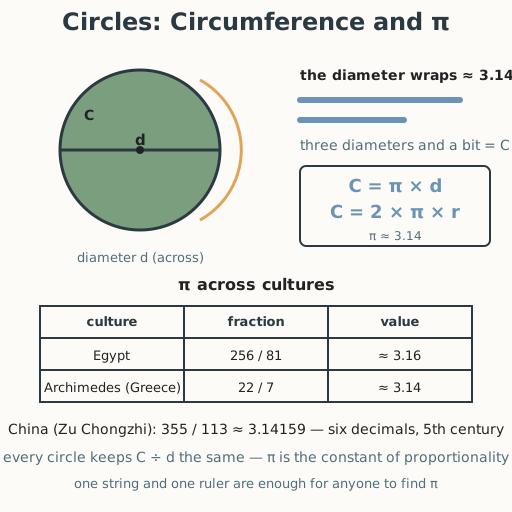
A wheel rolls one full turn, and it moves forward a distance equal to its circumference — the distance around. If you measure a wheel’s distance across (its diameter) and then wrap a string around its edge, the string is always about 3.14 times the diameter — no matter how big or small the wheel. That constant is π. A potter making a lid, a tailor measuring a round hem, a builder setting a round column, a driver reading an odometer — all use the same circle fact. And people in many lands found it: the Egyptians used 256/81 (about 3.16), Archimedes bounded it between 3 10/71 and 3 1/7, and the Chinese mathematician Zu Chongzhi found 355/113, accurate to six decimal places, in the 5th century. π belongs to everyone.
Materials
- Round objects and string
- Circumference recording page
- Rulers or measuring tape
Preparation
- Gather round objects (cans, lids, wheels) and string per pair.
- Have worked examples ready: a circle with diameter 10 cm → C = π × 10 ≈ 31.4 cm.
- Recall from Lesson 3: proportional relationships (C and d are proportional).
Facilitator note
This lesson is written to the learner (“you”). The ideas to land: (1) circumference is the
distance around a circle; diameter is the distance across through the centre (twice the
radius); (2) for every circle, C ÷ d is the same constant, π ≈ 3.14; and (3) the formulas
C = πd and C = 2πr turn that fact into a problem-solving tool. Because circumference is a
foundational skill, use explicit instruction, worked examples, and guided practice before
independent work (Kirschner, Sweller & Clark, 2006). Watch for the slips of confusing radius and
diameter (d = 2r), and of using the wrong formula. Retrieval: ask learners to recall the constant
of proportionality (Lessons 8–9) — π is the constant of proportionality between circumference and
diameter: C = πd is a y = kx relationship. The global lens: π has been approximated across cultures
— Egypt (256/81), Archimedes (bounded by 22/7), Zu Chongzhi in China (355/113, c. 5th century) —
a shared human achievement, not one culture’s. The egalitarian lens (docs/philosophy.md §4): one
string and one ruler are enough for anyone to find π — the discovery is open to all. The
critical-thinking lens (docs/philosophy.md §7): measuring several circles and testing whether
the ratio really is constant is doing science honestly.
Procedure
- Gather (5 min). You have learned that some relationships are proportional. Today you find a famous one hiding in every circle.
- Measure and discover (15 min). For each round object: wrap the string around the edge, mark and measure it — that is the circumference C. Measure straight across the middle — the diameter d. Record both. Then divide: C ÷ d. What do you notice? It is always about 3.14.
- Meet π (10 min). That constant is π (pi), about 3.14. So C = π × d, written C = πd. Because the radius r is half the diameter (d = 2r), you can also write C = 2πr.
- Worked example (10 min). A round table has a diameter of 10 cm (say, a model). Its circumference is C = π × 10 ≈ 3.14 × 10 = 31.4 cm. Given a circumference of 62.8 cm, find the diameter: d = C ÷ π = 62.8 ÷ 3.14 = 20 cm.
- Practice with a partner (5 min). Take turns: one names a circle’s diameter or radius, the other finds the circumference (and back again). Check each other’s formulas and units.
- Close (5 min). Every circle keeps C = πd. Measure around and across to find π yourself, then use C = πd and C = 2πr to solve real circle problems.
Differentiation
- Support: Use only the formula C = πd with a measuring string; describe each step aloud so learners with low vision can follow by listening.
- Extension: Solve for radius or diameter given circumference, and estimate a tree’s girth or a wheel’s distance travelled per revolution.
Assessment
- Formative (observation/performance): Can the learner measure C and d, find their ratio near π, and use C = πd (or C = 2πr) to solve for an unknown in a real circle problem?
- Self-check: The learner asks, “Did I measure around for C and across for d? Is my ratio near 3.14? Did I use the right formula (C = πd, or 2πr), and are my units correct?”
Home connection
At home, find a round object, measure its diameter and its circumference with string, and check that the circumference is about 3.14 times the diameter — then use it to predict another circle’s circumference.
Resources
- Circumference and π are standard in middle-grades geometry; see John A. Van de Walle, Elementary
and Middle School Mathematics (10th ed., 2019). The notes that π was approximated by the
Egyptians (256/81), by Archimedes (bounded by 22/7), and by Zu Chongzhi in China (355/113, c. 5th
century, accurate to six decimals) are documented history (MacTutor, “A history of Pi,” S-291);
treating all traditions as worthy is a value (
docs/philosophy.md§4). The claim that π’s discovery should be open to all is a value commitment.