Lesson 14 — Probability of Simple and Compound Events
Learners compute the probability of a simple event as favourable outcomes over total outcomes, then list the sample space of a compound event (two coins, a die and a coin) with a tree diagram and multiply the parts. They compare a few trials to the theoretical probability.
Objectives
Objectives
- D05.S4.07.02 Investigate chance processes and compute probabilities of simple and compound events.
Essential question
How do I compute the probability of a simple event and of a compound event made of two parts?
Key vocabulary
Materials
Standard materials
- Dice, coins, and spinners · 1 set per pair Fair tools of chance to try outcomes and record results
- Sample space page · 1 per learner A page to list outcomes, draw tree diagrams, and write probabilities as fractions
- Probability problem cards · 1 set per pair Simple and compound events (one die, two coins, a spinner and a coin) to compute and check
Low-tech / no-cost
- Found chance tools A flat stone with two marked sides as a "coin," seeds as a "die," a twig as a spinner
- Voice and body Chant the outcomes ("heads-heads, heads-tails, tails-heads, tails-tails") and act out a two-step chance
Enriched / lab & device
- A probability simulation · 1 per group A tool that runs many trials and shows the experimental probability approaching the theoretical one, where devices allow
- A probability match game · 1 per group Cards pairing an event with its sample space and its probability, for repeated play
Works in different contexts
- large-group Build one tree diagram together, then have pairs compute probabilities and check each other's fractions
- multi-age Younger learners flip and record while older learners list the sample space and compute the fraction
- self-directed A learner works the problem cards alone, listing outcomes and computing probabilities against the worked examples
- level-grouped Learners ready to extend compute probabilities with three parts (e.g., three coins) and compare to long-run trials
- outdoor-only Use a marked stone and a spinner made of a twig to run trials and list outcomes aloud
Lesson 14 — Probability of Simple and Compound Events
Summary
Learners compute the probability of a simple event as favourable outcomes over total outcomes, then list the sample space of a compound event (two coins, a die and a coin) with a tree diagram and multiply the parts. They compare a few trials to the theoretical probability.
Objectives
- Compute probabilities of simple and compound events from a sample space. (D05.S4.07.02)
Connection
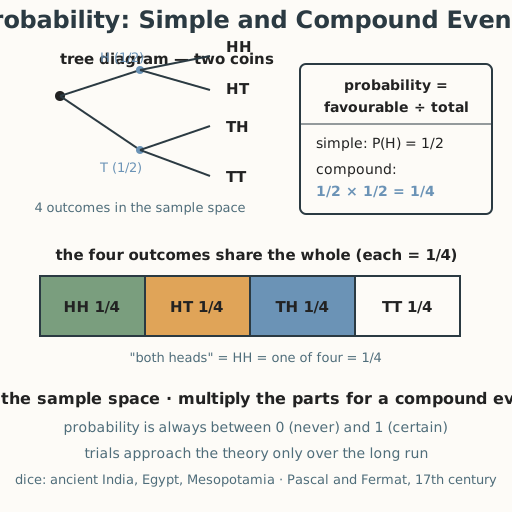
Flip one coin: the chance of heads is 1 out of 2, or 1/2. Flip two coins: the possible outcomes are HH, HT, TH, TT — four of them, and only one is “both heads,” so the chance is 1/4. Chance is measured as a fraction of the possible outcomes. Games of dice and coins appear in cultures all over the world — dice are found in ancient India, Egypt, and Mesopotamia — and the careful study of chance began with gamblers’ questions in 17th-century Europe, answered by mathematicians such as Blaise Pascal and Pierre de Fermat. Probability is how we weigh what is likely, from a game to a weather forecast to a medical decision — and naming it honestly helps everyone make fair choices.
Materials
- Dice, coins, and spinners
- Sample space page
- Probability problem cards
Preparation
- Prepare coins, dice, and spinners per pair and copy sample space pages and problem cards.
- Have worked examples ready: P(heads) = 1/2; P(both heads on two coins) = 1/4.
- Recall from Lesson 13: samples and conclusions — probability is the other half of chance reasoning.
Facilitator note
This lesson is written to the learner (“you”). The ideas to land: (1) probability = favourable
outcomes ÷ total outcomes, always between 0 and 1 (or 0% and 100%); (2) the sample space lists
all outcomes, and a tree diagram lays them out; and (3) for a compound event of two
independent parts, multiply the two probabilities. Because probability is a foundational skill, use
explicit instruction, worked examples, and guided practice before independent work (Kirschner,
Sweller & Clark, 2006). Watch for the slips of counting outcomes incorrectly (HH and HT and TH and
TT are four, not three) and of adding instead of multiplying for a compound event. Retrieval: ask
learners to recall fractions (Lesson 4) — probability is a fraction of outcomes — and sampling
(Lesson 13). The global lens: dice appear in ancient India, Egypt, and Mesopotamia, and probability
theory grew from 17th-century questions answered by Pascal and Fermat — chance is a shared human
study. The critical-thinking lens (docs/philosophy.md §7): a small number of trials can differ
from the theory; probability predicts the long run, not any single flip. The egalitarian lens
(docs/philosophy.md §4): understanding odds helps anyone judge a game or a claim fairly, and not
be cheated.
Procedure
- Gather (5 min). You have reasoned about samples. Today you reason about the other face of chance: how likely a single outcome is.
- Meet probability (10 min). Probability = favourable outcomes ÷ total outcomes. Flip one coin: two outcomes (H, T), one is heads → P(heads) = 1/2. Probability is always between 0 (never) and 1 (certain).
- Meet the sample space (10 min). Flip two coins and list every outcome: HH, HT, TH, TT — four outcomes. A tree diagram shows the two branches of the first coin, then two more from each. This list is the sample space.
- Worked example — compound event (10 min). “Both heads” is the single outcome HH out of 4, so P(both heads) = 1/4. You can also multiply: P(first H) × P(second H) = 1/2 × 1/2 = 1/4. Try 20 real flips and record how many are HH — it will be near 1/4, but not always exactly.
- Practice with a partner (10 min). Take your problem cards: list the sample space, draw the tree, and compute each probability as a fraction. For one card, run a few trials and compare. Trade and check each other’s outcomes.
- Close (5 min). Probability is favourable over total. List the sample space, multiply the parts for a compound event, and remember that trials approach the theory only over the long run.
Differentiation
- Support: Use one coin and one die with ready outcome lists; describe each outcome aloud so learners with low vision can follow by listening.
- Extension: Compute a three-part compound event (e.g., three coins) and compare a longer run of trials to the theoretical probability.
Assessment
- Formative (observation/self): Can the learner list a sample space, compute a simple and a compound probability as a fraction, and explain the multiplication of the two parts?
- Self-check: The learner asks, “Did I list every outcome (and count them correctly)? Did I write probability as favourable ÷ total, and did I multiply (not add) for a compound event?”
Home connection
At home, find a real chance situation (a coin, a die, a game spinner), list its outcomes, compute a probability, and try a few trials to see how close the results come.
Resources
- Probability of simple and compound events is standard in middle-grades mathematics; see John A.
Van de Walle, Elementary and Middle School Mathematics (10th ed., 2019). The notes that dice
appear in ancient India, Egypt, and Mesopotamia (Encyclopaedia Britannica, “Dice,” S-300) and
that probability theory grew from 17th-century questions studied by Pascal and Fermat
(Encyclopaedia Britannica, “Probability and statistics,” S-301) are documented history; treating
all traditions as worthy is a value (
docs/philosophy.md§4). The claim that understanding odds protects people from being cheated is a value commitment.