Lesson 03 — Is the Claim Supported by Evidence?
Learners move from correlation to evaluation: given a claim, they weigh whether the evidence actually supports it, name what further evidence would help, and practice saying the precise, fair answer — "supported," "weak," or "not enough to say yet."
Objectives
Objectives
- D06.S1.07.02 Evaluate whether a claim is supported by evidence and identify what further evidence would help.
Essential question
How do I decide whether a claim is really supported by evidence — and what evidence is missing?
Key vocabulary
Materials
Standard materials
- Claim-and-evidence card set · 1 set per pair Short claims with thin or strong evidence (a product ad, a one-person anecdote, a large repeated study) to evaluate
- Evidence-evaluation page · 1 per learner A three-column page — claim, evidence given, further evidence that would help
- Highlighters · per learner
Low-tech / no-cost
- Spoken claims Use claims heard aloud (a remedy, a rumour, an ad) and evaluate them by ear with a partner — no cards or page needed
- Voice and body Say "claim," then "evidence," then "what's missing" in a three-beat chant for each example
Enriched / lab & device
- A device to compare two sources on the same claim · 1 per group Look up one claim in two places and compare how strong each source's evidence is
- A class 'claim wall' · 1 A shared display where learners post a claim and grade its evidence support (strong, weak, not enough to say)
Works in different contexts
- large-group Evaluate one claim together on the board, then have pairs grade the card set and justify one verdict to the group
- multi-age Younger learners say whether evidence is "strong" or "weak"; older learners name the specific missing evidence
- self-directed A learner works the page alone, grading each claim and listing one piece of further evidence, checking against the worked example
- level-grouped Learners ready to extend compare two sources for the same claim and explain which is more trustworthy and why
- outdoor-only Evaluate a claim about the natural world ("this stream is safe to drink") by asking what evidence exists and what further evidence would help
Lesson 3 — Is the Claim Supported by Evidence?
Summary
Learners move from correlation to evaluation: given a claim, they weigh whether the evidence actually supports it, name what further evidence would help, and practice the precise, fair answer — “supported,” “weak,” or “not enough to say yet.”
Objectives
- Evaluate whether a claim is supported by evidence and identify what further evidence would help. (D06.S1.07.02)
Connection
A friend tells you a herbal tea “cures colds,” and shows you one person who got better after drinking it. A store ad says its shoes “make you faster.” A headline claims a certain food “is bad for you.” Some of these are supported by strong evidence; some are supported by almost none. Every day, claims like these compete for your money, your health, and your belief. The skill that protects you is simple: match the strength of your belief to the strength of the evidence, and know what is still missing.
Materials
- Claim-and-evidence card set
- Evidence-evaluation page
- Highlighters
Preparation
- Copy the claim-and-evidence card set and the evidence-evaluation page.
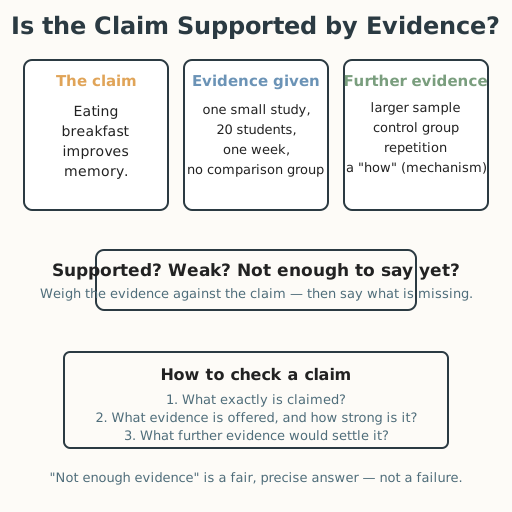
- Have the worked example ready: the claim “eating breakfast improves memory,” supported by one small study of 20 students for one week with no comparison group — a weak base for a strong claim.
- Retrieval: recall the four-step causation checklist from Lesson 2; evaluation is its cousin.
Facilitator note
This lesson is written to the learner (“you”). The idea to land: evaluate a claim by (1)
naming exactly what is claimed, (2) weighing the evidence offered, and (3) naming what
further evidence would settle it — and “not enough to say yet” is a precise, mature answer.
Use explicit instruction and a worked example first (Kirschner, Sweller & Clark, 2006), then
guided practice. The concepts of sample size, control groups, and replication are standard
ideas in scientific method and statistics. The technology lens (docs/philosophy.md §4): the
internet makes claims travel faster than ever, so the skill of weighing evidence — not just
the facts — is what learners most need to thrive in a media-saturated world. The egalitarian
lens: advertising and misinformation often target people with the least access to good
evidence; teaching everyone to evaluate claims is a way of evening the scales. The global
and anthropological lens (docs/philosophy.md §4, §11): claims — and ways of knowing — come
from every culture. A single anecdote about a herbal tea is not the same as a whole healing
tradition: traditional and Indigenous medicines are knowledge systems in their own right,
held respectfully alongside scientific medicine. This lesson teaches learners to weigh the
evidence for one claim, never to dismiss a tradition; “not enough to say yet” is respect
for the evidence, not disrespect for the people. Keep it
age-appropriate and non-dogmatic: the goal is not to call all ads lies, but to ask “what is
the evidence, and what is missing?”
Procedure
- Gather (5 min). Think of a claim you heard recently — an ad, a rumour, a health tip. How sure were you it was true? Today you learn to grade a claim by its evidence.
- Three questions (10 min). To evaluate any claim, ask: (1) What exactly is claimed? (2) What evidence is offered, and how strong is it? (3) What further evidence would settle it?
- Worked example (10 min). Claim: “Eating breakfast improves memory.” Evidence offered: one small study of 20 students for one week, no comparison group. Weigh it: a small sample and no control make the evidence weak. Further evidence that would help: a larger sample, a control group, repetition by other researchers, and a “how” (a mechanism). Verdict: not enough to say yet — the claim might be true, but the evidence does not yet support it.
- Grade your own (20 min). Take your card set. For each claim, fill your three columns and grade it: supported, weak, or not enough to say yet. Check with your partner — did you both name specific missing evidence, not just “more proof”?
- Close (5 min). Match your belief to your evidence. “I don’t know yet” is a strong, honest position — and the starting point of real knowledge.
Differentiation
- Support: Use two claims (one clearly weak, one clearly strong) and a sentence starter (“The claim is ___. The evidence is ___ because ___. To settle it I would need ___.”).
- Extension: Compare two sources on the same claim (who made it, how, and with what interest) and explain which is more trustworthy.
Assessment
- Formative (observation/self): Can the learner grade a claim’s evidence support and name at least one specific piece of further evidence?
- Self-check: The learner asks, “Did I name the claim, weigh the actual evidence, and say specifically what is missing — not just ‘more proof’?”
Home connection
Pick one claim you hear this week (an ad, a remedy, a headline) and run the three questions at home. Note what evidence was offered and what was missing, and share your grade.
Resources
- Sample size, control groups, and replication are standard concepts in scientific method and
statistics; the practice of “weighing the strength of evidence” is central to how science
evaluates claims. The value that everyone deserves the skill to evaluate claims is a value
commitment, not a factual claim (
docs/philosophy.md§5). For a global, accessible framing of evidence-based reasoning in health, see the World Health Organization’s emphasis on evidence in health information: https://www.who.int/ - On explicit instruction for novice reasoning skills: Kirschner, Sweller & Clark (2006), https://doi.org/10.1207/s15326985ep4102_1