Lesson 04 — Variation and Inheritance
Learners establish the first two ingredients of natural selection: within any population, individuals vary (no two are exactly alike), and traits are inherited — offspring resemble their parents. They sort real variation and predict offspring traits, preparing the ground for selection in the next lesson.
Objectives
Objectives
- D06.S2.07.01 Explain how variation, inheritance, and natural selection shape populations over time using evidence.
Essential question
Where does the variety in a population come from, and how is it passed on?
Key vocabulary
Materials
Standard materials
- Trait-variation card set · 1 set per pair Cards of one population (beetles, beans, or birds) showing varied traits — shade, size, beak — to sort and describe
- Family-trait page · 1 per learner A page with two parent shapes and blank offspring boxes for predicting what offspring might look like
- Crayons or markers · per learner
Low-tech / no-cost
- Found seeds or leaves Gather one kind of seed or leaf and sort them by size, shade, or shape; see the variation within one kind
- Voice and body Act out a parent passing a trait to offspring by mirroring a partner's gesture; no paper needed
Enriched / lab & device
- Photos of a real variable population · 1 set Images of a real species (shells, peppers, or dogs) showing inherited variation to discuss
- A class variation wall · 1 A display where learners post drawings of varied traits in one population across the unit
Works in different contexts
- large-group Sort one population's trait cards together, then have pairs sort their own set and describe one inherited trait each
- multi-age Younger learners sort by one visible trait; older learners also explain that traits are inherited and vary within a family
- self-directed A learner sorts the card set alone and predicts offspring traits on the page, checking against the worked example
- level-grouped Learners ready to extend discuss that traits come from parents (heredity) and that some variation is new (mutation), in simple terms
- outdoor-only Collect one kind of fallen leaf or seed outdoors and sort it into a variation line; name what is inherited and what differs
Lesson 4 — Variation and Inheritance
Summary
Learners establish the first two ingredients of natural selection: within any population, individuals vary (no two are exactly alike), and traits are inherited — offspring resemble their parents. They sort real variation and predict offspring traits, preparing the ground for selection in the next lesson.
Objectives
- Explain how variation and inheritance shape populations over time, as the raw material of natural selection. (D06.S2.07.01)
Connection
Look at a handful of the same kind of seed, a litter of puppies, or the beans in a market sack: none are exactly identical. Some are larger, some smaller; some darker, some lighter; some with a slightly different shape. And a calf resembles its mother and father more than it resembles a stranger’s calf. These two plain facts — things vary, and traits are passed from parents to offspring — are the raw material for how life changes over time, in every field and village and ocean on Earth.
Materials
- Trait-variation card set
- Family-trait page
- Crayons or markers
Preparation
- Copy the trait-variation card set and the family-trait page.
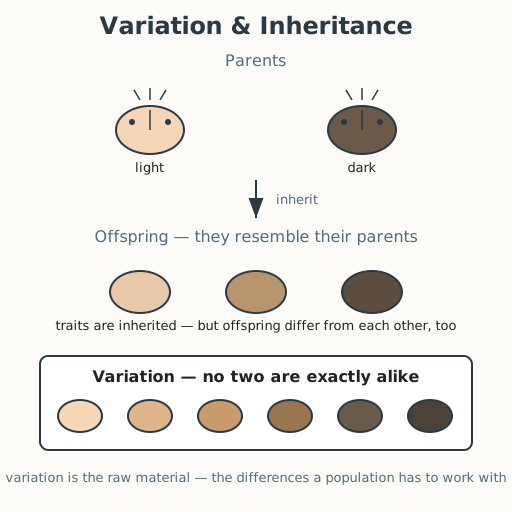
- Have the worked example ready: two parent beetles, one light and one dark; offspring vary in shade but resemble the parents — traits are inherited, and offspring differ from each other too.
- Retrieval: recall from Grade 5 (D06.S2.05.02) that traits pass from parents to offspring and that some traits vary within a family.
Facilitator note
This lesson is written to the learner (“you”). The ideas to land: (1) variation — within a
population, individuals differ; (2) inheritance — offspring resemble their parents, so traits
run in families; and (3) offspring also differ from each other, so variation does not vanish.
Use explicit instruction and the beetle worked example first, then guided sorting (Kirschner,
Sweller & Clark, 2006). These are established facts of biology (genetics and heredity). Keep
the mechanism age-appropriate: in Grade 8 learners will meet genes and DNA; here, “traits are
passed from parents to offspring” is enough. The egalitarian lens (docs/philosophy.md §4):
variation is normal and universal, not a defect — this quietly counters the false idea that
there is one “correct” type of body or being, in humans as in beetles. The global lens:
farmers everywhere have selected crops and animals by noticing variation and inheritance for
thousands of years — from maize in the Americas to rice in Asia — long before the science had
a name; inheritance is something human beings have used across cultures.
Procedure
- Gather (5 min). Quick recall: what did we learn about evidence in the last few lessons? Today we start a new question: how does life change over time? The answer begins with two plain facts.
- Meet the two facts (10 min). (1) Variation: within any population — a field of the same plant, a litter, a class of people — no two individuals are exactly alike. (2) Inheritance: traits pass from parents to offspring, so offspring resemble their parents — yet also differ from each other.
- Worked example (10 min). A light beetle and a dark beetle have offspring. The offspring are not all identical: some are light, some dark, some in between. They resemble their parents (inheritance), but they differ from each other (variation continues). Draw this on your page.
- Sort and predict (20 min). Take your trait-variation cards. Sort them by one trait (shade, size, or shape) and describe the range. Then, on your family-trait page, predict what two parents’ offspring might look like. Check with your partner: did you show both resemblance and difference?
- Close (5 min). Variation is the raw material, and inheritance passes it on. Tomorrow you will see what happens when the environment starts choosing among that variation.
Differentiation
- Support: Sort by a single, easy trait (light vs. dark) and describe each step aloud so learners with low vision can follow by listening.
- Extension: Notice and describe a trait that varies continuously (shade, height) versus one that is more either/or (a spot present or absent).
Assessment
- Formative (observation/self): Can the learner identify variation in a population and explain that traits are inherited (offspring resemble parents)?
- Self-check: The learner asks, “Did I show that offspring resemble parents and differ from each other — both at once?”
Home connection
Look at a family or a group of the same kind of plant or animal you know. Notice one trait that is inherited (resembling a parent) and one way individuals vary. Share what you found.
Resources
- Variation and inheritance are established facts of biology; in Grade 8 learners meet the
mechanism (genes/DNA). The role of heritable variation as the raw material of evolution is a
cornerstone of Darwin’s On the Origin of Species (1859). The claim that farmers have
selected plants and animals using variation and inheritance for thousands of years is
documented in the history of agriculture (e.g., maize domestication in the Americas, rice
in Asia). The value that human variation is normal and not a defect is a value commitment,
not a biological claim (
docs/philosophy.md§5). - On explicit instruction for novice content: Kirschner, Sweller & Clark (2006), https://doi.org/10.1207/s15326985ep4102_1