Lesson 10 — Wave Properties and What We Observe
Learners connect wave properties to experience: frequency becomes pitch, amplitude becomes loudness, and wavelength becomes color. They hum, clap, twang, and split light — translating what they observe back into wave language.
Objectives
Objectives
- D06.S3.07.02 Describe how waves (such as sound, light, and water) carry energy and relate wave properties to what we observe.
Essential question
How do the properties of a wave become the pitch, loudness, and color I experience?
Key vocabulary
Materials
Standard materials
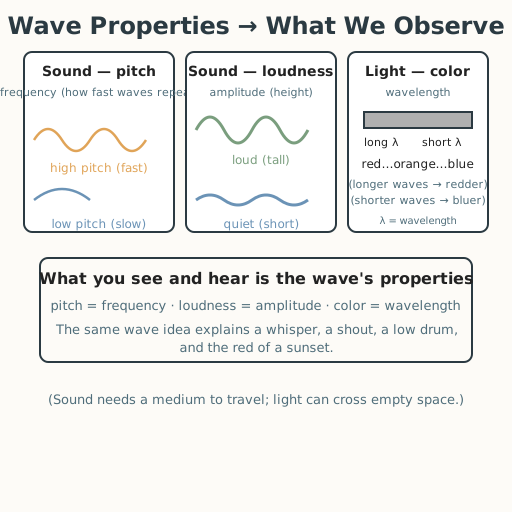
- Wave-property chart · 1 A chart pairing frequency→pitch, amplitude→loudness, wavelength→color, with simple wave drawings
- Sound-and-light observation page · 1 per learner A page to record observations of pitch, loudness, and color in the room or outdoors
- A ruler or stiff card · per group Twanged over a table edge to hear pitch change with length (frequency)
Low-tech / no-cost
- Voice and body Hum a high and low note (pitch/frequency), clap soft and loud (loudness/amplitude), and name colors seen (color/wavelength) — no cards needed
- Found sounds and light Compare a stretched string or blade of grass and notice how shorter things sound higher; look at a rainbow or prism if available
Enriched / lab & device
- A prism or diffraction grating · 1 per group To split white light into colors and see wavelength made visible
- A tone generator or tuning app · 1 per group To play specific frequencies and hear pitch change while seeing the wave drawn on screen
Works in different contexts
- large-group Show the chart and hum high/low, clap soft/loud together, then have pairs complete the observation page
- multi-age Younger learners match a sound to "high/low" and "soft/loud"; older learners connect each to frequency and amplitude
- self-directed A learner completes the observation page alone, connecting pitch to frequency, loudness to amplitude, and color to wavelength
- level-grouped Learners ready to extend use the relationship speed = frequency × wavelength to reason about one wave example
- outdoor-only Compare bird calls (pitch), near/far thunder (loudness), and a rainbow or sky colors (wavelength) outdoors
Lesson 10 — Wave Properties and What We Observe
Summary
Learners connect wave properties to experience: frequency becomes pitch, amplitude becomes loudness, and wavelength becomes color. They hum, clap, twang, and split light — translating what they observe back into wave language.
Objectives
- Describe how waves (sound, light, water) carry energy and relate wave properties to what we observe. (D06.S3.07.02)
Connection
A bird’s high chirp and a drum’s low boom: both are sound, but one is “high” and one “low.” A whisper and a shout: same words, different loudness. A red sunset and a blue sky: same light, different colors. All of these are the same wave idea wearing different clothes. The pitch you hear is the wave’s frequency; the loudness is its amplitude; the color you see is its wavelength. One idea explains a whole world of sights and sounds.
Materials
- Wave-property chart
- Sound-and-light observation page
- A ruler or stiff card
Preparation
- Copy the chart and observation page; gather rulers/cards for twanging.
- Have the worked example ready: a short, tight string vibrates fast (high frequency) → high pitch; a long, loose one vibrates slowly → low pitch.
- Retrieval: recall from Lesson 9 the parts of a wave (crest, trough, amplitude, wavelength).
Facilitator note
This lesson is written to the learner (“you”). The ideas to land: (1) frequency (how many
waves pass per second) → pitch (high/low); (2) amplitude (wave height) → loudness (loud/quiet);
(3) wavelength → color of light (longer → redder, shorter → bluer). Use explicit instruction
with the twanged-ruler worked example first, then hands-on observation (Kirschner, Sweller &
Clark, 2006). These are standard physics relationships. The environment lens
(docs/philosophy.md §4): wavelength is why the sky is blue and sunsets are red (shorter blue
light scatters more); a prism or rainbow shows the same sunlight spread into its wavelengths.
The global lens: music everywhere — drums, flutes, strings — is humans playing with frequency
and amplitude; every culture found the same physics in its own instruments. The egalitarian
lens: a child humming in a field and a concert hall orchestra are using identical wave rules.
Procedure
- Gather (5 min). Quick recall: what is a wave, and what travels in it? (Energy, not the medium.) Today: how does a wave’s shape become what you hear and see?
- Three matches (10 min). Frequency (how fast the wave repeats) → pitch: high frequency = high pitch. Amplitude (height) → loudness: tall wave = loud. ** Wavelength** (distance between crests) → color: long wavelength = red, short = blue.
- Worked example (10 min). Twang a ruler over a table edge. Press more of it down (shorter free end): it vibrates faster (higher frequency) → higher pitch. Let more hang out: slower → lower pitch. Pluck it harder (bigger amplitude) → louder, same pitch.
- Observe and record (20 min). Hum a high and a low note, clap soft and loud. Find colors around you and order them red→blue by wavelength. Record each on your page with the matching wave word (frequency, amplitude, wavelength).
- Close (5 min). Pitch = frequency. Loudness = amplitude. Color = wavelength. You have translated your senses into physics.
Differentiation
- Support: Use only sound (high/low, soft/loud) and describe each step aloud; provide a matching sentence starter (“A high sound means ___ frequency.”).
- Extension: Use the relationship speed = frequency × wavelength to reason: for a fixed wave speed, a higher frequency means a shorter wavelength.
Assessment
- Formative (observation/self): Can the learner match pitch to frequency, loudness to amplitude, and color to wavelength, with a real example of each?
- Self-check: The learner asks, “Did I connect each observation to the correct wave property — pitch to frequency, loudness to amplitude, color to wavelength?”
Home connection
Listen to three sounds at home (high/low, loud/quiet) and name each one’s frequency and amplitude. Look at one color and say whether its wavelength is long or short.
Resources
- Pitch = frequency, loudness = amplitude, and color = wavelength are standard physics
relationships (wave mechanics and the electromagnetic spectrum). The claim that the sky is
blue and sunsets red because shorter blue light scatters more is established atmospheric
optics (Rayleigh scattering). The value that wave physics belongs to everyone is a value
commitment, not a physical claim (
docs/philosophy.md§4). - On explicit instruction for novice content: Kirschner, Sweller & Clark (2006), https://doi.org/10.1207/s15326985ep4102_1