Lesson 03 — Sound in Media: How Film, Games, and Ads Shape Mood and Meaning
Learners discover that sound does invisible work in media: the same image paired with soft slow music, a sudden sting, or a bouncy rhythm reads as calm, fearful, or playful. They learn the vocabulary — soundtrack, sound effect, sting, underscore, leitmotif — analyze one film, game, or ad scene, and practice noticing *who chose the sound and what they wanted us to feel*, including when sound is used to sell.
Objectives
Objectives
- D07.S2.07.02 Explain how sound is used in media such as film, games, and ads to shape mood and meaning.
Essential question
How is sound used in film, games, and ads to shape mood and meaning — sometimes without us even noticing?
Key vocabulary
Materials
Standard materials
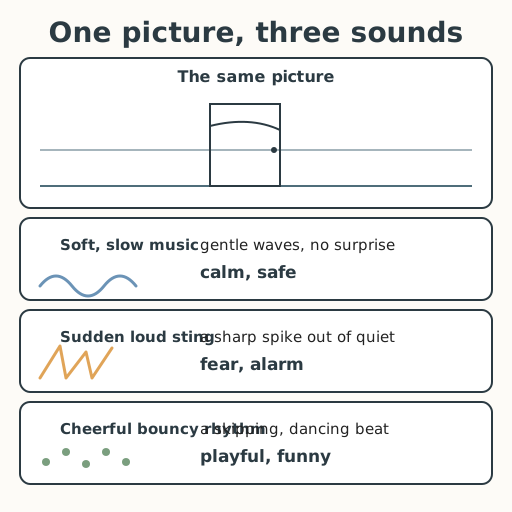
- Sound-mood poster · 1 The 'one picture, three sounds' chart — the same scene paired with soft slow music (calm), a sudden sting (fear), and a bouncy rhythm (playful)
- Sound-mood worksheet · 1 per learner A three-column page — 'scene,' 'sound I hear,' 'mood/meaning it makes' — for analyzing a film, game, or ad example
- Three short media clips (optional) · 1 A calm scene, a tense scene, and an ad, each with clear sound design, for guided analysis
Low-tech / no-cost
- One classroom scene, three voices Describe or hum three different 'sounds' over the same described scene — a soft hum, a sudden clap, a skipping tune — and name the mood each makes; no device needed
- Found sound-makers A scraped stone, a clapped hand, a shaken seed pod — any sounds the room can make — to layer a 'score' over a spoken scene
Enriched / lab & device
- Headphones and devices · 1 per pair Watch a game cutscene, film trailer, or ad twice — once with sound, once muted — and compare what changes
- A simple audio editor · 1 An app to drop a music loop under a short clip or image and try how the mood shifts with each loop
Works in different contexts
- large-group Play one example to the whole room, mute it, and collect the group's 'what changed' responses on the board before pairs do their own analysis
- multi-age Younger learners name the mood a sound makes; older learners also name the *technique* (tempo, volume, silence, a recurring theme) and its likely intent
- self-directed A learner watches a scene they choose, fills the worksheet alone, and writes one sentence about how the sound changed the meaning
- level-grouped Learners ready to extend compare how a *leitmotif* (a recurring musical theme for a character or idea) signals meaning across scenes
- outdoor-only Listen to the real soundscape — wind, birds, traffic, voices — and name how each layer sets a mood, then imagine adding or removing one layer to change it; no device needed
Lesson 3 — Sound in Media: How Film, Games, and Ads Shape Mood and Meaning
Summary
Learners discover that sound does invisible work in media: the same image paired with soft slow music, a sudden sting, or a bouncy rhythm reads as calm, fearful, or playful. They learn the vocabulary — soundtrack, sound effect, sting, underscore, leitmotif — analyze one film, game, or ad scene, and practice noticing who chose the sound and what they wanted us to feel, including when sound is used to sell.
Objectives
- Explain how sound is used in media such as film, games, and ads to shape mood and meaning. (D07.S2.07.02)
Connection
Next time a movie makes your heart pound, notice what you are hearing, not just seeing: a low drone creeping up, a sudden silence, then a sting. Sound is the reason a hallway feels safe one moment and haunted the next — even though the picture never changed. Games do it too: a soft loop means “explore, you’re safe,” and a rising beat means “get ready.” Ads do it most of all — a cheerful tune can make a drink feel like a party. Today you learn to hear the mood being built, and to name who is building it and why.
Materials
- Sound-mood poster (one picture, three sounds)
- Sound-mood worksheet
- Three short media clips (optional)
Preparation
- Print or draw the sound-mood poster.
- Copy a sound-mood worksheet for each learner.
- If using clips, cue a calm scene, a tense scene, and an ad, each with clear sound design; have the low-tech voice-and-clap path ready if there are no devices.
Facilitator note
This lesson is written to the learner (“you”). The idea to land is that sound is a deliberate, often hidden, meaning-maker: a learner should be able to name the mood a sound builds and connect it to a choice (tempo, volume, silence, a recurring theme). Model the one-picture-three-sounds worked example fully (explicit instruction for a novice skill — Kirschner, Sweller & Clark, 2006). Keep the ethics and egalitarian lenses visible: ads and trailers use sound to steer feeling, and the question “who benefits from this feeling?” is always fair. Be aware that some learners cannot hear (or hear differently); sound analysis must not exclude them — describe every sound in words, and offer visual alternatives such as reading a caption or watching a silent scene and imagining its score. Sound traditions differ across the world (film scores from Nollywood, Bollywood, Studio Ghibli, and video-game composers in Japan and Korea), so keep examples global rather than one industry’s default.
Procedure
- Gather and recall (5 min). In Lessons 1–2 you made images carry a message. Today you learn how sound carries mood — often without anyone noticing it working.
- Meet the one-picture-three-sounds idea (15 min). Look at the poster: one drawing — a hallway with a half-open door. Now hear it three ways (hum, clap, or imagine): soft, slow music (gentle waves) → calm, safe; a sudden loud sting (a sharp spike) → fear, alarm; a cheerful, bouncy rhythm (skipping dots) → playful, funny. The picture never changed; the sound carried the meaning. The tools have names: the soundtrack (the music), sound effects (the door creak, the footstep), the sting (a sudden loud hit), the underscore (music under speech), and the leitmotif (a short tune that returns each time a character or idea appears). Say them once with a partner.
- Analyze one scene (15 min). Watch or recall one short film, game, or ad scene. On your worksheet, fill three columns: the scene, the sound you hear (music? effects? silence?), and the mood/meaning it makes. Then ask the bigger question: who chose this sound, and what did they want me to feel — and is that feeling true to the scene or a trick to sell me something?
- Try it muted / imagined (10 min). Watch the same scene with the sound off (or close your eyes and imagine the picture). What is lost? What did the sound alone add? Write one sentence.
- Share and compare (5 min). With a partner, name one sound choice you each found and the mood it built. Notice how sound makes meaning even when we never see a word.
- Close (5 min). You can now hear the mood being made. Next lesson you become the sound-maker yourself.
Differentiation
- Support: Give a word bank for moods (calm, fearful, playful, sad, exciting, tense) and a sentence frame: “The ___ (music/sting/silence) makes the scene feel ___ because ___.”
- Extension: Find or invent an example of a leitmotif — a tune that returns for one character or idea — and write how its return changes a scene’s meaning.
Assessment
- Formative (observation/self): Can the learner name one sound choice (music, effect, sting, or silence) and connect it to the mood or meaning it creates, in their own chosen example?
- Artifact (portfolio): The completed sound-mood worksheet, kept for the unit portfolio.
- Self-check: The learner asks, “Can I name a mood a sound built and say which sound choice made it — tempo, volume, silence, or a returning theme?”
Home connection
Next time you watch or play something, pause once and ask: what would this exact moment feel like with the sound off? Name what the sound was doing.
Resources
- Smithsonian Folkways Recordings, for hearing how sound and music carry meaning across world traditions: https://folkways.si.edu/
- NAMLE’s “Key Questions” for asking who made this and why about media messages, including sound: https://namle.org/resources/key-questions/
- Kirschner, Sweller & Clark (2006), “Why Minimal Guidance Does Not Work,” on modeling a worked example before independent practice.