Lesson 04 — Performing with Dynamics, Phrasing, and Ensemble — and Revising by Recording
Learners perform a short piece — a chant, rhythm pattern, round, or melody — with attention to dynamics (loud and soft), phrasing (musical sentences shaped like breaths), and ensemble (many parts on one shared beat). They record a first take, listen back, choose one specific revision, and perform again. Expression is reachable many ways: voices, bodies, movement, and found sound, so no one needs a particular instrument or a spoken voice to join.
Objectives
Objectives
- D07.S2.07.01 Perform a piece with attention to dynamics, phrasing, and ensemble, and revise after listening to a recording.
Essential question
How do I perform a piece with attention to dynamics, phrasing, and ensemble — and use a recording to revise it?
Key vocabulary
Materials
Standard materials
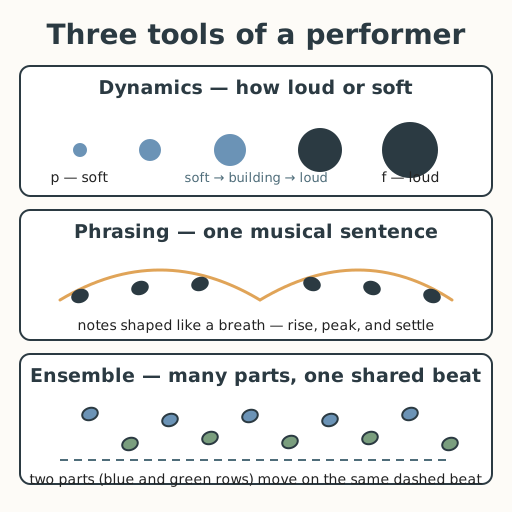
- Performer-tools poster · 1 The 'three tools of a performer' graphic — dynamics (soft to loud), phrasing (one musical sentence), and ensemble (many parts, one shared beat)
- A short piece or chant to perform · 1 per group A short, learnable piece — a call-and-response chant, a round, a rhythm pattern, or a simple melody — that can be done with voices, bodies, or found instruments
- Recording device · 1 per group Any recorder — a phone, tablet, or voice memo — to capture a first take for listening back
Low-tech / no-cost
- Voices, bodies, and found sound-makers Perform with claps, steps, humming, or shaken seed pods; no instruments or device needed
- A human 'recorder' A listening partner who pays close attention and then describes back, in words, what they heard — the low-tech stand-in for a recording device
Enriched / lab & device
- Instruments and a metronome · per group Pitched or unpitched instruments plus a metronome (or a beat app) to keep the shared beat steady while rehearsing ensemble
- Audio editing app · 1 An app to record, listen, and mark moments — 'softer here,' 'together there' — to guide revision
Works in different contexts
- large-group Perform as one large ensemble, record one take, listen back together, and pick two shared fixes before the second take
- multi-age Younger learners keep the beat or sing a simple part; older learners lead dynamics and phrasing and help coach the ensemble
- self-directed A learner records their own take, listens back, writes one specific change (softer here, together there), and records again alone
- level-grouped Learners ready to extend notate or mark the dynamics and phrase shapes on the piece before performing, then check the recording against their marks
- outdoor-only Use natural acoustics — an open space, a wall that echoes, a slope — and perform with claps, steps, and voices, then have a listening partner describe what they heard; no device needed
Lesson 4 — Performing with Dynamics, Phrasing, and Ensemble — and Revising by Recording
Summary
Learners perform a short piece — a chant, rhythm pattern, round, or melody — with attention to dynamics (loud and soft), phrasing (musical sentences shaped like breaths), and ensemble (many parts on one shared beat). They record a first take, listen back, choose one specific revision, and perform again. Expression is reachable many ways — voices, bodies, movement, and found sound — so no one needs a particular instrument or a spoken voice to join.
Objectives
- Perform a piece with attention to dynamics, phrasing, and ensemble, and revise after listening to a recording. (D07.S2.07.01)
Connection
A choir doesn’t just sing the notes; it decides how loud, how shaped, and how together. The same song whispered feels secret; belted feels brave; with everyone landing exactly together it feels powerful, and with one voice late it feels unsure. This is true of a drum circle, a soccer chant, a call-and-response in a classroom, or a lullaby. Today you are the performer who chooses those effects — then listens back to your own sound and makes it better, the way musicians everywhere rehearse with their own recordings.
Materials
- Performer-tools poster (dynamics / phrasing / ensemble)
- A short piece or chant to perform
- A recording device (or a listening partner)
Preparation
- Print or draw the performer-tools poster.
- Choose or let groups choose a short, learnable piece — a call-and-response chant, a round, a rhythm pattern, or a simple melody — reachable by voice, body percussion, movement, or found sound.
- Set up one recording device per group, or assign each group a “human recorder” listener.
Facilitator note
This lesson is written to the learner (“you”). The idea to land is that dynamics, phrasing, and ensemble are chosen, not accidental — and that a recording is a mirror for the ear: it lets a performer hear what an audience hears and revise. Model each tool with the worked example before groups perform (explicit instruction for a novice skill — Kirschner, Sweller & Clark, 2006). Keep performance accessible to every body: dynamics can be loud/soft or big/small movement, fast/slow energy, or full/empty space; phrasing can be shaped with the breath, a gesture, or a drawn arc; ensemble means matching a shared beat, which can be seen or felt, not only heard. No learner is required to sing or speak — offer signed, movement, and found-sound parts. Call-and-response and interlocking rhythms (e.g., Andean siku panpipes or West African drumming) are living traditions; frame them with respect, and let learners perform the piece they know or make, not an imitation of a tradition they do not belong to.
Procedure
- Gather and recall (5 min). Last lesson you learned to hear how sound makes mood in media. Today you make the sound yourself — and listen back to your own.
- Meet the three tools (15 min). Look at the poster. Dynamics is how loud or soft — from p (soft) to f (loud), and everything building in between. Phrasing is playing a musical sentence shaped like a breath: it rises, peaks, and settles, instead of a flat run of notes. Ensemble is many parts moving on one shared beat — when everyone lands together, the group sounds like one thing instead of many. Model each: clap a steady beat, then clap one phrase soft-to-loud, then have half the room clap while half steps, on the same beat.
- Learn the piece (10 min). In your group, learn the short piece. Decide, together: where will it be soft, where loud (dynamics)? where does each phrase breathe (phrasing)? and what is the shared beat that keeps you together (ensemble)? Practice once.
- Record the first take (5 min). Record (or have your listener attend to) one full take. This is not a test — it is a mirror.
- Listen and revise (10 min). Listen back. Ask three questions: Did the louds and softs show? Did the phrases breathe, or did it run flat? Did we land together, or drift apart? Choose one thing to fix, say what it is, and rehearse just that part.
- Record the second take (5 min). Perform again, recorded. Notice the difference — that is revision, made audible.
- Close (5 min). You made a sound, heard it back, and made it better. That loop — do, listen, revise — is how every ensemble on Earth rehearses.
Differentiation
- Support: Limit the piece to one phrase and one dynamics change (“soft the first time, loud the second”), with the beat clapped by a partner.
- Extension: Mark the dynamics and phrase shapes on a written copy of the piece before performing, then check the recording against your marks and note any drift.
Assessment
- Formative (observation/peer): Can the learner demonstrate one dynamics choice, one phrase shape, and staying on the shared beat — and name one change they made after hearing the recording?
- Artifact (performance): The two takes (or a partner’s written description of the change), showing a revision made after listening.
- Self-check: The learner asks, “Could I point to the moment in the recording where I made my one revision, and say why it made the piece stronger?”
Home connection
Record yourself (or have someone listen to you) doing a short rhythm, chant, or tune. Listen back and name one thing you would change — then do it once more.
Resources
- Smithsonian Folkways Recordings, for hearing how dynamics, phrasing, and ensemble shape music across world traditions (including call-and-response and interlocking rhythms): https://folkways.si.edu/
- Kirschner, Sweller & Clark (2006), “Why Minimal Guidance Does Not Work,” on modeling each skill before independent practice.